



By Uche Bibilari
The Chairperson, First Ladies Against Cancer (FLAC), Mrs Chioma Uzodimma, has called for strengthened awareness, early detection and collaborative action to address the rising burden of cancer in Nigeria and globally.
Uzodimma is the wife of the Governor of Imo State, Hope Uzodimma.
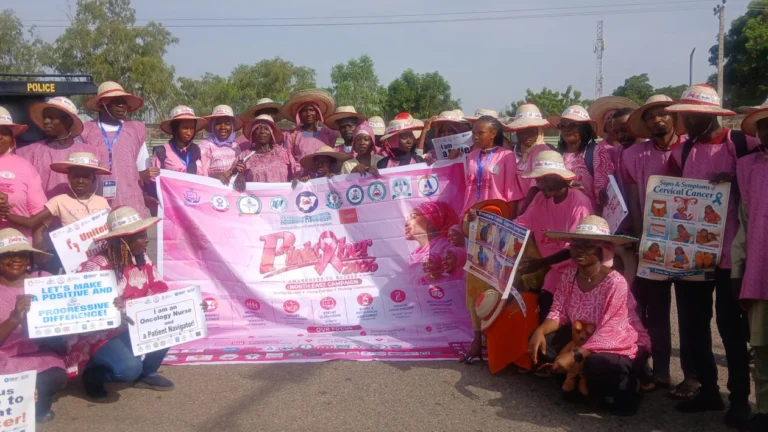
She made the call at the University of Abuja Women’s Association (UAWA), Cancer Awareness Programme with the theme: “United by Unique: Know it, Check it, Act Early” on Wednesday in Abuja.
She said that cancer remained one of the leading causes of mortality worldwide, adding that global health data showed that nearly 20 million new cancer cases and 10 million deaths were recorded globally.
According to her, the burden continues to rise in Nigeria with over 120,000 new cases annually and far too many lives lost due to the illnesses and limited access to care.
“Breast cancer remains the most commonly diagnosed cancer among Nigerian women, followed by cervical cancer, while prostate cancer continues to be a leading cause of cancer-related deaths among men.
“What makes this challenge even more compelling is that a significant proportion of cancers are preventable, and many are treatable when detected early.
“This is why awareness, education, and access to timely screening are essential pillars of an effective cancer control strategy,” she said.
She said that such awareness programmes demonstrated the critical role that institutions, particularly universities could play in shaping health outcomes.
“By engaging the university community, we are not only creating knowledge but also cultivating a culture of prevention, early detection, and shared responsibility.
“We are also helping to dismantle the stigma that continues to surround cancer and often delays life-saving action,” she said.
She said that FLAC, a coalition of spouses of current and former African governors, was leveraging leadership and partnerships to improve cancer care through advocacy, screening programmes, and policy reforms.
“Our work focuses on raising awareness, expanding access to screening and treatment, strengthening partnership, and advancing policy reforms that ensure equitable and quality care for all Nigerians, regardless of where they live.
“We have an MoU with this university to develop educational materials for childhood cancer,” she said.
Uzodimma advised the students to adopt healthy lifestyle, maintain a balanced diet, and stay physically active, adding that their health choice today would shape their future.
“Avoid smoking and limit alcohol consumption.
“Take advantage of preventive services including HPV vaccination and routine screening where available.
“To the women here, prioritise regular breast examinations and cervical screening,” she said.
She called for an end to stigma surrounding cancer, while encouraging open conversation and support for affected persons, adding that a diagnosis was not a death sentence, rather a call to action and compassion.
She commended the association for organising the programme and expressed hope that the knowledge shared would inspire positive health outcomes.
Earlier, the Vice-Chancellor, UniAbuja, Prof. Hakeem Fawehinmi, said that cancer, which is a chronic non-communicable disease, has a huge burden on the quality of any country.
He said that cancer was a lifelong condition, adding that people detecting cancer early makes a whole lot of difference.
“At the early stage, which is the primary stage, something can be done that will lead to complete treatment, but when you let it get to the secondary stage, all you do is wait until the morbidity.
“The morbidity and mortality of cancer is very high.
“The best way to go about it is to prevent it; to create this type of awareness so that it is detected early.
“With that we will see that a lot of lives will be changed and a lot of things will be solved,” he said.
He called on men to also assist in creating awareness for the fight against cancer in the society.
“I can assure you that men also suffer from cancer but I am happy that women are the arrowheads and are taking the lead.
“I urge the men to follow suit. However, I am happy that the women are spearheading this and women occupy a very important part of society.
“They have this intuitive power, they have influence and therefore they can drive the fight against cancer,” he said.
The Vice-Chancellor commended the association creating the necessary cancer awareness.
He described it as a very important service to humanity adding that the impact would be felt within Nigeria, the region, the sub-region and beyond for a very long time.
Similarly, the Patroness of UAWA, Dr Hadeezat Fawehinmi, said that cancer affected families, friends, colleagues and communities.
“But together, we can bridge the care gap, dispel myths, stigma and promote healthy choices,” she said.
The Director-General, National Institute for Cancer Research and Treatment (NICRAT), Prof. Usman Aliyu, said that cancer was a growing global health crisis with significant disparities between countries.
Represented by Dr Nandi Ishaya, Aliyu said that approximately one in five people will develop cancer, while one in nine men and one in 12 women would die from it.
He said that projections showed that new cases were expected to reach 35 million by 2050, a 77 per cent increase with the largest rise in low Human Development Index countries.
He said that Low-and Middle-Income Countries (LMICs), represented over 80 per cent of the global population and bore the majority of the cancer burden.
“The LMICS account for 57 per cent of new cancer cases and 65 per cent of cancer deaths globally.
“In 2022, LMICS recorded 3.8 million new cases and 2.4 million deaths, while Sub-Saharan Africa in 2022, there were 848,000 new cases and 559,000 deaths.
“Nigeria in 2022 had 127,763 new cases and 79,542 deaths. Top cancers are breast (women), prostate and cervical,” he said.
Aliyu said that by 2050, cancer cases could reach 35 million globally, adding that bold action today in LMICs would determine whether this becomes a crisis or an opportunity for equity.
The Founder, Medical Cancer Foundation (MFC), Dr Zainab Shinkafi-Bagudu, said that aside from awareness and low education, poor diagnostic facilities, treatment, and funding remained a big challenge in the fight against cancer.
She said there was need for a comprehensive data to show the actual number of cancer cases in the country, which would help know which was more common.
“Data is a problem for us in most low-income countries, and we have to do something about that. And that is where NICRAT comes in.
“Whether you are in College of Health Sciences or you are in education, data is vital.
“We are not putting together our data as we should for a lot of illnesses, and cancer is on top of all that. If we do not record it, it does not exist. If it does not exist, how do we get the funding for it?”
Shinkafi-Bagudu called on members of the university community to put their heads together and come up with laudable research programmes that would help in the fight against cancer in Nigeria.
Also present at the event were members of Ministers’ Wives Association led by their Chairperson, Hajiya Bilikisu Kyari.
The News Agency of Nigeria (NAN) reports that the highlight of the event was the presentation of plaques to some of the guests.(NAN)(www.nannews.ng)
Edited by Josephine Obute/Kadiri Abdulrahman

Comments