





By Deji Abdulwahab
The Minister of Information and National Orientation, Alhaji Mohammed Idris, says the Federal Government’s intelligence-led approach to tackling insecurity in the country is yielding positive results.
Idris said this on Thursday in Abuja at an interactive session with foreign media organisations.
He said the government had shifted from a reactive posture to an intelligence-driven security model, with improved coordination among the Armed Forces, Police, Department of State Services (DSS) and National Intelligence Agencies.
According to him, the coordinated efforts have begun to produce measurable gains on the ground.
The minister recalled that few months to the end of 2025, security agencies, led by the National Security Adviser paraded some of the most wanted terrorists that even the U.S. and other international agencies had been tracking.
He cited the capture of a commander of the Islamic State West Africa Province (ISWAP), Mahmoud, describing it as a significant breakthrough.
Idris said the suspect was among those with international bounties placed on their heads.
“Through this intelligence-led coordination, the Nigerian government is able to capture this commander and his chief of staff and they are taking their time in court.
“The Abuja-Kaduna road and rail corridor, which used to be among the most dangerous stretches of road in the country, with dozens of kidnapping incidents recorded, has seen significantly improved conditions.
“This follows targeted military deployment and joint operational command structures.
“Of course, for those of you who ply Kaduna-Abuja road here, it was almost impossible for you just to embark on the journey without first asking questions and finding out from those who have either gone the previous day or on that day to know whether it was safe to travel.
“This is no longer the case. I came back from Kaduna myself only yesterday and it’s a road that I ply together with others here very regularly. It has really become very safe.”
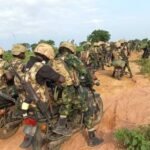
The minister said ongoing military operations in the North-East had also led to the recovery of territories previously under insurgent control.
“Nigeria’s partnership with the United States, United Kingdom, France, and other regional bodies, including the Multinational Joint Task Force, remain very active and substantive.
“They cover intelligence sharing, capacity building, equipment support, and counter-terrorism financing.
“We do not see these partnerships as a substitute for domestic capability. They are complementary to each other.
“In other words, our partnerships with our international partners, including our neighbours, is a complement to what government is doing to ensure that we bring this issue of terrorism to a complete halt.
“Of course, we know that terrorism has no borders and that is why it is important for government to continue to engage with our neighbours and international partners to ensure that this is brought to an end.”
On the proposed creation of state police, Idris said it would help decentralise policing and strengthen internal security.
“The agitation for state police is usually met with strong resistance, but now we are seeing a shift in that.
“Many of those who are heads of national and state governments are agreeing with the federal government that we indeed require state police to ensure security of lives and property for our people.”
According to him, President Bola Tinubu and the National Assembly have begun the constitutional amendment process to establish state police in Nigeria.
“The Senate plans to complete constitutional amendments for state police by the end of 2026 after stakeholders’ consultations across Nigeria.”
He said safeguards, including oversight mechanisms and judicial checks, had been built into the legislative framework to prevent abuse.
Idris also said reforms were being implemented to strengthen local government administration and ensure direct payment of allocations following a Supreme Court judgment.
“For 25 years or thereabout, governors who truly withheld local government funds, dissolved elected councils and appointed caretaker committees.
“The Supreme Court described this practice as gross misconduct and ruled that caretaker-administered councils would be ineligible to receive federal allocations.”
He said the Federal Government through the Central Bank of Nigeria (CBN), was enforcing the court judgement by paying the allocations directly.
According to him, there is a lot of work that needs to be done to make sure that this operates seamlessly.
“What the federal government is trying to say is that it is important for the third tier of government to be carried along at all times so that there can be fair distribution of resources across all parts of the country.
“And this in turn has a direct effect on ensuring that security is brought down to the barest minimum,” he said.
Also speaking, Mr Bayo Onanuga, Special Adviser to the President on Information and Strategy, urged foreign media practitioners to ensure balanced reporting on Nigeria’s security situation.
Onanuga, who decried one-sided reports on the nation’s security situation, said some foreign media only reported terrorist attacks while ignoring the roles played by the security agencies in neutralising the terrorists. (NAN)(www.nannews.ng)
Edited by Funmilayo Adeyemi