


By Ibironke Ariyo/Lengnan Dapam Tobias
Stakeholders in Nigeria’s justice and media sectors have expressed concern over the use of legal processes to intimidate civic actors and silence journalists.
They expressed their concerns in Abuja at the stakeholders’ validation of research on Strategic Lawsuits Against Public Participation (SLAPPs) in Nigeria.
The event was organised by Hope Behind Bars Africa (HBBA), supported by the National Endowment for Democracy in commemoration of World Press Freedom Day 2026.
Addressing guests, civil society actors, members of the Bar and development partners, the Chairperson of the FCT Council, Nigeria Union of Journalists (NUJ), Grace Ike, commended the organisers for convening what she described as a timely and important forum.
She noted that the issue of SLAPPs was of deep concern to journalists, as there had been increasing instances where legal mechanisms were deployed, not to seek justice, but to harass, intimidate and suppress voices acting in the public interest.
“The NUJ has remained consistent in defending press freedom and freedom of expression.
“The council has, in recent years, continued to speak out against unlawful intimidation of journalists, arbitrary arrests, harassment in the course of duty, and attempts to suppress the media through coercive legal and extra-legal means.
“A society where journalists are silenced is a society where citizens are denied access to truth, accountability and informed participation,” she said.
She reaffirmed the union’s commitment to supporting lawful initiatives aimed at protecting civic space, strengthening democratic accountability and ensuring that journalists operate without fear.
She expressed confidence that the outcome of the validation meeting would contribute to practical legal reforms and stronger institutional safeguards against the misuse of the law to stifle public participation.
Also speaking, a human rights activist and lawyer, Inibehe Effiong, called for a combination of financial backing and sanctions against rights violators to curb the growing use of SLAPPs in Nigeria.
Effiong stressed that inadequate resources remained a critical barrier for victims seeking to defend themselves against suppressive litigation.
He proposed the establishment of a National Anti-SLAPP Endowment Fund to provide structured and transparent financial support for journalists, activists and other individuals targeted by such lawsuits.
According to him, most victims lack the capacity to fund legal battles and are often forced to rely on pro bono services from lawyers, which are not always sustainable.
He said the availability of dedicated funding would not only empower victims to defend themselves but also deter individuals and institutions that deploy legal actions to intimidate others.
“With resources available, those initiating these suits will be more careful, knowing their targets can mount a proper defence,” he said.
Effiong cited cases of individuals, including women targeted for expressing opinions and reviews, noting that many lacked the financial means to pursue justice.
He urged civil society organisations, particularly HBBA and its partners, to take the lead in mobilising donor support and creating a pooled funding mechanism for such cases.
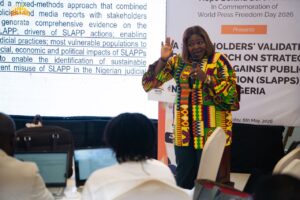
In a paper presentation, Ogechi Ogu, Executive Director, Public Awareness on Rights and Rehabilitation of Vulnerable Persons Initiative (PAR-RVP), examined the increasing deployment of SLAPPs in Nigeria and the legal, judicial and institutional frameworks enabling their proliferation.
Ogu said the study highlighted how such lawsuits were being used to silence dissent, discourage investigative journalism and intimidate civil society actors.
She explained that the research assessed the economic, social and political implications of SLAPP actions, noting that they had far-reaching consequences on civic engagement, democratic governance and the administration of justice.
“The study reviewed existing Nigerian laws and judicial practices that enable SLAPPs, while also proposing measures to address the growing threat and protect vulnerable groups.
“Defendants in such cases often incurred heavy financial losses, alongside severe social, political and psychological impacts,” she said.
Ogu called for urgent reforms to strengthen legal protections, ensure judicial consistency and safeguard press freedom and civic engagement in Nigeria.
Also, HBBA Programme Manager, Hassan Nurudeen, explained that the validation meeting was convened to review a technical report that critically examines legal frameworks, judicial practices and case precedents that enable SLAPPs in Nigeria.
Nurudeen said that the engagement would allow stakeholders to interrogate and strengthen the report to ensure it reflects practical realities and offers actionable solutions.
He also announced the presentation of a digital platform, the SLAPPs Monitor, designed to track incidents across all 36 states and the Federal Capital Territory, while also connecting victims to pro bono legal support.
He added that the platform would enhance documentation, visibility and coordinated response to SLAPP cases nationwide.
Nurudeen further unveiled a growing network of lawyers committed to defending victims of SLAPPs, describing it as a collective effort within the legal community to ensure access to justice for affected individuals and organisations.
He urged participants to engage critically and constructively in the discussions, noting that the meeting represented a continuation of efforts to curb abuse of legal processes and safeguard civic space in Nigeria.
The News Agency of Nigeria (NAN) reports that the HBBA challenges unlawful detention and arbitrary arrests by providing free legal aid and rapid response support, ensuring that no innocent person is left to languish behind bars.
They also work alongside correctional officers, chaplains, and community leaders, by building a culture of rehabilitation that addresses the root causes of incarceration and prevents people from being cycled back into the criminal justice system.(NAN) (www.nannews.ng)
Edited by Sadiya Hamza

Comments