



By Mark Longyen
ECOWAS parliamentarians have interrogated the details of the new “ECOWAS Compact of the Future of Regional Integration” unveiled by the ECOWAS Commissioner for Political Affairs, Peace and Security, Amb. Abdel-Fatau Musah.
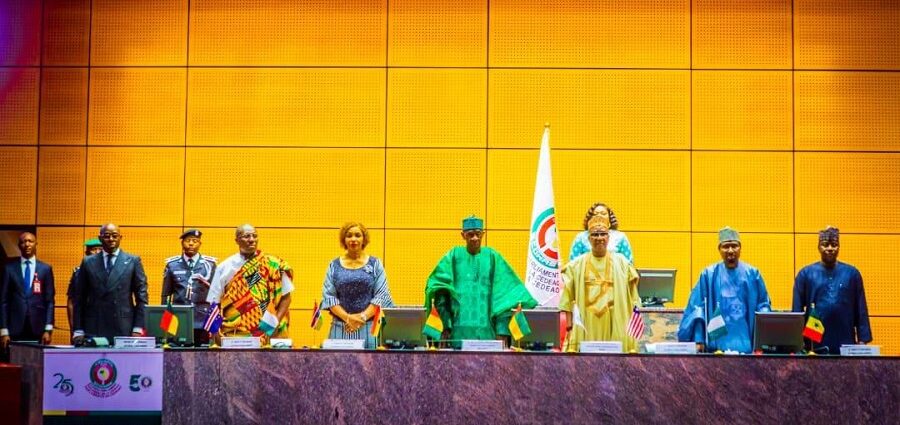
Musah unveiled the strategy while presenting a paper at the ongoing First 2026 Ordinary Session of the ECOWAS Parliament in Abuja.
He said ECOWAS had proposed a new six-pillar strategic initiative aimed at reshaping the bloc’s political and economic direction.
The commissioner explained that the initiative was being unveiled ahead of a planned special summit of regional leaders scheduled for later in the year.
Musah said the framework was a survival strategy aimed at strengthening regional integration and repositioning ECOWAS to better respond to growing political, economic and security challenges.
He said the ultimate goal was to transform ECOWAS from an institution known for declarations into one that delivers concrete public goods such as security, economic mobility and digital connectivity to citizens.
“The Compact is designed to operationalise the ECOWAS Vision 2050, and represents a fundamental reset of the regional integration agenda, shifting the bloc from an elite-driven ECOWAS of States to ECOWAS of the Peoples.
“This initiative acknowledges that the regional body is at its most fragile point since its establishment in 1975, due largely to governance failures, democratic setbacks and the emergence of alternative alliances such as the Alliance of Sahel States (AES), comprising Burkina Faso, Mali and Niger,” he said.
Musah said the strategy was adopted by the ECOWAS Authority of Heads of State and Government during a summit in Abuja, where they proposed a Special Summit on the Future of Regional Integration.
He added that the draft framework was developed through extensive consultations involving citizens across West Africa, civil society groups, the African diaspora, ECOWAS institutions and regional leaders.
Following the presentation, lawmakers took turns to seek clarification on the details of the initiative.
MP Abiante Awaji-Inombek expressed doubts about the prospects of the initiative achieving its objectives, noting that it was not the first time ECOWAS was unveiling such a strategy.
The lawmaker criticised ECOWAS’ engagement with the breakaway Sahel countries of Mali, Burkina Faso and Niger, while raising questions on implementation and monitoring.
“What has changed in terms of convergence?
“What is to be monitored and evaluated when we don’t even know?
“If previous targets of the ECOWAS have not been met, how will this Pact succeed?” he queried.
MP Abdul Kargbo commended the timing of the initiative, noting that it came at a crucial moment as ECOWAS faced governance and security challenges.
Kargbo called for bold action by regional leaders to address military coups, warning that failure to tackle the issue could encourage further unconstitutional takeovers.
He said ECOWAS must create jobs for citizens to discourage dangerous migration to North Africa and Europe.
The lawmaker also advocated the “federalising” of ECOWAS like the European Union, stressing that it was time for the bloc to stop being “the horse that carries others, but one that moves itself forward.”
Also contributing, MP Billay Tunkara hailed the initiative’s six pillars, saying the proposals would help transition the ECOWAS Parliament from an advisory to a mandatory institution.
MP Memuna Sesay welcomed the idea of re-engaging the Sahel states, describing it as necessary in view of prevailing security threats in the region.
She said “ECOWAS missed its way on the AES issue”.
While appreciating the proposed pact, Sesay underscored the need to protect the lives and livelihoods of community citizens through the six-pillar initiative.
“This is what we want to see in ECOWAS, reality and visibility,” she emphasised.
The lawmaker also urged ECOWAS to learn from the experiences of the Rwandan genocide and the Sierra Leone civil war in addressing the issue of the exited Sahel countries.
“The work of the ECOWAS Commission is heavy, I don’t envy you. Bring back all states together,” she added.
Responding, Musah thanked the lawmakers for their contributions and constructive engagement on the proposed pact.
He assured them that their concerns would be reflected in the final revised document to be approved by the Authority of Heads of State and Government.
He urged the lawmakers to work closely with the ECOWAS Commission and its institutions to achieve the objectives of the initiative.
“The Parliament’s role is critical and must not just be advisory,” Musah added. (NAN)(www.nannews.ng)
Edited by Tosin Kolade