










By Edith Tsokar
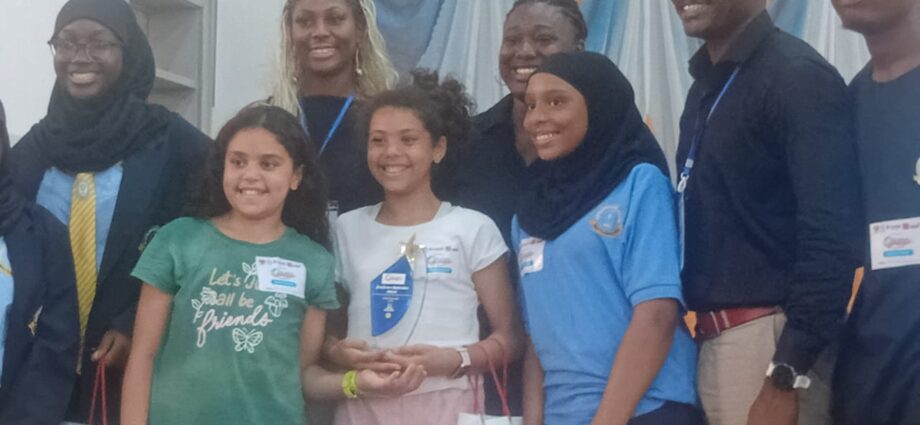
Some young innovators have won top awards in drone and robotics competitions at the 2026 Abuja Hackathon, showcasing technological solutions designed to solve societal challenges.
Some of the innovators spoke in an intervew with the News Agency of Nigeria (NAN) at the end of the competition on Saturday in Abuja.
They said the imnovations could be developed as practical solutions to addressing some of the country’s needs.
Fatima Kalembe, a member of the Team Alpha Flyers, who developed a drone project, said the project highlighted the potential of Nigerian youths to collaborate and create innovative solutions.
According to her, the drone demonstration showed how technology could move beyond recreation to solving real-life problems.
“It’s not just us pushing balls, going through gates, but it’s all showing how far Nigerian minds can go and how much we can achieve if we just come together.
“We have problems in the society and hopefully in the future with our youths, our great minds and our innovative and creative selves, we can find a way to solve them,” she said.
Another team member from Alpha Flyers, Karma Mohammed, said the team trained for only two weeks before the competition but remained committed to excellence.
Mohammed expressed excitement over the recognition and pledged improved performance in future competitions.
Also speaking, Emmanuel Offornagoro, a member of the Everest team in the Robotic Senior Category Challenge, said the success of the project was driven by collaboration among team members who combined ideas to develop an effective robotic solution.
Offornagoro explained that the robot was designed to move objects representing people to safer locations during emergencies.
“This is a robot controlled by our drivers here to move objects into their specific places. These objects are just imagined as people.
“We could build a robot that saves citizens when it’s needed and then move where it needs to be controlled. That’s just what the robot was meant to do,’ he said.
Similarly, Mary-Claret Onyenwe, a member of Team Spark, who also clinched the best in the Robotic Senior Category Challenge, commended the team work displayed in actualising the win.
Onyenwe, whose team also worked on the Rescue Naija project, said the project-in form of a robot, was programmed as a rescue prototype capable of assisting security and emergency operations.
According to her, the innovation could be adapted for both rural and urban environments to address national challenges, particularly insecurity.
“Our team came first in the robotics game. So our robot can actually rescue because it has been programmed and all the programmes have been stored in it.
“It has been programmed to rescue human beings. It’s just a prototype. It could actually be developed to rescue human beings also.
“It can be replicated in both rural and urban areas. So I think this project can solve our problems as a nation.
“It can solve the problem of insecurity and this depends on the design programme installed in the robots,” she said.
Earlier, the Convener of the event, Abba Saidu, said the initiative was aimed at empowering Nigerian youths with practical technological skills needed to develop solutions tailored to the country’s challenges.
Saidu said the Hackathon was designed to promote collaboration, creativity, critical thinking and innovation among young people.
He said many technologies introduced into Nigeria were often foreign-based and did not adequately address local realities, hence the need to nurture home-grown innovation.
“We know that robotics is the future of economies or nations, and that’s why we’re bringing in this aspect of robotics.
“It also involves that coding aspect of it, where children can really code autonomously to see how they can do so many projects so that they can execute a thing.
“So if you have a machine or a tool that can perform tasks on its own, it’s a robot basically,” he said.
Saidu noted that the emergence of artificial intelligence had changed the global learning landscape, making practical skills and problem-solving abilities increasingly important.
He emphasised that beyond academic qualifications, young people must acquire hands-on skills, design-thinking competence and communication abilities to remain relevant in the future workforce.
“Coding is a platform where you learn basic languages, computer languages, and it teaches children what computational thinking is.
“This means how does a computer reason, how does software and hardware reason and how does it understand,” he said.
NAN reports that other categories of awards were also given to various innovators who demonstrated outstanding creativity, coding and piloting skills during the competition.
The theme of the 2026 edition of Abuja Hackathorn is “Code, Create, Innovate: Building a Smarter Nigeria.” (NAN)(www.nannews.ng)
Edited by Funmilayo Adeyemi