


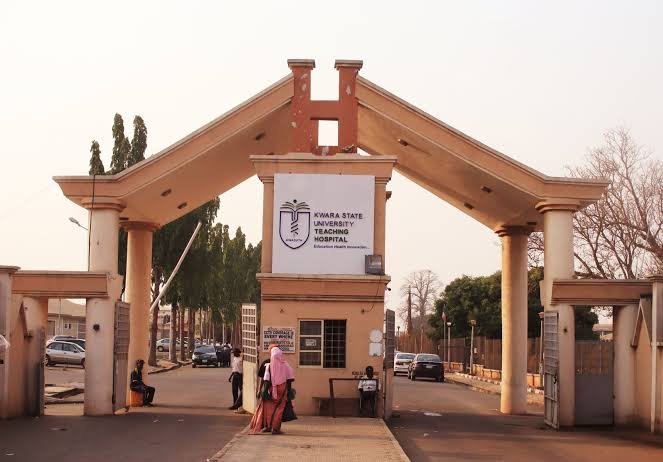
 Frontage of the Kwara State University Teaching Hospital (KWASUTH), Ilorin
By Usman Aliyu, News Agency of Nigeria (NAN)
In the early hours of March 31, the maternity ward at Kwara State University Teaching Hospital (KWASUTH), Ilorin, hummed with the familiar rhythms of a public hospital.
Nurses rushed; relatives hovered and whispered along the corridors; in the background, the sudden cries of newborns broke the morning quiet.
Amid the excitement of welcoming his newborn child, Jamiu Mahmoud was preoccupied with the long list of hospital bills that usually accompany childbirth.
Navigating admissions, medications, laboratory tests, and discharge procedures required multiple payments.
But something was different; as he moved from one service point to another, there was no frantic search for cash, no hurried trip to a nearby POS operator, and no worries about carrying large sums of money around the hospital premises.
Instead, each payment was completed with a bank card.
By the time his wife and baby were discharged, Mahmoud had settled every bill electronically without touching a single naira in cash.
“I made all the payments through ATM,” he said.
He added that the payment was so easy and involved less trouble because looking for cash alone would have added more tension during that period.
For Mahmoud, the experience was a welcome relief at a moment already filled with emotion and responsibility.
For Kwara, however, it represented something bigger — a bold experiment in fully digitising public service payments and testing whether a cashless system can improve accountability, increase government revenue and make services more efficient without leaving vulnerable citizens behind.
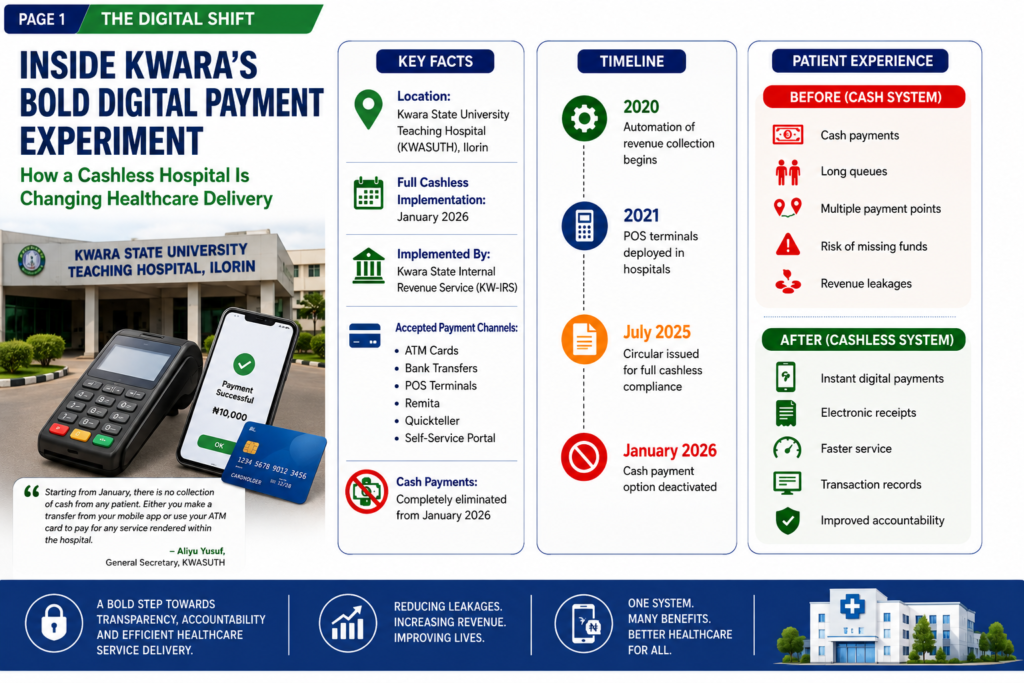
In January 2026, KWASUTH became one of the public institutions implementing a fully cashless payment regime under a broader revenue automation programme driven by the Kwara State Internal Revenue Service (KW-IRS).
The move eliminated cash payments entirely, requiring patients to pay through bank transfers, ATM cards, Point of Sale (POS) terminals, Remita, Quickteller, or online portals.
While many government institutions across Nigeria still operate hybrid systems combining cash and electronic payments, Kwara’s approach represents one of the country’s most ambitious attempts to align public service delivery with the Central Bank of Nigeria’s cashless policy.
The experiment is already producing measurable results. But it is also exposing a critical question confronting Nigeria’s digital future on whether efficiency and inclusion can move together.
From Cash Counters to Digital Screens
For years, hospital transactions followed a familiar pattern.
Patients carried cash from one payment point to another, queued for receipts, and worried about misplaced funds. Relatives often became informal cash couriers within hospital premises.
According to Mr Aliyu Yusuf, General Secretary of KWASUTH, that system is now history.
“Starting from January, there is no collection of cash from any patient.
“Either you make a transfer from your mobile app or use your ATM card to pay for any service rendered within the hospital.”
Yusuf describes the transition as a major operational success.
“When we’re talking about accountability and reducing leakages, I can give the system 90 per cent.”
Before digitalisation, opportunities existed for revenue leakages, overcharging, or discrepancies between payments made and amounts recorded.
Today, every transaction leaves a digital trail.
“Whatever you are doing, you receive your alert. If something is N10,000, you pay exactly N10,000,” he said.
The system has also decentralised payment points. Instead of travelling across the hospital to make payments, patients can pay at Accident and Emergency, the pharmacy, maternity unit, or other service locations.
Hospital administrators say this has reduced waiting times and improved patient flow.
Revenue Rising, Leakages Falling
The financial impact has been substantial.
Mr Yusuf La-Kadri, Director of Administration and Operations at KW-IRS, said automation of revenue collection began in 2020, with hospitals receiving POS infrastructure from 2021.
The decisive shift came in January 2026 when the “Vault” cash-payment option was completely disabled.
Since January, the director said the system achieved a 25 per cent increase in hospital revenue collections.
La-Kadri said the growth has contributed significantly to Kwara’s Internally Generated Revenue (IGR), while improving transparency and eliminating risks associated with cash handling.
“In our bid to improve revenue collection and block leakages, we automated payment collection processes across all sectors and provided various payment channels to enhance ease of doing business,” he said.
For a state seeking sustainable domestic revenue sources amid shrinking federal allocations, he said the gains are significant.
A Relief for Some Patients
Among many patients, the system has been warmly received.
Mrs Fatimah Salam, who frequently visits the hospital with her baby, said the change had removed a major burden.
“I hardly move about with cash. When vendors insist on only cash, it becomes a problem. But since I noticed this system here, I am happy.
“The stress of looking for cash or POS outlets with my baby anytime I come here is over,” she said.
Another patient, Mrs Sekinat Eniwumide, said the digital process has made healthcare transactions faster and more transparent.
“There is now a fixed price for all transactions in the hospital, and receipts are given for all payments made online.
“I have never experienced network problems. I either transfer money through my phone or use my ATM card,” she said.
Mr Akin Lawal also believes the system has simplified hospital visits.
“This process is fast. You just need to know the amount and transfer it directly without stress,” he said.
Beyond convenience, some patients see security benefits.
Alhaja Risikat Adio, whose daughter was admitted at the hospital, said digital payments eliminated fears of carrying cash around wards.
“There is no fear of stolen money in the ward or losing money while moving from one place to another,” she said.
The Other Side of Digitalisation
Yet, not everyone experiences the system equally.
When Suleiman Saro arrived at the hospital recently, he encountered an unexpected obstacle.
“I was not aware of the policy before coming. At the pharmacy, I was told they don’t accept cash,” he decried.
Saro neither carried an ATM card nor owned a smartphone capable of mobile transfers.
He eventually relied on another patient to complete the transaction electronically while he reimbursed her with cash.
“I had to wait until somebody helped me.”
While he supports the initiative, he believes policymakers must recognise that many Nigerians remain outside the digital ecosystem.
“It’s not everyone that has embraced ATM cards or transfers,” he said.
The experience mirrors broader national concerns about financial inclusion.
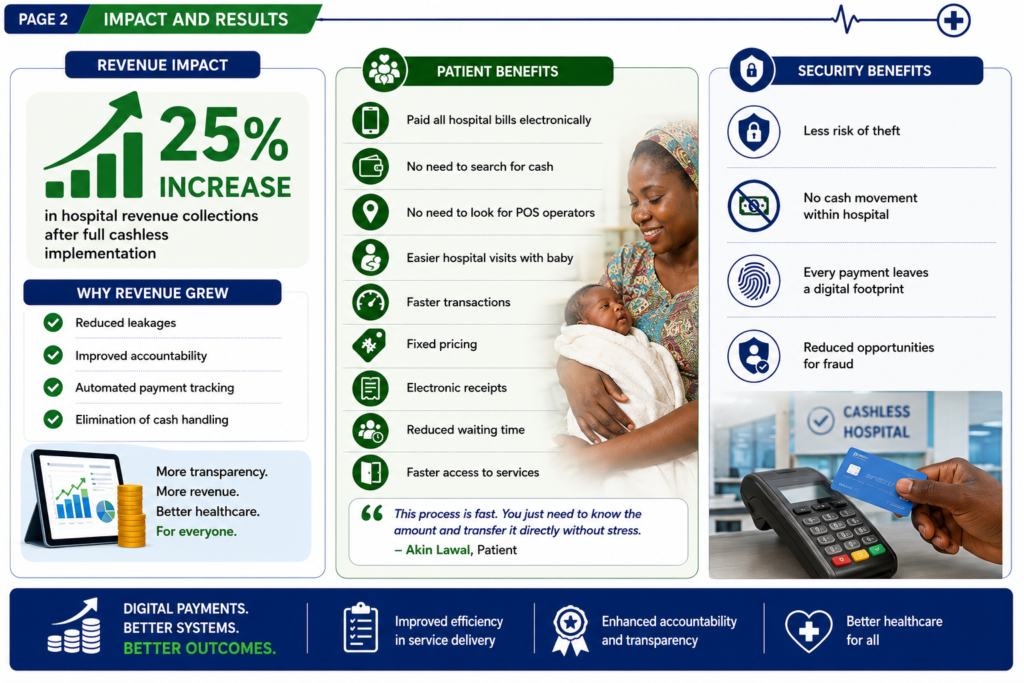
According to the latest financial inclusion data from the Central Bank of Nigeria and development partners, formal financial inclusion stands at about 64 per cent, with 32 per cent of the adult population (roughly 33.9 million Nigerians) remaining completely excluded from the formal financial system.
For such groups, a fully cashless system can become an access barrier rather than an enabler.
Adio faced similar challenges initially.
“I do not have an ATM card and I can’t operate the phone they use for transfers.
“In the beginning, I had to call my son to make transfers for me,” she said.
Over time, she adapted. But her experience highlights the learning curve many vulnerable users face.
Balancing Efficiency with Inclusion
Financial expert, Chukwuemeka Nsika, believes the advantages outweigh the drawbacks.
“It is one of the best things introduced into Nigeria’s financial system.
“All the leakages inherent in the old system are gone.”
However, he acknowledges that digital payments can disadvantage citizens with low literacy levels.
“The illiterate woman or man who goes to the hospital and cannot use an ATM will depend on somebody else,” he said.
Rather than reversing digitalisation, Nsika argues that governments should invest heavily in digital literacy.
“It is important that people get educated on the use of ATMs and digital banking,” he said.
He also noted that electronic transactions generally offer stronger security and accountability than cash handling.
Solving the Challenges
Officials say they anticipated resistance.
According to La-Kadir, the KW-IRS director, taxpayers’ reluctance to abandon cash and network reliability issues emerged as the biggest obstacles during implementation.
To address these concerns, he said the service established a Change Management Committee comprising trained change managers responsible for stakeholder engagement and public sensitisation.
“Network assessments were also conducted to identify the most reliable service providers at different locations.
“Data subscriptions and backup SIM cards were deployed to reduce downtime,” he said.
At KWASUTH, administrators report minimal disruption.
“We have backup systems. If one network fails, another can be used.”
The hospital also maintains complaint mechanisms for failed transactions and refund requests.
Most importantly, administrators say no patient has been denied care because of the payment system.
A Model for Other States?
As governments across Nigeria search for ways to improve revenue generation and reduce corruption, Nsika, a renowned financial expert, said Kwara’s experiment deserved attention.
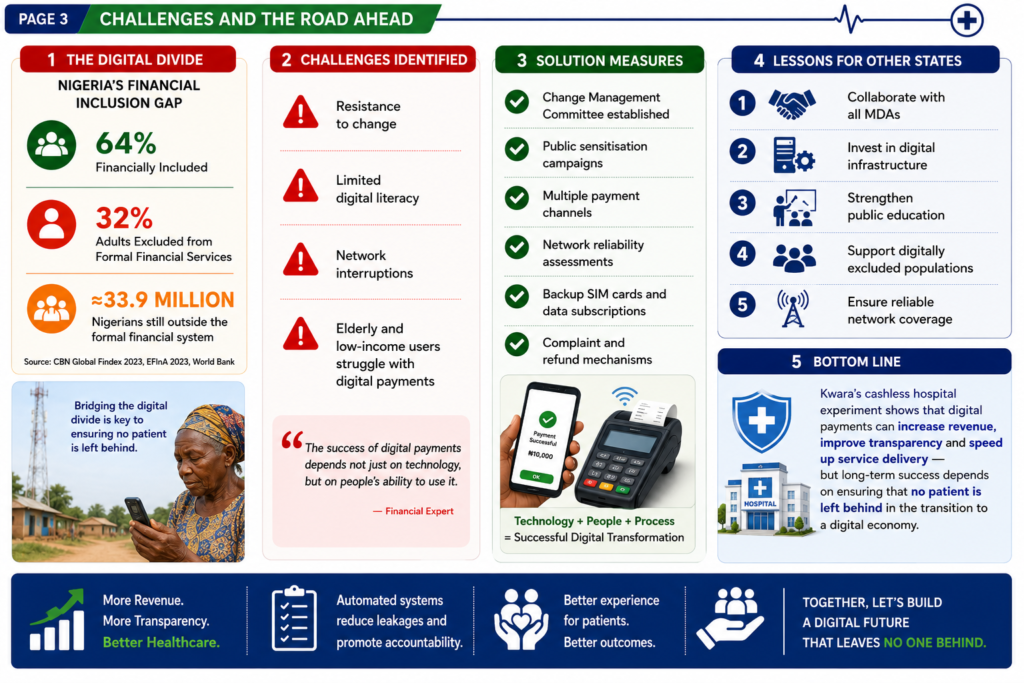
The combination of improved accountability, increased revenue, faster service delivery, and reduced cash handling, he said, presented a compelling case for wider adoption.
Still, the experience also demonstrates that digital transformation cannot be measured solely by revenue figures.
Success depends on ensuring that elderly patients, low-income earners, rural residents, and digitally excluded citizens are not left behind.
For now, Kwara appears to be striking that balance.
In the maternity ward where Mahmoud’s wife delivered their baby, payments now move through digital channels instead of envelopes stuffed with cash.
For hospital managers, the change means cleaner records and higher revenues.
Patients enjoy more convenience and transparency. However, for others, it remains a lesson in adaptation.
For Nigeria, this offers a glimpse into what the future of public service delivery might look like when technology, governance, and healthcare converge.(NANFeatures)
Edited by Chijioke Okoronkwo
This report is produced under the DPI Africa Journalism Fellowship Programme of the Media Foundation for West Africa and Co-Develop.

Comments