


By Sumaila Ogbaje, News Agency of Nigeria (NAN)
For more than a decade, the Nigerian Government’s strategy for countering terrorism and banditry has been driven largely by military offensives, intelligence gathering and law enforcement operations aimed at dismantling insurgent networks and restoring peace to affected communities.
These kinetic operations have resulted in the neutralisation and arrest of thousands of terrorists and criminal elements, the destruction of insurgent camps and the rescue of kidnapped victims.
Yet, security experts argue that military force alone cannot permanently defeat violent extremism, as the conditions that fuel radicalisation often persist long after the guns fall silent.
Recognising this reality, the Federal Government adopted a complementary non-kinetic approach through Operation Safe Corridor (OPSC), a deradicalisation, rehabilitation and reintegration programme established to provide a pathway for willing and low-risk former terrorists to renounce violence and return to society as law-abiding citizens.
Under the initiative, participants undergo psychological counselling, religious reorientation, civic education, vocational training and behavioural therapy before being handed over to state governments for reintegration into their communities.
Nearly a decade after its establishment, however, Operation Safe Corridor remains one of Nigeria’s most debated counter-terrorism initiatives.
Supporters view it as a strategic tool that has encouraged defections, weakened terrorist organisations and generated valuable intelligence for security agencies, while critics question whether the programme adequately addresses victims’ concerns and sufficiently guarantees public safety.
The debate has gained renewed attention following the surrender of thousands of insurgents and their family members in the North-East, as well as growing discussions on whether similar rehabilitation models could be applied to bandits operating in parts of the North-West.
According to the Defence Headquarters, thousands of former insurgents have voluntarily surrendered in recent years following sustained military pressure across the North-East, with many passing through the Operation Safe Corridor programme before reintegration into society.
Government authorities insist the programme complements military operations rather than replacing them.
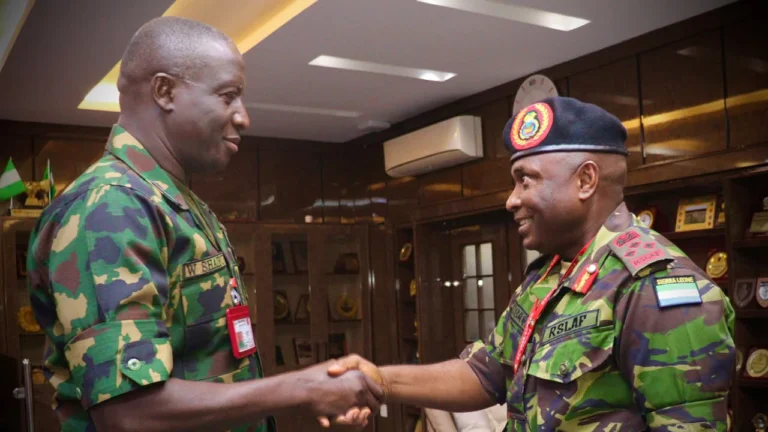
The Coordinator of Operation Safe Corridor, Brig.-Gen. Yusuf Ali, recently described the initiative as a carefully structured non-kinetic strategy aimed at encouraging genuine disengagement from violent extremism.
Ali dismissed allegations that rehabilitated former insurgents were being recruited into the Armed Forces, describing such claims as false, misleading and entirely unfounded.
According to him, beneficiaries undergo comprehensive profiling, deradicalisation, rehabilitation and vocational training before being handed over to state governments for reintegration under established monitoring mechanisms.
He said the programme had continued to reduce the number of active terrorist fighters, encourage voluntary defections and contribute to long-term national stability.
Following sustained public debate over the programme, senior military authorities have continued to defend deradicalisation as a vital component of Nigeria’s counter-insurgency strategy.
The Chief of Defence Staff (CDS), Gen. Olufemi Oluyede, said military operations alone could not permanently eliminate insurgency, stressing that rehabilitation and reintegration remained globally recognised counter-terrorism practices.
According to him, Operation Safe Corridor demonstrates the Armed Forces’ commitment to combining kinetic operations with carefully structured non-kinetic measures aimed at preventing recidivism, encouraging voluntary disengagement from violent extremism and promoting lasting peace.
While government insists that the programme is producing positive outcomes, security experts say its long-term success depends largely on effective implementation and sustained post-reintegration monitoring.
A security analyst, Dr Sani Abubakar, described Operation Safe Corridor as an essential component of modern counter-terrorism.
He noted that successful counter-insurgency campaigns across the world combine military pressure with rehabilitation because insurgencies are driven by complex ideological, economic and social factors.
“You cannot eliminate every insurgent through military action. There will always be individuals willing to surrender.
“If government creates no pathway for peaceful surrender, many fighters may choose to remain on the battlefield.
“Deradicalisation weakens terrorist organisations from within because it encourages defections and creates distrust among remaining fighters,” he said.
Abubakar, however, emphasised that rehabilitation must be backed by rigorous risk assessment, continuous monitoring and strong community participation to minimise the risk of recidivism.
According to him, traditional rulers, religious leaders, community associations and security agencies all have critical roles to play in ensuring that rehabilitated former fighters successfully reintegrate into society.
Similarly, Security and Defence Analyst, Dr Steve Okwori, said available evidence suggested that the programme had recorded measurable gains, although it required stronger institutional support to achieve its full potential.
According to Okwori, the growing number of insurgents who have voluntarily surrendered indicates increasing confidence that government is willing to accept genuine repentance.
He noted that intelligence provided by former insurgents had contributed significantly to military operations, leading to the dismantling of terrorist camps, disruption of logistics networks and rescue of kidnapped victims.
“The programme has reduced the operational capacity of insurgent groups because every surrendered fighter represents one less combatant on the battlefield.
“Many of those who surrendered also provided useful intelligence that enabled troops to target terrorist commanders and logistics routes.
“These are strategic gains that should not be ignored.”
Nevertheless, Okwori acknowledged that public scepticism, particularly among conflict-affected communities, remains understandable.
He argued that victims deserved greater attention through compensation, trauma healing, livelihood support and the reconstruction of communities devastated by insurgency.
“Reconciliation cannot succeed where victims feel neglected. Justice and rehabilitation must go hand in hand.
“Government should strengthen programmes that support victims alongside efforts aimed at rehabilitating former fighters,” he said.
Indeed, while many analysts acknowledge the strategic value of deradicalisation, they also agree that rebuilding public confidence requires addressing the concerns of victims and communities that have borne the brunt of terrorism.
A community leader, Malam Ibrahim Musa, from Borno, said fear persists among residents who lost relatives, homes and livelihoods during years of insurgency.
He urged government to carry communities along to ensure proper monitoring so that those returning do not go back to violence.
According to him, rebuilding trust requires addressing the emotional and economic consequences of terrorism on affected families.
Mrs Liyatu Tawasu, a survivor of the Boko Haram insurgency, said many victims still struggled with the physical and emotional scars of the conflict and believe greater attention should be given to their welfare.
Having lost 15 members of her extended family during an attack on Gwallam community in 2014, she questioned why many victims remained in difficult conditions while resources were being committed to rehabilitating former insurgents.
“I am a victim and no one can quantify my anguish,” she said.
Tawasu urged government to balance reconciliation efforts with justice and support for survivors.
Similar concerns have been echoed by many residents of Internally Displaced Persons (IDP) camps in the North-East, who argue that while they support peace initiatives, rehabilitation programmes should not overshadow the needs of victims who lost relatives, homes and livelihoods to insurgency.
Many insist that assistance to survivors should receive equal priority with efforts to rehabilitate repentant insurgents.
Community leaders in conflict-affected areas have also stressed that successful reintegration depends on transparency, adequate consultation and sustained monitoring of rehabilitated ex-combatants.
According to them, many residents remain apprehensive because they are uncertain about the criteria used to classify former insurgents as “low risk” before their return to society.
In spite of the validity of victims’ grievances, peacebuilding experts argue that support systems and rehabilitation do not have to clash.
They argue that true peace relies on a balanced approach: securing justice, fostering reconciliation, compensating victims, and successfully reintegrating genuinely repentant former insurgents.(NANFeatures)

Comments