









By Folasade Akpan
The United Nations Population Fund (UNFPA) has urged Nigeria to end speculation over its population size, stressing that credible demographic data remains essential for effective planning and investment.
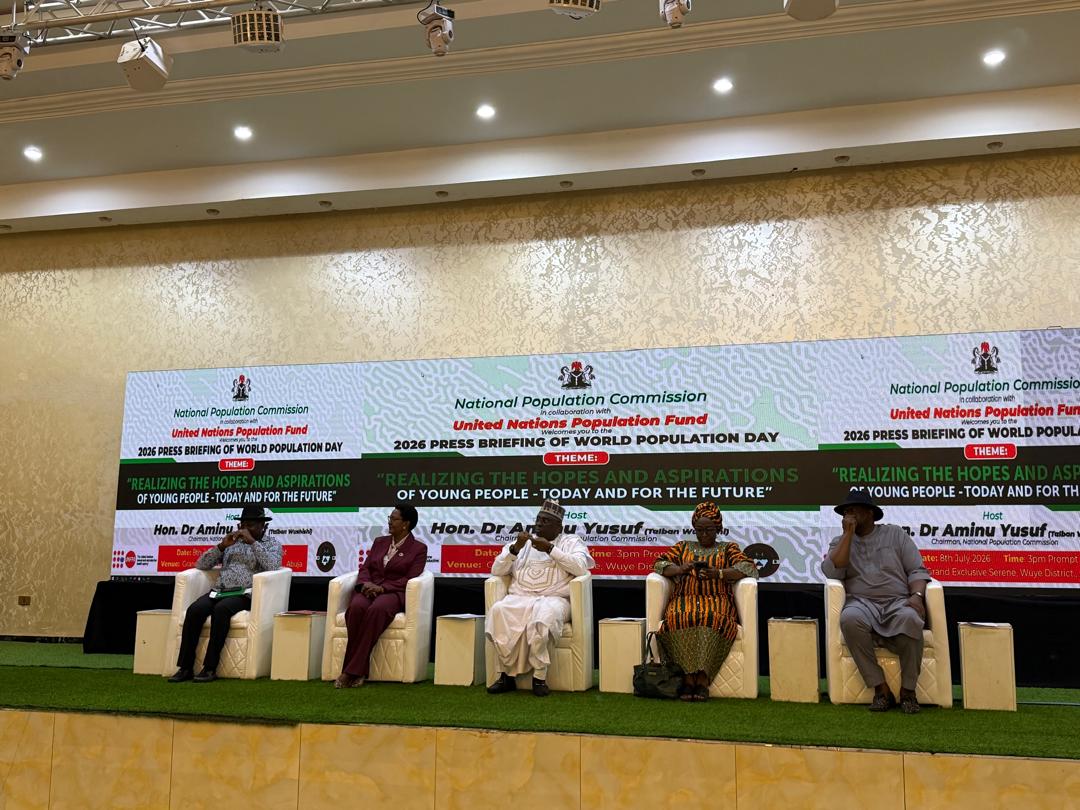
UNFPA Nigeria Resident Representative, Ms Muriel Mafico, made the call on Wednesday in Abuja at a news conference ahead of the 2026 World Population Day commemoration.
Mafico said Nigeria already possessed the expertise and tools required to generate reliable demographic information and should leverage existing initiatives to strengthen evidence-based planning.
“We should not be guessing. Are we 240 million? Are we 250-something million? Are we going to be 450 million in 2050? We should not be guessing,” she said.
She said demographic profiles being produced across states and the 2024 Nigeria Demographic and Health Survey provided rich information that could guide development planning at national and sub-national levels.
According to her, investing in quality data enables government to determine where resources, programmes and services are most needed and ensures interventions reach priority communities.
“That is why we remain committed to investing in data so that we are evidence-driven,” he said.
Mafico said the 2026 World Population Day theme, “Realising the Hopes and Aspirations of Young People — Today and for the Future,” reflected findings from UNFPA’s Global Demographic Futures Survey.
She said the survey, involving more than 100,000 young adults across 73 countries, showed young people still valued relationships, family and parenthood but faced economic and social barriers.
According to her, young people identified financial security, stable employment and emotional readiness as major conditions for starting families, alongside concerns over unequal caregiving responsibilities.
She said Nigeria’s estimated 73.1 million young people aged 10 to 24 represented more than 30 per cent of the population and remained central to the country’s demographic future.
Mafico said Nigeria’s youthful population presented an opportunity to reap the demographic dividend through sustained investments in health, education, skills development and employment.
She, however, expressed concern that 12.5 per cent of Nigerian youths were not in education, employment or training, while 93 per cent of employment existed in the informal sector.
She urged governments at all levels to strengthen implementation of existing youth policies, improve inter-agency coordination, expand access to quality education, affordable housing and social protection, and promote peace and security.
Mafico reaffirmed UNFPA’s support for Nigeria’s next Population and Housing Census, describing it as “an instrument of justice” capable of ensuring no young person was excluded from national planning.
Earlier, Chairman of the National Population Commission (NPC), Dr Aminu Yusuf, said Nigeria’s estimated population of 242 million made it Africa’s most populous nation and one of the world’s youngest countries.
Yusuf said people aged 15 to 29 accounted for nearly 30 per cent of the population, stressing that the country’s future depended on creating opportunities for its young people.
He said government interventions under the Tinubu administration, including youth skills development, student loans, vocational training and digital birth registration, demonstrated commitment to addressing youth development challenges.
The chairman said youth unemployment was about 33 per cent, while underemployment exceeded 20 per cent, largely due to the mismatch between educational curricula and labour market demands.
He cited ongoing initiatives, including the Three Million Technical Talent Programme, which had certified 30,000 fellows, the Nigerian Education Loan Fund and the expanded vocational training programmes.
He said other initiatives included the modernisation of birth registration through the Civil Registration and Vital Statistics (CRVS) system, as evidence of the government’s commitment to human capital development.
He also highlighted improvements in reproductive health, noting that Nigeria’s Total Fertility Rate had declined from 5.3 to 4.8 children per woman, although adolescent fertility remained high at 15 per cent.
Yusuf, however, identified infrastructure deficits, insecurity, rising living costs and weak implementation of existing policies as major obstacles to harnessing the demographic dividend.
“We cannot plan for a population we do not accurately count. A credible, technology-driven Population and Housing Census remains the ultimate tool required,” he said.
He called for accelerated review of the National Youth Policy and urged sustained investment in health, education, skills acquisition and reproductive health to unlock Nigeria’s demographic potential.
The chairman also appealed to journalists to sustain accurate reporting on population dynamics, youth development and evidence-based planning to deepen public understanding of demographic issues.
Also speaking, the Director-General of NPC, Dr Osifo Ojogun, said available estimates placed Nigeria’s population below 250 million pending a new national census.
“Most often, I say we are under 250 million persons. The statistics show you can say plus or minus. We work within that range,” he said.
Ojogun said only the Federal Government could determine the date for the next census, noting that such an exercise could not be conducted simultaneously with national elections.
He reiterated the need to institutionalise the use of data in planning across all sectors, saying countries that consistently relied on evidence for planning generally recorded stronger development outcomes.
“The use of data should become cultural, a way of life. Let us plan with data,” Ojogun said.
The News Agency of Nigeria (NAN) reports that World Population Day is observed annually on July 11 to raise awareness on global population issues and their implications for sustainable development.(NAN)(www.nannews.ng)
Edited by Funmilayo Adeyemi