










By Tiamiyu Prudence Arobani
Tunji Disu, Nigeria’s Inspector-General of Police (IGP), has urged global law enforcement leaders to ensure that technological innovations strengthen public trust, transparency and human rights
Disu made the call while addressing the Fifth United Nations Chiefs of Police Summit (UNCOPS 2026) on Innovation and New Technologies in UN Policing on Wednesday.
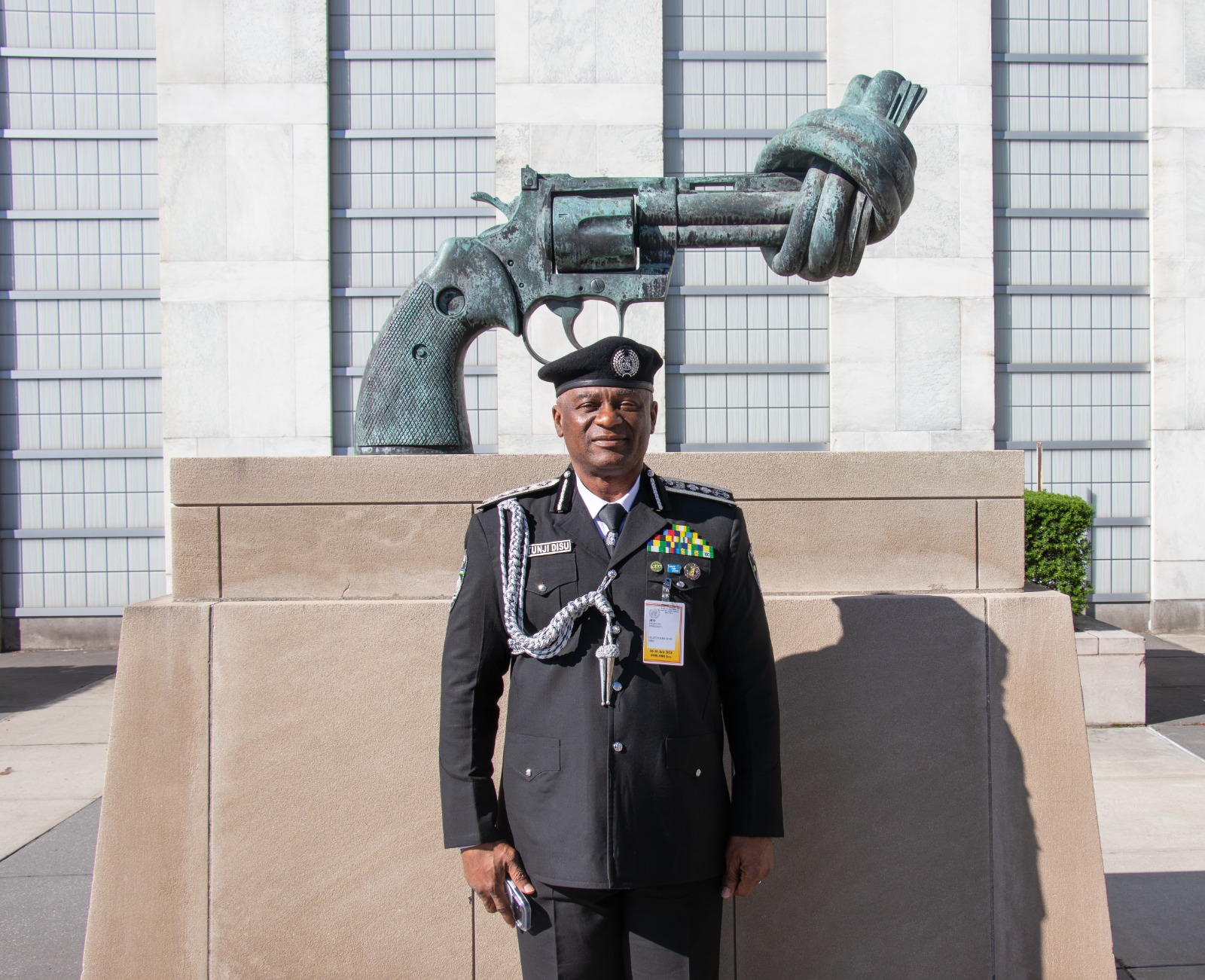
Nigeria’s Inspector-General of Police Tunji Disu at the Non-Violence (Knotted Gun) sculpture during the UN Chiefs of Police Summit at the UN headquarters in New York
The Nigeria’s police chief warned that embracing technological advancement should never diminish the confidence citizens place in policing institutions.
“Technology can enhance policing but it can never replace public trust. The legitimacy of every police institution rests on the confidence of the people it serves,” he said.
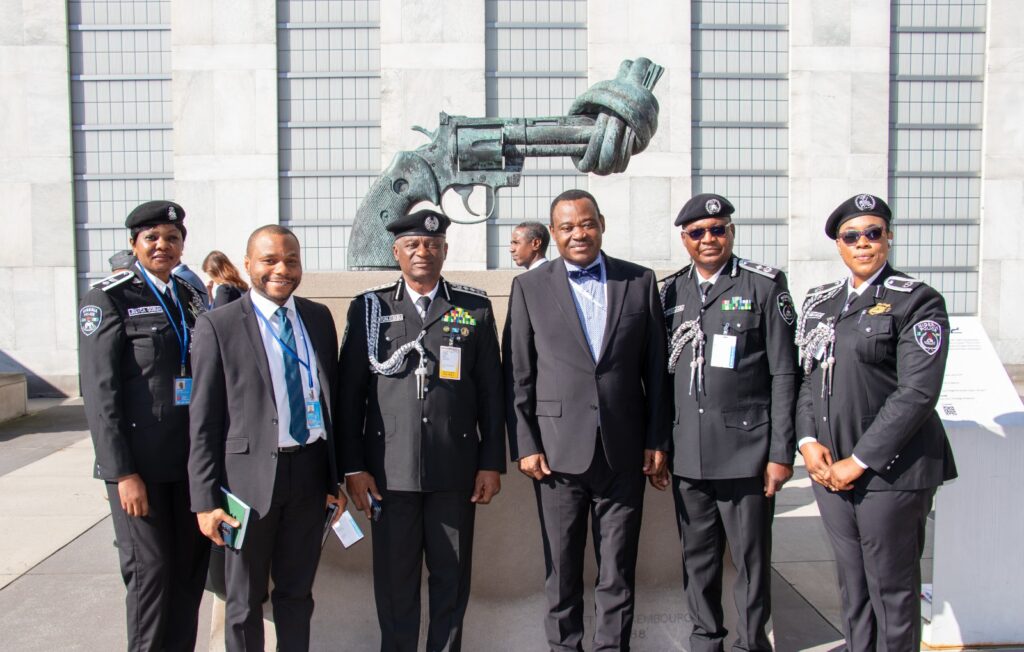
IGP Tunji Disu (3rd left) flanked by the Permanent Representative of Nigeria to the UN, Amb. Jimoh Ibrahim and other members of Nigeria’s delegation during the 5th UN Chiefs of Police Summit at the UN Headquarters in New York.
The IGP said technology would continue to transform policing but trust would remain the defining pillar of every credible law enforcement institution.
“Together, through responsible innovation and visionary leadership, we can build policing institutions that are not only smarter but more trusted, more inclusive and better equipped to secure a peaceful world,” he said.
The IGP said the Nigeria Police Force, serving over 230 million people, was navigating rapid digital transformation, making innovation “no longer a choice” but “an operational necessity.”
“Criminal networks now exploit artificial intelligence, encrypted communication and cyber-enabled fraud to operate across borders with high sophistication,” Disu said.
“This challenges traditional policing models and forces us to rethink how we protect vulnerable communities.”
Disu, however, said the same technologies exploited by criminal networks also presented “extraordinary opportunities” for law enforcement agencies worldwide.
“Artificial intelligence, digital forensics and geospatial intelligence are transforming how we anticipate threats and conduct investigations,” he said.
According to him, innovation must strengthen transparency, accountability and respect for human rights rather than undermine democratic policing principles.
“Innovation must therefore strengthen transparency, accountability and respect for human rights. Technology should complement human judgment, not replace it.
“It must always remain anchored in the rule of law and the protection of human dignity,” he said.
Disu stressed that the future of UN policing depended on ensuring that technological innovation benefits every nation, regardless of its level of development.
“To achieve this, the benefits of innovation must not remain the exclusive preserve of technologically advanced nations.
“The future of UN policing must be founded upon genuine international cooperation, capacity building and equitable access to digital capabilities for all Member States,” he said.
Disu reaffirmed Nigeria’s commitment to supporting collaborative international policing efforts aimed at promoting global peace, security and the rule of law through responsible technological innovation.
The summit brought together 145 delegations, comprising ministers, chiefs of police and senior representatives of regional and professional policing organisations to UN Headquarters, the highest level of participation to date.
The purpose of the summit was to discuss the future of UN Police, innovation and new technologies and international cooperation to address transnational challenges. (NAN)
Edited by Ismail Abdulaziz