



By Martha Agas, News Agency of Nigeria (NAN)
Beneath Africa’s vast landscape lies one of the world’s richest concentrations of mineral wealth.
From cobalt and copper to lithium, bauxite, graphite and rare earth elements, the continent possesses many of the critical minerals driving the global transition to clean energy, advanced manufacturing and digital technologies.
Yet, in spite of this abundance, Africa captures only a small share of the wealth generated from these resources.
For decades, analysts say the continent has exported raw minerals while industries elsewhere transformed them into batteries, electric vehicles, electronics and other high-value products.
Consequently, African countries earn relatively little from extraction and later import finished products manufactured from their own mineral resources at much higher prices.
Albeit holding about 30 per cent of the world’s known mineral reserves, Africa accounts for only a small fraction of global mineral processing and manufacturing.
From cobalt in the Democratic Republic of Congo, bauxite in Guinea and lithium in Zimbabwe to Nigeria’s deposits of lithium, iron ore and rare earth minerals, Africa remains richly endowed.
However, limited value addition, inadequate infrastructure, technology gaps and fragmented industrial capacity continue to constrain the continent’s mining sector.
Analysts refer to this contradiction as Africa’s resource paradox.
The paradox reflects a continent blessed with enormous mineral wealth but still grappling with poverty, unemployment, limited industrialisation and low returns from its natural resources.
Against this backdrop, analysts say unlocking Africa’s mineral wealth requires addressing longstanding structural constraints, especially inadequate infrastructure.
They advocate greater investment in transport and energy infrastructure, stronger regional cooperation, wider technology adoption and harmonised policies that promote industrial development.
Similarly, stakeholders insist Africa must end its dependence on exporting raw minerals and instead develop industries that process resources closer to where they are extracted.
They argue that meaningful progress will only come when African countries replace fragmented national approaches with stronger continental partnerships.
Such partnerships, they say, would strengthen Africa’s bargaining power and enable countries to negotiate from a position of greater economic strength.
This growing consensus is shared by policymakers, investors, development institutions and industry leaders across the continent.
They believe closer collaboration among governments, businesses and development partners is essential to promote mineral beneficiation, build regional value chains and accelerate industrialisation.
These issues came under focus at the fifth African Natural Resources and Energy Investment Summit (AFNIS) held in Abuja.
The summit, held from June 23 to June 25 under the theme, ‘One Africa, One Resource Vision: Forging a Continental Alliance for Sustainable Development,’ reinforced the belief that no African country can achieve mineral-led industrialisation in isolation.
Speaking at the summit, President Bola Tinubu said Africa holds the key to the world’s industrial future because of its vast endowment of critical minerals.
Tinubu said African countries must abandon fragmented approaches and work together to negotiate from a position of strength.
His address was delivered by the Minister of Solid Minerals Development, Dr Dele Alake.
The president urged African countries to adopt common strategies for resource management, energy development and industrial growth.
“Africa must no longer export the future in raw form and import poverty in finished form,” Tinubu said.
He called for increased refining, processing and manufacturing across the continent to strengthen local value chains.
“We must power our factories, train our engineers and build our own value chains,” he said.
Tinubu also urged African countries to harmonise regulations, remove barriers to intra-African trade and strengthen infrastructure supporting industrial growth.
He advocated transparent investment frameworks and a new continental resource compact capable of transforming Africa’s mineral wealth into broad-based prosperity.
Reinforcing the president’s position, Alake said Africa must integrate minerals, energy systems, infrastructure and markets across borders.
According to him, regional integration remains essential for achieving sustainable industrialisation.
“The gas field in one region should support power and industrial growth across borders,” Alake said.
He said mineral development corridors should stimulate manufacturing, logistics and export opportunities throughout Africa.
Furthermore, Alake noted that rising global demand for critical minerals had placed Africa at the centre of the global energy transition.
However, he cautioned that natural resource endowment alone could not guarantee economic transformation.
He stressed that credible regulation, modern infrastructure, advanced technology and skilled manpower were indispensable to unlocking Africa’s mineral potential.
In addition, Alake described innovative financing as critical to expanding Africa’s mineral and energy sectors while supporting long-term industrial development.
The minister expressed optimism that stronger continental cooperation would enable Africa to build industries, create value and shape its own economic future.
Beyond Nigeria, the call for deeper collaboration resonated among delegates from Kenya, Liberia, South Sudan and other African countries, who advocated practical measures to maximise the continent’s mineral wealth.
They agreed that Africa could no longer afford to remain a supplier of raw materials while other regions captured most of the value through processing and manufacturing.
Similarly, the Kenyan Government urged African countries to accelerate local mineral beneficiation and value addition to secure greater economic returns from their abundant mineral resources.
Kenya’s Cabinet Secretary for Mining, Blue Economy and Maritime Affairs, Hassan Ali Joho, made the call in a goodwill message delivered by his adviser, Maryam Abdullahi.
Joho advocated the establishment of an African mineral standardisation and certification framework aligned with the continent’s development priorities.
He also urged African countries to redefine their critical minerals agenda rather than relying on externally imposed frameworks.
According to him, Africa’s mineral resources should be developed in ways that advance the continent’s collective interests and long-term industrial aspirations.
Likewise, Liberia stressed the importance of stronger regional cooperation in unlocking Africa’s vast natural resource potential.
Mr Joseph Habakkuk, Deputy Director-General (Technical Services) of the Liberia Petroleum Regulatory Authority, said African countries needed stronger regional infrastructure and greater trust among themselves.
He said Africa’s natural resources should be viewed not merely as commodities but as instruments capable of transforming economies and improving livelihoods.
According to Habakkuk, the continent’s resources can power industries, create jobs and secure a more prosperous future for coming generations.
Meanwhile, the Secretary-General of the Africa Minerals Strategy Group (AMSG), Moses Engadu, shared a similar perspective.
Engadu said strategic partnerships among African countries would determine whether the continent succeeds in translating its mineral wealth into sustainable industrial development.
Nevertheless, although optimism dominated discussions throughout the summit, delegates acknowledged that achieving the vision would require more than political declarations.
They agreed that implementation, sustained investment and institutional reforms would ultimately determine the success of Africa’s mineral transformation agenda.
To translate these ambitions into practical solutions, experts highlighted the need to accelerate exploration, improve transparency and attract investment through the deployment of advanced technology across Africa’s mining value chain.
Experts urged African countries to embrace satellite-based exploration technology and artificial intelligence (AI) to accelerate mineral discovery and improve resource management.
They said the technologies could also enhance transparency, reduce exploration risks and lessen dependence on external financing.
According to the experts, Africa possesses enormous mineral wealth but continues to face unreliable geological data, outdated exploration methods, inadequate funding and weak mineral asset management systems.
They explained that AI can process vast volumes of geological information within a short period, enabling faster and more informed investment decisions while also improving efficiency across mineral exploration, processing, production, marketing and environmental monitoring.
Building on these technological opportunities, the summit showcased Thermal Vision Tomography (TVT), an innovative geophysical exploration technology designed to transform mineral exploration by detecting minerals and hydrocarbons deep beneath the earth’s surface with remarkable accuracy.
The technology greatly reduces exploration costs, lowers uncertainty, shortens project timelines and improves investor confidence.
However, experts stressed that technological innovation alone would not be enough without modern infrastructure linking mines, industries, transport networks and regional markets.
Without efficient transport systems, reliable electricity and integrated logistics, they said mineral discoveries would deliver only limited economic benefits.
Nevertheless, participants maintained that Africa’s mineral wealth would achieve its greatest value only when countries cooperate across borders and build industries serving regional markets rather than individual national economies.
That position was reinforced by Prof. Kevin Urama, Vice-President of the African Development Bank (AfDB).
Urama urged African countries to develop economic corridors linking mining, agriculture, industries and regional markets.
According to him, many transport networks still reflect colonial-era extraction models rather than supporting regional industrial development.
He called for improved intra-African connectivity to reduce trade barriers, lower business costs and strengthen economic integration.
Equally important, the AfDB vice-president advocated stronger local content policies to increase African ownership of mineral assets.
He urged governments to prioritise African companies in procurement, licensing and investment opportunities across the mining sector.
Urama further proposed minerals development agreements instead of conventional mining concession agreements.
According to him, stronger mineral value chains would accelerate industrialisation, create jobs and improve livelihoods for Africa’s growing population.
He added that greater value addition would also strengthen global efforts to address climate change while delivering wider economic benefits to African countries.
Beyond policy discussions, the summit also produced concrete partnerships aimed at translating commitments into action.
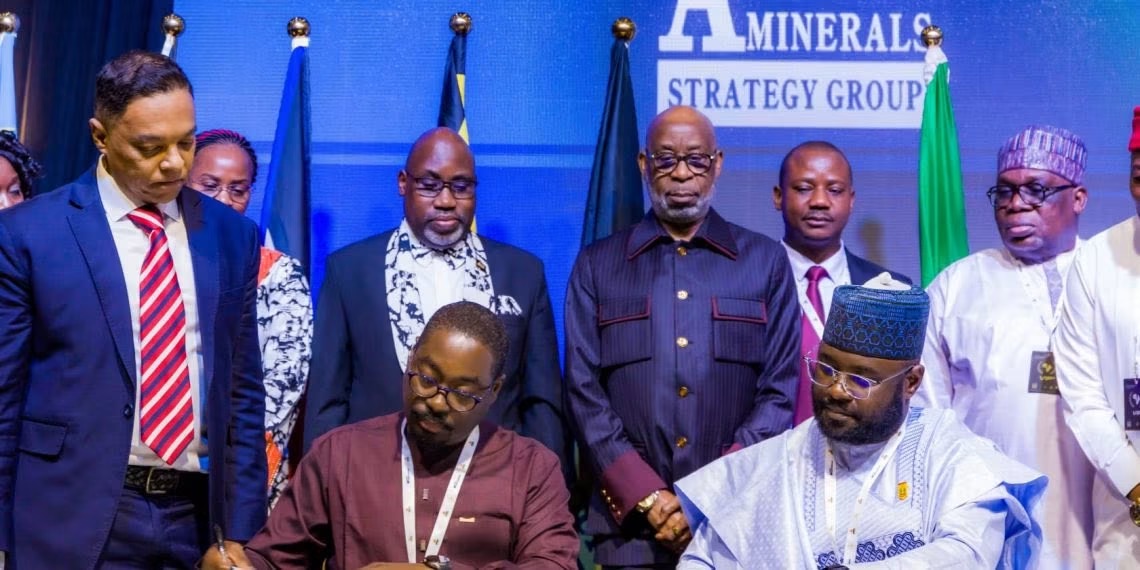
One of the landmark agreements was a Memorandum of Understanding (MoU) between the Africans for Africa (AFA) Initiative and Steron International Resources Limited.
The agreement seeks to accelerate the development of Nigeria’s critical minerals, especially lithium and rare earth elements, through investment, technology transfer and regional collaboration.
Steron also showcased a lithium-for-technology exchange model designed to promote local value addition, industrialisation and renewable energy development.
Rather than exporting minerals solely for foreign exchange, the model uses partially processed lithium to acquire advanced technologies and industrial equipment.
The company said the approach demonstrates how Africa’s mineral resources can finance its own industrial development.
Mr Muhammed Otokiti, Consultant Mining Engineer at Steron International Resources Limited, said the company exchanges partially processed lithium with Chinese partners for technology and equipment.
Otokiti said the value of the exported lithium is exchanged for solar energy components under a mutually beneficial partnership.
According to him, the model could encourage technology transfer, expand local manufacturing and strengthen Nigeria’s renewable energy sector.
Similarly, the summit witnessed several cooperation deals involving private companies and African governments, including Liberia and South Sudan.
These engagements reflected growing confidence in regional partnerships as vehicles for accelerating mineral development.
Meanwhile, a South Sudanese delegation, led by the Director-General of the Geological Survey of South Sudan, Mr James Kund, visited the Nigeria Mining Cadastre Office in Abuja to study its operational framework.
Kund said the visit formed part of efforts to strengthen South Sudan’s mining administration through technical cooperation with Nigeria while also exploring opportunities for institutional support and knowledge sharing in mineral governance.
Analysts believe such exchanges could strengthen regulatory institutions and improve investor confidence across Africa’s mining sector.
Beyond individual agreements, participants agreed that Africa’s mineral future depends on sustained collaboration rather than isolated national initiatives.
They maintained that no single country possesses all the resources, technology, financing and industrial capacity needed to maximise the continent’s mineral wealth.
Instead, countries with abundant mineral deposits, industrial capacity, financial resources and technological expertise should complement one another.
Such collaboration, they argued, would enable Africa to build integrated regional value chains capable of competing globally.
Ultimately, analysts say the continent has reached a defining moment in its mineral development journey.
As global demand for critical minerals continues to rise, the situation presents Africa with a rare opportunity to move beyond exporting raw materials towards building industries that create jobs, generate wealth and strengthen economic resilience.
Realising that ambition will require more than political declarations.
It will demand consistent policies, strategic investment, modern infrastructure, advanced technology, skilled manpower and effective institutions.
Above all, it will require African countries to pursue a shared vision anchored on trust, cooperation and mutual benefit.
While the theme of the summit reflects that aspiration, whether the commitments made in Abuja translate into industries, jobs and lasting prosperity will depend on how effectively African countries convert dialogue into action.
For many stakeholders, the summit has laid the foundation for a more coordinated approach to managing the continent’s vast mineral wealth.
If sustained, they believe the partnerships forged in Abuja could help position Africa not merely as a supplier of critical minerals, but as a global hub for mineral processing, manufacturing and green industrial development. (NANFeatures)
Edited by Tosin Kolade