


By Sarafina Christopher
When China announced in 2021 that it had eradicated absolute poverty after an eight-year campaign, the milestone achievement attracted global attention.
For many developing countries confronting persistent poverty, the question was no longer whether China had succeeded, but what lessons its experience might offer.
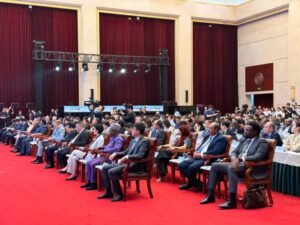
That search for answers to this question recently brought political leaders, scholars and media representatives from more than 50 countries to Yinchuan, capital of Ningxia Hui Autonomous Region.
The region is where China’s poverty reduction journey was examined through the voices of policymakers, grassroots officials, development practitioners and villagers whose lives had been transformed.
A common message ran through their accounts: poverty reduction requires more than economic growth.
It depends on governance, long-term planning, targeted interventions, community participation and sustained investment in people.
Liu Haixing, Minister of the International Department of the Communist Party of China (CPC) Central Committee, described poverty as one of the greatest challenges facing developing countries on the path to modernisation.
He said China lifted 98.99 million rural residents out of poverty, removed all 832 designated impoverished counties from the poverty list and helped 128,000 villages shake off poverty.
Liu explained that China achieved the poverty reduction target under the UN 2030 Agenda for Sustainable Development a decade ahead of schedule.
According to him, the achievement is rooted in what China describes as targeted poverty alleviation identifying the specific needs of communities and households.
This is done by deliberately tailoring assistance to local conditions and combining poverty reduction with industrial development and employment creation.
“Development paths must suit each country’s national conditions,” he said.
The minister emphasised that while China’s experience could provide useful insights, every country must develop approaches that reflect its own realities.
He added that China had entered a new phase focused on rural revitalisation by strengthening agriculture, expanding rural industries and preventing a return to large-scale poverty.
Beyond the figures, however, were the experiences of people whose lives reflected the impact of those policies.
Liu Kerui, a villager from Hongde Village in Ningxia, recounted moving beyond years of hardship to building a more secure future.
He described poverty alleviation as a journey that restored hope and dignity to his family.
For Ma Yanlong of Miaomiaohu Village, the transformation came through developing industries suited to local conditions.
What was once sparsely productive desert land now supports livelihoods, creating employment opportunities and improving household incomes.
Education also emerged as an important part of the development process.
Ms Wu Juan, Academic Principal of Ningxia Antong Zhitu Education Co., Ltd., said improving access to education had expanded opportunities for children from disadvantaged communities.
This, he explained, demonstrated that lasting poverty reduction depended on investing in people as much as infrastructure.
Another speaker, Xin Baotong, Head of the Longlongshu Minning Disability Support Trade Centre, highlighted efforts to ensure that persons with disabilities were included in development programmes through skills acquisition and employment support.
His experience illustrated a broader emphasis on ensuring that vulnerable groups were not left behind.
Another defining feature of China’s approach was the role of grassroots governance.
Mr Zhou Daxing, First Secretary of the CPC Libu Village Branch in Tongxin County, said poverty reduction relied on coordinated action across village, township, county, provincial and central authorities.
He said identifying local needs, implementing projects and continuously monitoring progress required sustained cooperation rather than isolated interventions.
Regional cooperation also played a significant role.
Li Huiqin, a member of the 14th Fujian Aid Task Force to Ningxia, underscored the benefits of this approach.
He explained how partnerships between China’s more developed eastern provinces and less-developed western regions helped attract investment, strengthen industries and expand markets for agricultural products.
Li said initiatives such as e-commerce, livestreaming and business partnerships connected Ningxia’s products to consumers across China while creating jobs and encouraging enterprise development.
Guo Shaoling, Secretary of the CPC Yaomo Village Branch in Guyuan City, said the focus after eliminating absolute poverty had shifted towards rural revitalisation.
According to him, continued policy support, improved agricultural technology and expanding e-commerce enabled farmers to move beyond primary production to complete agricultural value chains.
This, he said, is done by also encouraging more young people to remain in or return to rural communities.
Members of the international media delegation said visiting villages, farms and industrial projects offered an opportunity to compare policy objectives with realities on the ground.
Mr Frederick Idehai, President of the Diplomatic Correspondents Association of Nigeria, said visits to poverty alleviation communities, poultry farms and e-commerce centres demonstrated how development policies were implemented at the grassroots.
“We went to the poverty alleviation village. We saw it. We went to the poultry farm. We saw it. We went to the e-commerce centre. We saw it,” he said.
According to Idehai, one of the most striking observations is the close interaction between public officials and local communities.
“When your leaders are always there, relating with the people, creating that unity and that bond, things work.
“In China, I could see the relationship between the Party and the people reaching the grassroots level,” he said.
The experience also aligned with foreign political leaders.
Mr Mohammed Ouzzine, Deputy Speaker of the House of Representatives of Morocco, underscored this point.
He said China’s targeted poverty alleviation strategy demonstrated the importance of tailoring policies to local conditions, accurately identifying households in need and deploying resources efficiently.
Ouzzine said the experience also underscored the importance of political commitment, effective implementation mechanisms and broad social mobilisation in tackling poverty.
Mr Ghulom Halimzoda, Chairman of the Socialist Party of Tajikistan, corroborated this point.
According to him, the principal lesson from China’s experience is not merely the scale of resources invested but the continuity of policies, institutional coordination and a people-centred approach to development.
Zimbabwe Senate President Mabel Chinomona described Ningxia’s transformation as evidence that poverty reduction should be viewed as a comprehensive development strategy rather than a temporary welfare intervention.
“The transformation of once impoverished communities into thriving centres of economic activity stands as a testament to visionary leadership, sound policy implementation and an unwavering commitment to improving people’s lives,” she said.
She added that while China’s experience offered valuable lessons, countries would need to adapt those lessons to their own governance systems, institutions and development priorities.
Indera Sagewan, University of the West Indies don and economist from Trinidad and Tobago, offered a similar perspective, cautioning against treating China’s experience as a model to be copied wholesale.
“It is not necessarily to be replicated, but to be adopted to your own circumstance,” she said.
Sagewan, who teaches international trade, said countries should draw lessons that fit their own economic systems, governance structures and development priorities, rather than attempting to replicate another country’s model.
What emerged from Ningxia was a broader picture of development whereby poverty reduction is linked to governance, education, industrial development, rural revitalisation and continuous policy support.
For many participants, the country’s experience is attracting attention not because it offers a universal blueprint.
Rather, it is because it demonstrates how long-term planning, accountable institutions and locally tailored solutions can work together to improve people’s lives.
As developing countries continue searching for pathways to inclusive development, China’s success story provides a model, which they can adapt to suit their local realities. (NAN)(www.nannews.ng)
Edited by Mark Longyen


Comments