


By Lucy Ogalue
President Bola Tinubu has called on African countries to end their long-standing dependence on exporting raw cocoa beans and embrace value addition to capture greater benefits from the global chocolate industry.
Tinubu, represented by the Minister of Agriculture and Food Security, Sen. Abubakar Kyari, made the call at the Africa Cocoa Summit in Abuja, themed “From Bean to Brand” on Tuesday in Abuja.
The President noted that Africa produced about 70 per cent of global cocoa but retained barely six cents of every dollar earned from the chocolate industry.
“We gathered in Abuja today not to lament that arithmetic. We gathered to end it,” he said.
Tinubu said Nigeria would process cocoa beans, manufacture chocolate, build local brands and compete globally instead of exporting raw commodities.
He said value addition was central to the Renewed Hope Agenda and Nigeria’s industrialisation drive.
While noting that investors were developing a 70,000-tonne cocoa processing facility in Shagamu, he added that Nigeria’s grinding capacity had exceeded 120,000 tonnes yearly.
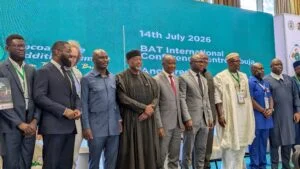
Earlier, the Minister of Industry, Trade and Investment, Dr Jumoke Oduwole, said the summit aligned with the ministry’s mandate to build a one trillion-dollar economy by 2030.
Oduwole said Nigeria earned only a fraction of the value generated from cocoa in spite of contributing significantly to global production.
She said the Federal Government was supporting value addition through manufacturing incentives, investment promotion and stronger collaboration across relevant agencies.
The minister said government would also improve market access through existing trade partnerships and the African Continental Free Trade Area.
She urged investors to leverage opportunities across regional and global value chains to unlock the sector’s full potential.
Also speaking, the Minister of State for Industry, Sen. John Enoh, said the summit marked another step in implementing Nigeria’s Industrial Policy.
Enoh said the Cocoa Value Addition Alliance would unite Nigeria, Ghana, Côte d’Ivoire and Cameroon, which together account for about 75 per cent of global cocoa production.
He said the alliance would strengthen regional cooperation and enable producing countries to capture more value from the global cocoa market.
“We are not here to disrupt existing partnerships but to expand them,” Enoh said.
He urged African countries to move beyond exporting raw beans and focus on producing branded cocoa products for global markets.
Also speaking, Managing Director of the Bank of Industry (BOI), Dr Olaupo Olusi said that bank had secured a 60-million-euro credit facility from the European Investment Bank to fund Nigeria’s cocoa value addition drive, with a focus on processing, ingredients and chocolate manufacturing.
Olusi said that the facility was to support the cocoa sector and would establish dedicated financing windows for cocoa processing, ingredient manufacturing, packaging and chocolate production.
“An example of this is the 60 million euros credit facility we received from the European Investment Bank to develop the cocoa sector. This will help Nigerian processors compete more fairly with multinationals that have access to cheaper finance
“This will help Nigerian processors compete more fairly with multinationals that have access to cheaper finance,” he said.
Olusi said the facility was part of BOI’s broader strategy to mobilize blended, concessional and patient capital from development partners to support the cocoa sector.
He explained that beyond the EIB facility, BOI would also explore financing shared physical and digital platforms such as a Cocoa Value Addition Park in the cocoa belt.
The park, he said, would have shared processing lines, quality laboratories, reliable power, effluent treatment and digital traceability to serve processors of all sizes.
“We are not approaching cocoa as a lending programme; we are building an industrial ecosystem. Our goal is to finance everything from nurseries and cooperatives to grinding plants, ingredient factories, packaging lines and chocolate manufacturers.”
According to him, cocoa financing cannot be generic. It must be structured around the biology of the tree, the rhythm of the harvest, and the economics of the factory.
He noted that replanting finance must carry grace periods of three to five years, while grinding plants need hundreds of millions of dollars in seasonal finance to buy a year’s beans within a four-month window. Processing plants and ingredient lines, he added, require patient seven to10 years term capital that commercial banks rarely offer.
Citing BOI’s track record, Olusi said the bank disbursed over ₦164 billion in 2025 to more than 3,500 agro and food-processing businesses.
“The support financed factories, mills, packhouses and cold chains, and linked nearly 48,000 smallholder farmers into industrial value chains.”
He said the new financing would target the entire ecosystem: from nurseries and farmer cooperatives to grinding plants, ingredient factories, packaging lines and chocolate manufacturers.
Olusi stressed that Nigeria produced over 300,000 tonnes of cocoa annually but had effective grinding capacity of only about 50,000 tonnes, adding that closing that gap could multiply export value two to four times.
The BOI boss added that capital would be paired with business development support, technical advisory and enterprise training to strengthen costing, quality, standards and export documentation. (NAN)(www.nannews.ng)
Edited by Isaac Aregbesola


Comments