










By Moses Kolo
Stakeholders have called for stronger community ownership and sustained government support to consolidate gains recorded under the child labour eradication project in Kaduna’s ginger-producing communities.
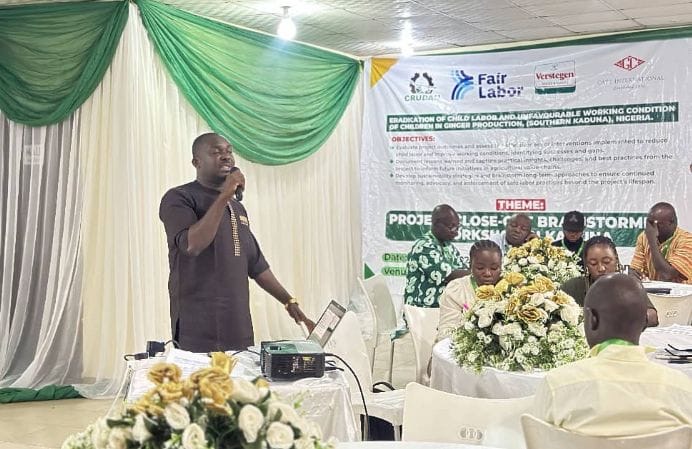
The call was made on Wednesday at the Project Close-Out Brainstorming Workshop on the Eradication of Child Labour and Unfavourable Working Conditions of Children in Ginger Production, organised by CRUDAN in partnership with the Fair Labor Association in Kaduna.
Mr Joseph Gyandi, CRUDAN Executive Director, said the project succeeded largely because communities embraced the intervention after initial resistance.
“The most significant achievement has been the change in attitude among community members.
“Initially, there was resistance, but through continuous engagement they came to understand that the intervention was designed to protect their children from hazardous activities and improve their opportunities, particularly in education,” Gyandi said.
He explained that many families initially feared that the project was intended to stop them from transferring farming knowledge from one generation to another.
“People thought we wanted to deprive them of practices inherited from their forefathers, but when they understood that the focus was on protecting children from hazardous work, they embraced the initiative wholeheartedly,” he added.
Gyandi said the project also provided an opportunity to restore confidence in ginger farming through the introduction of healthier ginger seedlings.
“The piloting of healthier ginger seedlings has rekindled hope that ginger farming can again become a reliable source of livelihood for many families,” he said.
Programme Manager of the Fair Labor Association, Dr Jean ean Appia, said awareness of child labour among respondents increased from about two per cent at the beginning of the project to around 87 per cent at the end.
“At the beginning of the project, only about two per cent of respondents were aware of what constitutes child labour, but by the end of the project, awareness had risen to around 87 per cent,” Appia said.
He noted that the project also strengthened the capacity of ginger producers in good agricultural practices and trained companies on human rights due diligence.
“The project equipped farmers with skills to better manage challenges such as ginger blight and trained companies on human rights due diligence, making their code of conduct more visible and accessible to community members,” he said.
Appia added that sustainability measures were integrated into the project from the design stage by involving companies, community members and other stakeholders in implementation.
CRUDAN Project Coordinator, Mr Michael Agon, said official data showed significant improvement in school retention and labour monitoring.
“The project recorded significant progress in child labour awareness, school retention and economic empowerment among ginger-producing households,” Agon said.
He disclosed that farmers informed about child labour increased from six per cent at baseline in 2023 to 87 per cent at endline in 2026.
According to him, workers below the age of 14 on farms dropped to zero, while school enrolment of identified children increased from 38 per cent to 70 per cent.
Agon further stated that access to financial services through Village Savings and Loan Associations increased from 10 per cent at baseline to 51 per cent at endline.
“We will continue to work with community structures and extension services to ensure that the gains recorded under the project are sustained,” he said.
Mr David Jonathan, an agricultural extension officer covering the Southern Kaduna Zone, described the intervention as highly effective.
“The baseline and endline surveys show clear improvement in the selected communities, and the training has contributed positively to ginger production and awareness on child labour issues,” Jonathan said.
Chief Executive Officer of Shade of Women Ltd., Mrs Deborah Apochi, said the project helped parents understand that children should remain in school and only be assigned age-appropriate tasks.
“We will continue promoting child labour-free ginger production through school-based awareness programmes, scholarships for vulnerable children and sustained community engagement,” she said.
Mrs Ladi Musa, a female farmer from Fai community, commended the organisers for the successful implementation of the project.
“The project has helped many of us understand better farming practices, and we have seen improvements in our ginger production,” she said.
She, however, appealed to the government to intensify efforts to tackle insecurity and ginger disease outbreaks affecting rural farmers.
The News Agency of Nigeria (NAN) reports that the workshop also reviewed strategies for sustaining child labour monitoring, community awareness and safe labour practices beyond the lifespan of the project. (NAN)
Edited by Yakubu Uba