


By Isaac Aregbesola
The Chairman of the Independent Corrupt Practices and Other Related Offences Commission (ICPC), Dr Musa Aliyu, SAN, has called for stronger collaboration between Parliament and anti-corruption agencies to successfully fight corruption.
Aliyu made the call on Thursday in Abuja at a One-Day Interactive Session on “The Role of Parliamentarians in the Fight Against Corruption.”
The ICPC boss maintained that “no anti-corruption agency can succeed in isolation, hence, there is need for support from all stakeholders.”
He identified corruption as one of the greatest impediments to Africa’s development and continued to “divert scarce public resources, weaken institutions, impair service delivery, discourage investment and erode public confidence in government.”
The chairman stated that effects of corruption were visible in “abandoned infrastructure, underperforming healthcare and educational systems, and diminished economic opportunities.”
According to him, addressing the challenges require collective commitment, resilient institutions and sustained political will.
Aliyu noted that, “while the ICPC is mandated to fight corruption through enforcement, prevention and public education, Parliament holds a uniquely strategic position in the fight.
“The constitution entrusts Parliament with three critical responsibilities that are indispensable to effective anti-corruption governance – lawmaking, appropriation and oversight.”
He urged lawmakers to ensure continuous legislative reforms to match the evolving nature of corruption.
“As corruption evolves through technological innovation, increasingly sophisticated financial crimes and emerging governance challenges, our laws must evolve accordingly,”Aliyu stated.
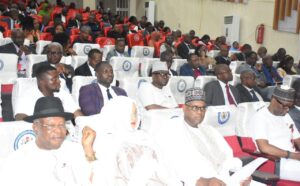
A cross section of particpants during a strategic high-level program focused on the Role of Parliamentarians in the Fight Against Corruption and the Launch of the Joint Tracking Report Conducted with Ministry of Works at the ICPC headquarters in Abuja in ThursdayOn budgeting, the ICPC boss, said that transparency was key to delivering development, and described the commission’s Constituency and Executive Projects Tracking Initiative (CEPTI) as a partnership tool.
“CEPTI is not intended as an adversarial mechanism or a witch-hunt against legislators, rather, it is a collaborative initiative designed to ensure that constituency and executive projects are properly implemented,”he explained.
Aliyu further called on parliamentarians to provide moral leadership, saying that their conduct shapes public attitude towards integrity and accountability.
The Senate Committee Chairman on Anti-Corruption and Financial Crimes, Sen Emmanuel Udende, said that fighting corruption requires collective action, not just anti-corruption agencies.
Represented by his Chief of Staff, Hon. Tsumbu Michael, he stressed that parliament must lead through legislation, oversight, and accountability to protect public trust and resources.
Udende urged technology-driven reforms to tackle digital fraud and illicit flows, stressing that parliament must adopt e-procurement, open data, whistleblower protection, and integrity education to prevent corruption and strengthen democratic governance.
He pledged the senate support for ICPC’s preventive work and project tracking, noting that, “sustainable progress depends not merely on punishment, but on prevention,”he said.
The committee chairman therefore called for stronger institutions and public trust.
Also in his goodwill message, the Chairman of the House Committee on Anti-Corruption, Hon. Kayode Akiolu, pledged the legislative support for ICPC in its war against corruption.
The Minister of Works, Sen. David Umahi, in a keynote address, called for review of existing anti-corruption laws to close loopholes that encourage corruption.
“Members of Parliament must continually review existing laws, close negative proposals that encourage corruption, strengthen anti-corruption institutions, and enact legislation that promotes transparency and equitability for all people,”he said.
He noted that corruption was beyond misappropriation of funds, which required collaborated efforts to deal with.
“Corruption is not only a misappropriation of public policy; it is also an assault on justice, equity, and the confidence of citizens. When we distort the information on social media, it is also corruption.”
The minister also cautioned that oversight must not be seen as confrontation.
“Oversight should never be reduced to a confrontational matter. It should be a constitutional mechanism for ensuring that public funds are utilised effectively,”he said.
Goodwill messages were delivered by the representatives Code of Conduct Bureau, the Economic and Financial crimes Commission, Nigeria Financial Intelligence Unit, Bureau of Public Procurement among others. (NAN)(www.nanew.ng)
Edited by Remi Koleoso



Comments