







By Vivian Emoni
The Federal Government says Nigeria’s trade sector has recorded remarkable expansion, while efforts are ongoing to ensure investments translate into real economic activities.
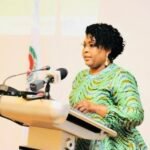
The Minister of Industry, Trade and Investment, Dr Jumoke Oduwole, disclosed this in an interview with the News Agency of Nigeria (NAN) Abuja on Tuesday, while responding to questions on trade and investment trends.
Oduwole said that merchandise trade value increased significantly between 2023 and 2025, supported by stronger exports and improved economic activities.
She noted that according to the National Bureau of Statistics (NBS) the country recorded merchandise trade values of N66.8 trillion in 2023, N138 trillion in 2024 and about N149 trillion in 2025.
”These are nominal Naira values, so part of that increase reflects exchange-rate movements and valuation effects.
”We should not present the entire increase as a corresponding rise in physical trade volumes.
”The more important structural trend is that Nigeria has maintained a positive merchandise trade balance across recent periods, with exports outperforming imports; though crude oil still accounts for a substantial share of export earnings,” she said.
The minister also said that in the 2025 fourth quarter, total merchandise trade stood at N36.21 trillion, with exports of N18.96 trillion and imports of N17.25 trillion.
”On volume, we need to be statistically precise. There is no economically meaningful single tonnage figure for total merchandise trade.
”This is because Nigeria trades crude oil, gas, vehicles, machinery, agricultural commodities and thousands of other products measured in different physical units.
”The NBS therefore reports aggregate trade principally by value and provides quantities at commodity level. Where we do have a clean physical-volume series is non-oil exports,” she explained.
Oduwole further said that the Nigerian Export Promotion Council (NEPC) reported that non-oil export volume increased from 7.29 million metric tons in 2024 to 8.02 million metric tons in 2025, a 10 per cent increase.
”So, the overall picture is one of significantly higher trade values, sustained trade surpluses and encouraging non-oil export growth.
”Our task now is to deepen value addition so that Nigeria exports more processed and manufactured products, rather than relying excessively on raw commodities,” she added.
The minister cautioned that nominal increases should not be interpreted entirely as growth in physical trade volumes due to exchange rate effects.
She said that Nigeria’s trade balance remained positive, with exports exceeding imports across recent reporting periods.
She also said the government was prioritising policies that would encourage manufacturing, processing and higher-value exports.
Oduwole noted that non-oil export volume increased by 10 per cent, moving from 7.29 million metric tons in 2024 to 8.02 million metric tons in 2025, showing progress in efforts to diversify Nigeria’s export base.
On investments, the minister said the government was moving beyond celebrating investment announcements to monitoring actual implementation.
She said about 50 billion dollars in investment announcements had been recorded, with over six billion dollars in inflows since 2024.
According to her, at the ministry level, our latest reporting refers to more than 50 billion dollars in investment announcements and over 6 billion dollars in investment inflows since 2024.
”Separately, the NBS recorded 10.37 billion dollars in total capital importation in 2026 first quarter. However, that 10.37 billion dollars is overwhelmingly portfolio capital, 9.86 billion dollars was portfolio investment.
“The Foreign Direct Investment (FDI) component stood at 135.08 million dollars.
”The pipeline is strengthening, investor interest is rising, and our responsibility is to convert that pipeline into productive, long-term capital.
”That is exactly why we are focused on investment facilitation and retention. The real work begins after an investor announces an intention to invest,” she said.
Oduwole explained that investments must pass through several stages before becoming operational.
She listed the stages to include approval processes, financial closure, equipment importation, construction and production as key in investment actualisation.
She said that the government’s assessment of investment success was based on capital deployment, industrial expansion, job creation and technology transfer.
The minister said the country’s investment pipeline remained strong, but the priority was ensuring commitments translated into productive ventures.
She said the administration remained committed to improving investor confidence and converting opportunities into sustainable economic growth.(NAN)(www.nannews.ng)
VOE/DCO
======
Edited by Deborah Coker