







By Perpetua Onuegbu
A coalition of Civil Society Organisations and trade unions have called for accountable implementation of Nigeria’s tax laws and increased investments in public services.
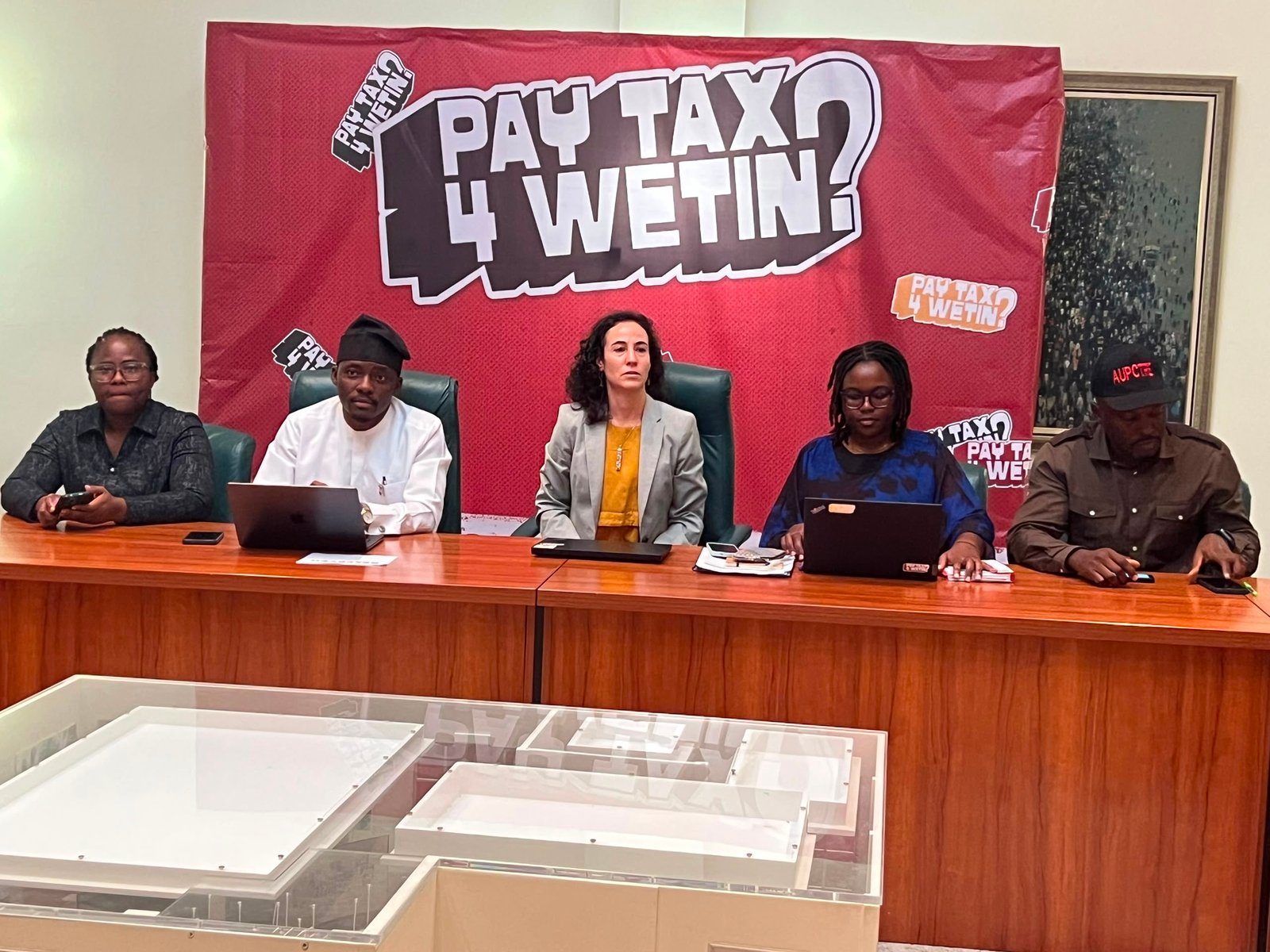
The coalition, comprised of Global Initiative for Economic, Social and Cultural Rights- GI-ESCR, Tax Justice and Governance Platform, Connected Development and Gatefield made this call at a news conference on Thursday in Abuja.
According to the coalition, the conference was to launch the ‘#PayTax4Wetin’ campaign which aims to promote accountable implementation of Nigeria’s tax reforms.
The News Agency of Nigeria (NAN) reports that the coalition unveiled the campaign after a policy dialogue on funding quality public services and strengthening public trust in Nigeria’s tax laws.
Ms. Camila Barretto, Executive Director, Global Initiative for Economic, Social and Cultural Rights (GI-ESCR), said the campaign supports transparent and effective implementation of the new tax framework introduced in January 2026.
Barretto who read a joint statement by the coalition, said the reforms aim to improve revenue mobilisation, streamline tax administration and strengthen Nigeria’s business environment.
She noted that the laws also introduced stronger corporate taxation, including measures targeting multinational companies and digital businesses operating in Nigeria.
The GI-ESCR executive director noted that successful implementation would determine additional revenue generation, improved compliance and reduced harmful tax exemptions and incentives.
Also speaking at the launch, Chika Okoh, Senior Programme Coordinator, International Budget Partnership, Tax Justice and Governance Platform, urged federal, state and local governments to coordinate implementation.
“Government can coordinate implementation while providing regular public information to enhance transparency and accountability.
“Transparency would enable citizens and civil society to monitor implementation, identify gaps and support institutions in achieving reform objectives.”
Okoh expressed concern that many Nigerians still privately fund healthcare, education, water, energy and transportation in spite of paying taxes.
She argued that additional tax revenue should improve public services, create jobs, reduce poverty, empower women and expand opportunities for young people.
Okoh described Nigeria as Africa’s most populous country, saying successful implementation could provide lessons for other African countries pursuing equitable domestic revenue reforms.
On his part, Mr Stephen Akinfala, Communications Manager, Connected Development (CODE) demanded for publication of tax revenue, compliance data, tax incentives and multinational corporations’ financial disclosures to curb tax avoidance.
He also called for stronger taxation of digital companies, effective enforcement of minimum corporate tax rates and improved oversight through an independent Tax Ombuds Office.
The coalition, therefore, urged government to protect education, health, water and energy spending while adopting transparent, citizen-focused systems for monitoring public expenditure.
It said the #PayTax4Wetin campaign seeks assurance that tax revenue would translate into improved schools, hospitals, public services and better living standards for Nigerians.
Responding to the question on timelines for the implementation, the coalition said implementation timelines vary, with some reforms requiring longer periods.
Mr Chinedu Bassey, GI-ESCR Advocacy and Political Engagement Consultant, added that transparency and public participation measures could begin quickly through political will and sustained civil society monitoring.
He said the #PayTax4Wetin campaign would extend nationwide through partner organisations, trade unions, advocacy, sensitisation, capacity building and social media to reach grassroots communities.
The coalition maintained that government implements reforms while civil society monitors accountability, promotes tax education, tracks monthly allocations and works with nationwide networks to improve public understanding and service delivery.(NAN)(www.nannews.ng)
Edited by Francis Onyeukwu