









By Ibukun Emiola
Mr David Afolayan, Chairman, Geoinformation Society of Nigeria (GEOSON), Oyo State Chapter, has called for greater deployment of geospatial intelligence and stronger collaboration to combat human trafficking and protect vulnerable communities.
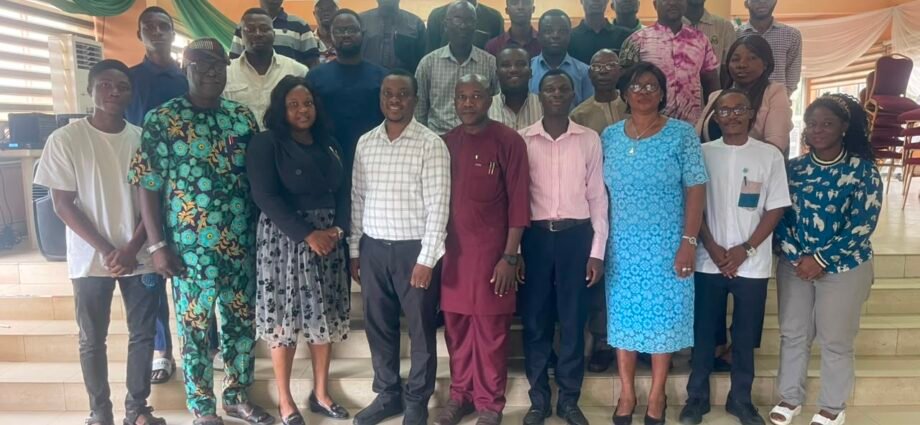
Afolayan made the call in Ibadan on Tuesday at a roundtable organised by the society to commemorate the United Nations World Day Against Trafficking in Persons in Ibadan.
Speaking on the theme, “Preventing Human Trafficking and Protecting Vulnerable Communities,” he said this year’s global theme, “Trapped Behind the Scam,” was apt.
Afolayan, who is also the Chief Executive Officer of GIS Konsult Ltd., Ibadan, highlighted the growing use of fraudulent job offers, online recruitment, false promises and organised criminal activities to lure victims into trafficking.
According to him, geospatial professionals have a critical role to play in identifying vulnerable communities, mapping trafficking routes, exposing recruitment fraud, supporting early-warning systems and strengthening coordinated interventions.
“Today, we move beyond awareness to action by asking an important question: How can knowing ‘where’ help protect lives?
“This gathering provides an opportunity to share practical experiences, deepen collaboration and develop solutions that can protect lives,” said Afolayan said.
The experts at the roundtable also advocated the use of geospatial intelligence, stronger institutional collaboration and socioeconomic interventions to tackle human trafficking.
They said technologies such as Geographic Information Systems (GIS), remote sensing, Global Positioning System (GPS), spatial analysis and artificial intelligence could help identify trafficking hotspots, vulnerable communities, recruitment locations and movement routes.
A former Head of the Department of Urban and Regional Planning, Lead City University, Dr Ademola Adeyemi, said geospatial intelligence could strengthen decision-making, improve resource deployment and support rescue operations.
“There is the need for stronger inter-agency collaboration and data sharing to enhance efforts aimed at preventing child trafficking and protecting vulnerable communities,” Adeyemi said.
Also speaking, a Full-Stack Geospatial Engineer with GIS Konsult Ltd., Mr Victor Eluyera, warned that fake job offers and recruitment fraud had become major gateways to human trafficking.
He urged job seekers to verify employers’ registration, official contact details and physical addresses before accepting offers or travelling.
Eluyera also advised applicants never to pay to secure employment and to share their travel plans and destinations with trusted persons.
“GIS can support address verification, scam-location mapping, geotagged reporting and trafficking-route analysis,” Eluyera said.
In her presentation, Mrs Eegunyemi Adepeju, a surveyor and Managing Director, Right Time Surveys and Engineering Ltd, said poverty, unemployment, gender inequality and limited access to education continued to expose many people to trafficking.
She called for livelihood support, quality education, safe migration pathways, stronger child welfare systems and women’s economic empowerment to reduce vulnerability.
Presenting a geospatial and policy research report, Surveyor Rasheed Babatunde Adesoji said Nigeria remained a source, transit and destination country for human trafficking.
He identified poverty, weak law enforcement, corruption, conflict and fraudulent employment offers as key drivers of trafficking.
“I recommend the integration of GIS, remote sensing, unmanned aerial vehicles, GPS and community surveys to identify trafficking hotspots and movement routes, while advocating intelligence-led security operations,” Adesoji said.
Similarly, the Director of Strategic Infrastructure, Rural Development and Project Management in the Oyo State Ministry of Lands, Housing and Urban Development, Mrs Adetola Omofuma, said poor planning, poverty and weak public services created conditions that enabled trafficking.
She noted that inclusive planning, improved infrastructure, community participation and economic empowerment were essential to building safer and more resilient communities. (NAN) (www.nannews.ng)
Edited by Bayo Sekoni