


Global economic shifts are reshaping trade patterns, investment flows and development priorities.
Against this backdrop, stakeholders have urged African countries to build resilience, strengthen regional cooperation and pursue policies that support sustainable growth.
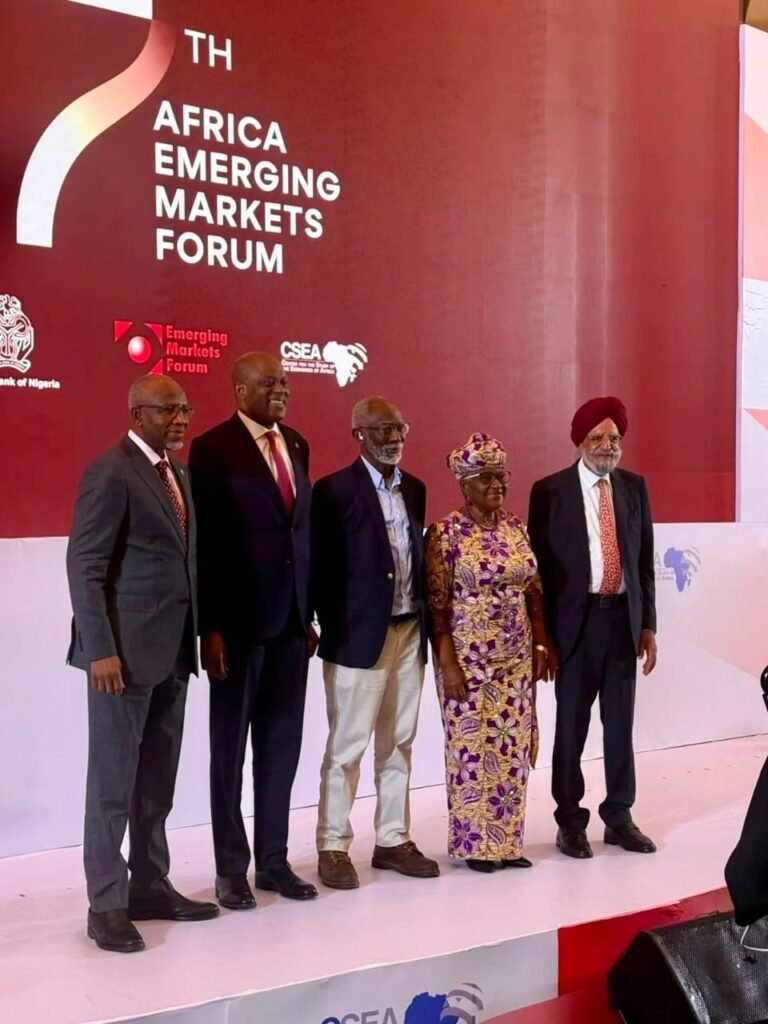
The call was made at the 7th Africa Emerging Markets Forum held in Abuja from July 29 to July 30, where policymakers, economists and business leaders discussed strategies for enabling Africa to play a stronger role in the global economy.
The forum, organised by the Central Bank of Nigeria (CBN), Emerging Markets Forum (EMF) and the Centre for the Study of Economies of Africa (CSEA), was themed: “Building Resilience Amidst Geoeconomic Uncertainties”.
The Emerging Markets Forum, established by the Centennial Group, brings together government and corporate leaders from emerging economies to examine economic, financial and social issues affecting developing countries.
The Abuja edition focused on how African economies could respond to changing global realities, including shifting trade patterns, geopolitical tensions, climate change and technological advancement.
The forum featured contributions from key stakeholders, including CBN Governor Yemi Cardoso, Director-General of the World Trade Organisation (WTO), Dr Ngozi Okonjo-Iweala, and Minister of Finance and Coordinating Minister of the Economy, Mr Taiwo Oyedele.
Others were EMF Founder and Chief Executive, Harinder Kohli, and Executive Director of the Centre for the Study of the Economies of Africa (CSEA), Dr Chukwuka Onyekwena.
Cardoso said the global economic system was undergoing significant changes, adding that Africa must turn emerging challenges into opportunities for growth.
He said trade was becoming more uneven, capital was becoming more selective, and countries were continuously reorganising critical supply chains around strategic partnerships.
“The global system that has long shaped relations among nations is changing before our eyes.
“Trade is becoming more uneven, capital is becoming more selective and impatient, and the long-standing rules-based international system is being stretched and tested,” Cardoso said.
According to him, Africa’s challenge was no longer whether the global order was changing but how the continent could benefit from the transformation.
“For Africa and other emerging markets, the question is no longer whether the global order is changing, but how to turn that change from a source of vulnerability into one of growth and shared prosperity,” he said.
Cardoso stressed the need for stronger intra-African trade, noting that the continent must increase production capacity and develop regional value chains.
“With intra-African trade still accounting for only about 16 per cent of our total trade, we must build stronger regional value chains, produce more of what we consume and trade more with one another,” he said.
He said the African Continental Free Trade Area (AfCFTA) provided an opportunity for the continent to benefit from changing global economic realities.
“The African Continental Free Trade Area provides the platform and opportunity to turn this global shift to Africa’s advantage,” the CBN governor said.
He, however, noted that African countries must move beyond agreements by removing practical barriers affecting trade, including poor transport networks, customs challenges and inefficient payment systems.
Meanwhile, Cardoso said Africa must also reduce overdependence on foreign capital by mobilising domestic resources.
“The era of abundant liquidity chasing returns regardless of risk is over. Investors now have more choices and less tolerance for uncertainty,” he said.
He added that economies that attract investment were those with credibility, transparency, policy consistency and strong institutions.
On her part, Okonjo-Iweala said the world economy was experiencing a shift from cooperative interdependence to competitive interdependence.
She said the global system created after the Second World War to promote stability and prosperity was facing major disruptions.
“The hope that global economic integration would produce geopolitical harmony may have failed, at least for now,” she said.
The WTO director-general, however, said the situation presented an opportunity for countries to strengthen global trade rules.
She noted that in spite of current uncertainties, a significant proportion of world trade continued to operate under WTO frameworks.
Okonjo-Iweala also urged African countries to process their critical minerals locally instead of exporting them in raw form.
She said Africa’s resources could support industrial development, including the production of electric vehicle batteries and other green energy technologies.
According to her, “Africa must take advantage of the critical minerals in the continent to produce goods that can make it a major player in the global green energy revolution.”
Oyedele said Nigeria’s economic reforms had moved into a phase focused on delivering tangible benefits to citizens.
He said the objective was no longer only to achieve macroeconomic stability but to ensure that reforms translated into investment, jobs and improved household incomes.
“Macroeconomic stability alone is insufficient if it fails to improve living standards,” Oyedele said.
“Our task now is converting that stability into investment, investment into productivity, productivity into decent jobs, and decent jobs into incomes that Nigerian families can actually feel in a tangible way,” he added.
Also speaking, Kohli said Africa must strategically position itself to benefit from ongoing changes in the global economy.
“The central question before us is not whether the global economy is changing. It clearly is.
“The challenge is how Africa positions itself to seize the opportunities emerging from this transformation,” he said.
Onyekwena said Africa was at a defining moment as global developments continued to reshape economic relations.
“Our challenge is not merely to withstand change, but to shape it.
“Our objective is not merely to build resilience, but to build prosperity,” he said.
At the conclusion of the forum, participants highlighted Africa’s young population, growing consumer markets, natural resources and entrepreneurial capacity as major advantages that could support economic transformation.
They, however, stressed the need for governments to move from policy discussions to concrete actions that would improve trade, investment and regional cooperation.
Stakeholders noted that Africa’s ability to benefit from the changing global economy would depend on effective policies, strong institutions and sustained commitment to implementation. (NAN)
Edited by Tosin Kolade
Comments