







By Philomina Attah
The Federal Government says Nigeria’s mango industry can drive food security, create jobs and export earnings if stakeholders embrace innovation, climate-smart practices and unity.
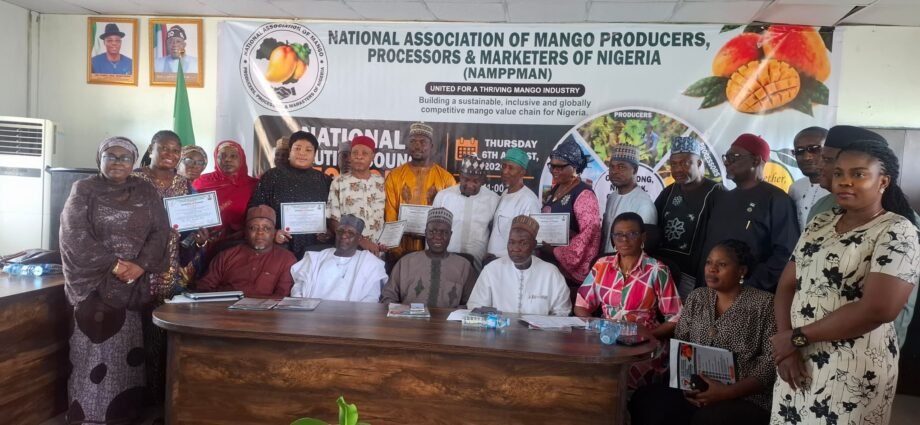
The Minister of Agriculture and Food Security, Sen. Abubakar Kyari, stated this on Thursday in Abuja during the election and inauguration of new executives of the National Association of Mango Producers, Processors and Marketers of Nigeria, (NAMPPMAN).
Kyari, represented by Deputy Director, Horticulture, Hajiya Afusatu Babalda, said mango remained one of the most important horticultural crops with potential to boost farmers’ income and expand export opportunities.
“The election of new executives is not merely a change in leadership but an opportunity to strengthen unity, promote innovation, and advance the collective interests of everyone in the mango value chain,” he said.
The Minister urged the new leadership to lead with integrity and focus on improved production, quality standards, value addition and market access in order to turn Nigeria’s mango industry into billions of naira.
He added that the ministry would continue to support initiatives on modern technology, extension services and access to finance.
Also speaking, the Director, Department of Climate Change, Federal Ministry of Environment, Dr Iniobong Adiola-Awe, said climate change was threatening mango productivity through erratic rainfall, flooding and pest outbreaks.
Adiola-Awe, represented by Dr Asmau Jibril, urged NAMPPMAN to institutionalise climate action, champion climate-smart agriculture, and invest in sustainable processing and storage to reduce post-harvest losses.
“Through sound governance and well-prepared climate-responsive projects, NAMPPMAN can attract climate finance to strengthen resilience and expand business opportunities,” she said.
Reflecting on his administration’s tenure, NAMPPMAN‘s outgoing National President, Abdulkadir Nasir, recounted international exposure programmes organised across Ghana, Kenya, Austria, and Singapore to benchmark best global practices.
”Egypt produces approximately 1.5 million metric tonnes of mangoes annually in spite of being a Saharan nation relying on canal irrigation.
“Nigeria currently produces about one million metric tonnes across 120,000 hectares.
Nasir said Nigeria produces about 1 million tonnes from 120,000 hectares and can surpass Egypt’s 1.5 million tons with improved varieties.
“With improved varieties and professional orchard management, our nation can easily surpass five million metric tonnes per year,” he added.
Nasir called on the incoming executive team to lead with unity, likening the association to a forest formed by individual trees coming together.
In his inaugural address, the association’s newly elected National President, Dr Garba Kangiwa, announced a shift from traditional orchard management to an advanced, tech-driven industrial ecosystem.
”Today we begin a new chapter. Our mission is clear. We must transform Nigeria’s mango industry from one characterised by massive post-harvest losses into a globally competitive value chain.
“This will create wealth, generate employment, attract foreign investment, and position Nigerian mangoes among the finest internationally,” he said.
Highlighting the socioeconomic impact of commercial mango cultivation, Kangiwa demonstrated how every part of the mango tree yields economic value.
”Mango seed kernels are already being processed into rich cosmetic creams by local women, while organic farm waste is being recycled into high-grade organic fertiliser,” Kangiwa explained.
He noted that smallholder farmers can overcome the financial lag of establishing new orchards, which typically take three to four years to bear fruit.
He explained that this is done by employing expert-guided inter-cropping techniques with short-term cash crops like vegetables to maintain steady cash flow.
“History will not judge us by the promises we make, but by the transformation we deliver. Together, let us unlock the immense potential of Nigeria’s Green Gold.”
Echoing a similar vision, the association’s newly elected National Secretary, Chief Oji Aso’a, referred to mango farming as a hidden economic powerhouse second only to crude oil in overall commercial potential.
”With targeted support from government institutions like the Ministries of Agriculture, Environment, Trade and Investment, and Science and Technology, post-harvest losses can be significantly curtailed.
“By empowering youth and women with 5,000 to 10,000 high-yield seedlings per state, we can build export capacity within two years,” he said.
Issuing certificates of return to the new executive council across the six geopolitical zones, Chairman, NAMPPMAN’s Board of Trustees (BOT), Mr Goni Ahmed, emphasised the dual environmental and economic dividends of the crop.
”There is no single state in Nigeria where mangoes do not thrive.
“Expanding our orchards does not only create wealth; it actively combats desertification, prevents soil erosion, and mitigates climate change impact.”
Ahmed charged the newly sworn-in leadership to operate with transparency, protect the trust of smallholder farmers, and steer the association toward lasting economic self-reliance.
Ahmed also urged the association’s new executives to put the association “in good light for the benefit of Nigeria.”(NAN)(www.nannews.ng)
Edited by Mark Longyen