


By Martha Agas
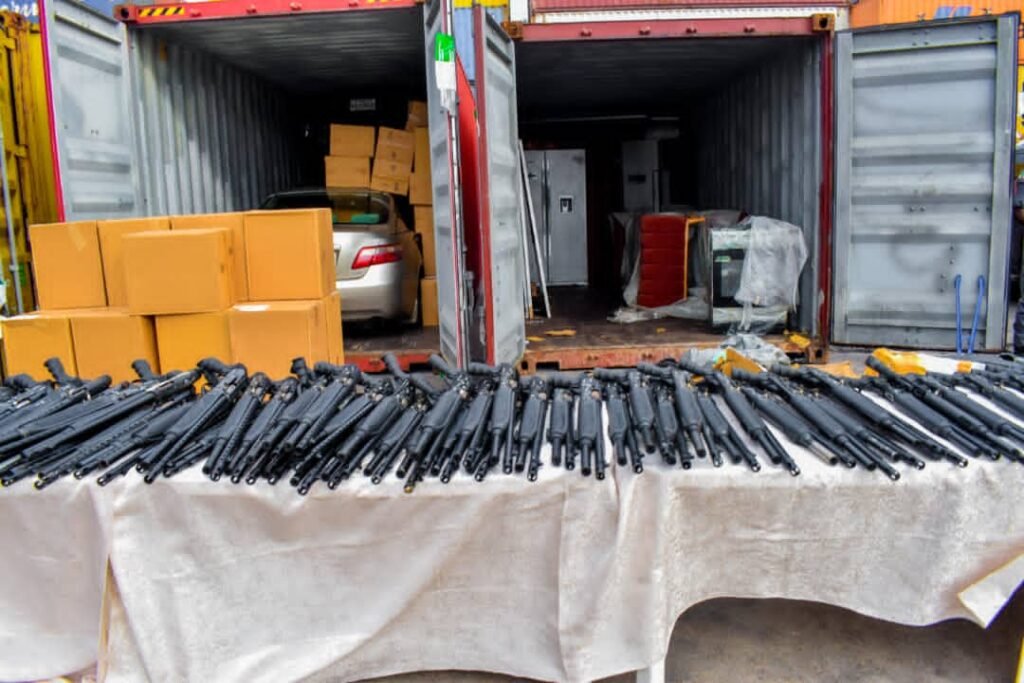
Some experts have called on relevant authorities to investigate the network behind the attempted importation of 399 rifles intercepted by the Nigeria Customs Service (NCS) at Tin Can Island Port in Lagos.
The News Agency of Nigeria (NAN) reports that the NCS on Sunday announced the interception of a container at the port containing concealed crates of knocked-down components identified as Jojef rifles with additional rifle parts.
The Comptroller-General(C-G) of NCS, Bashir Adeniyi, said the service would intensify surveillance and enforcement operations to curb the movement of illicit arms and other prohibited items through Nigeria’s entry points.
A consultant on international trade, Mr Okey Ibeke, said the seizure should be treated not merely as a routine customs interception but as an intelligence opportunity to uncover a broader arms-trafficking network.
Ibeke, Principal Consultant at International Trade Advisory Services, said investigations should be comprehensive and examine the entire supply chain considering the scale of the consignment.
He urged authorities to determine whether the shipment was an isolated incident or part of a wider illicit arms-trafficking operation, while also scrutinising associated documentation, financial transactions, and logistics arrangements.
He stressed the importance of Nigeria’s End-User Certificate regime for controlled arms and ammunition, calling for verification of whether the consignment lacked valid documentation, involved falsified records, or resulted from the misuse of legitimate permits.
“This makes the Tin Can seizure particularly significant, as authorities must establish how the consignment was presented for clearance and whether any regulatory processes were compromised,” he said.
Similarly, Mr Eugene Nweke, Head of Research at the Sea Empowerment and Research Centre (SEREC), described the interception as a serious national security concern and a critical intelligence opportunity.
Nweke advocated enhanced cargo risk management systems, improved port surveillance, strengthened intelligence sharing, financial investigations, and greater international cooperation to combat illicit arms trafficking.
He urged customs to sustain its intelligence-led enforcement strategy and continue supporting officers demonstrating professionalism in safeguarding Nigeria’s borders and trade corridors.
Meanwhile, the National Public Relations Officer of the NCS, Mr Abdullahi Maiwada, said the service had adopted geospatial intelligence as part of efforts to strengthen enforcement operations.
Maiwada said that scanners installed at Apapa and Tin Can Island ports provide non-intrusive inspection capabilities for cargo examination.
“We are also developing risk-management tools for our clearance platform,” he said.
He added that these measures were designed to enhance the service’s ability to detect and intercept high-risk consignments while facilitating legitimate trade.
NAN reports that the seizure has renewed calls for stronger intelligence-led cargo monitoring and improved coordination among customs and security agencies to prevent the exploitation of Nigeria’s maritime gateways for illicit arms trafficking.
NAN recalls that the NCS’ Port and Terminal Multi-services Limited Areas Command in January handed over to the National Centre for the Control of Small Arms and Light Weapons some firearms and ammunition.
The items were seized between 2022 and 2025 including one Crossman Pumpmaster rifle, five pistols and assorted live and blank ammunition and magazines.(NAN)(www.nannews.ng)
Edited by Yakubu Uba



Comments