









By Bushrah Yusuf-Badmus, News Agency of Nigeria (NAN)
On Aug. 3, Elizabeth Olawoyin, a student of Government Day Secondary School, Agbabiaka, Ilorin, walked into the training room at UMCAT Chapel in Ilorin.
Olawoyin knew the digital world only from afar. She had never written code, studied Artificial Intelligence (AI), or learned how to use a computer.
But, five days later, she stood before an audience with other members of her team, presenting a technology-based solution to one of Nigeria’s most disturbing social problems, human trafficking. The transformation surprised even her.
“After five days, I am able to learn about data science, digital accuracy, python loops and effective use of Microsoft Excel.
“My parents already had the intention to enrol me in a computer centre to learn how to operate the computer, because of the introduction of CBT to the West Africa Examinations Council (WAEC) and I am in SS 2 already.
“So, when the invitation came through my school, I was happy, though I didn’t know it is something this serious we are coming to learn.’’
For Olawoyin, the bigger change was not the ability to write a line of python code, but the confidence that came with discovering that she could.
“Before the week-long “AI & Data Science for Her” bootcamp, I had never considered myself a computer user, much less someone capable of using AI and programming to think about solutions to problems in my community.
“Now, I am already thinking about how to pass the knowledge on when I get back to school,” she said.
Olawoyin’s story captures the central idea behind the intervention by an NGO, Tech Girls Club, that closing the digital gender gap is not only about putting girls in front of computers.
It is about giving them the skills, confidence and opportunity to see themselves as creators of technology rather than merely consumers of it.
The need for such intervention is reflected in global data. According to UNICEF, digital inclusion has become increasingly important for success in school, work and access to services, yet adolescent girls and young women remain particularly disadvantaged.
In its study, in low-income countries, 90 per cent of girls and young women aged 15 to 24 are offline, compared with 78 per cent of boys and young men in the same age group.
The study also found that for every 100 male youths with digital skills across the 32 countries and territories analysed, only 65 female youths had comparable skills.
Nigeria’s figures tell a similar story. The country’s digital skills parity ratio among young people aged 15 to 24 shows that only 69 female youths have digital skills for every 100 male youths who do.
The figures represent more than a statistical imbalance. Behind them are girls who may enter a future workplace with less exposure to the tools that increasingly determine who gets opportunities, who creates solutions and who participates in the digital economy.
This is a gap Tech Girls Club is attempting to confront before it becomes even wider.
For Wonderful Osalor, the Project Manager of Tech Girls Club and one of the people driving the “AI & Data Science for Her” project, the most striking part of the programme was watching the girls move from uncertainty to confidence.
“Some arrived without knowing how to operate a computer, but they are all leaving now, writing codes. I see students that came in not even knowing how to operate a computer, now writing programmes.
“That is such a huge leap for five days.”
She said the training though very intensive, the organisers were not simply interested in teaching them technical vocabulary. They wanted the girls to use technology to interrogate problems around them. And on the final day, that objective became visible.
“The girls were taken through digital literacy before progressing into areas including AI, data science, python programming, machine learning, Excel and data visualisation.
“Upon graduation, the girls presented solutions to problems ranging from unemployment and agriculture to corruption, drug-related challenges, human trafficking and online fraud.
“For me, watching the presentations was the defining moment of the programme, because the girls had been taught the basics. But, they then went beyond the classroom, researched problems they had observed around them and attempted to apply what they had learnt.
“People that we just introduced to these tools, to these concepts now took the concepts and turned it into full-fledged solutions; that, for us is the real measure of success,” Osalor said.
For some of the girls, the training expanded skills they already possessed.
Modibbo Zainab, an SS2 student from GDSS Tanke, had previously encountered coding through STEM-related programmes in Ilorin. She had learnt HTML, CSS and JavaScript.
Python, however, was new to her. So was the possibility of using AI and data science to address a problem as complex as food distribution.
Her team identified inadequate food distribution in Nigeria as a problem and imagined an AI-powered platform that could connect farmers and buyers while helping determine better routes for transporting farm produce.
Zainab explained the problem through something familiar: tomatoes. If a farmer transporting 50 baskets of tomatoes from a major producing area encountered bad roads or heavy traffic, much of the produce could spoil before reaching its destination.
“The consequences would spread from the farmer to the consumer; the farmer loses income, while consumers eventually pay more for the smaller quantity of produce that survives.
“My team’s idea was to use technology to identify traffic and road conditions and improve the movement of perishable goods.
“I have never imagined myself developing such a solution; the experience here was transformative.
“Now I wish to establish a Tech Girls Club in my school so I can teach other students what I learnt, because this kind of knowledge should not stop with me,” she said.
On her part, Ajibade Aminat, a student of Government Day, Gaa Akanbi, also arrived with some basic computer knowledge. She knew Microsoft Word and Excel and had encountered HTML and CSS, but Python programming was different.
By the end of the training, Aminat and her teammates had developed an AI scam detector as their response to the problem of online fraud.
“Before the bootcamp, I did not see myself designing such a solution. I have knowledge of animation and other things, but I never thought I could do something like this with computer programmes. Now, I see technology differently,’’ she said.
Aminat and Zainab’s experiences illustrate an important shift the organisers of the “AI Data Science for Her” hope to create, that is, moving girls from simply knowing that technology exists to understanding that they can use it to respond to challenges in their own communities.
For Dr Wilson Sakpere, a lecturer at Lead City University, Ibadan, Associate Investigator and Lead Facilitator of the programme, unequal access to educational opportunities and facilities could deepen the digital divide, particularly in underserved communities.
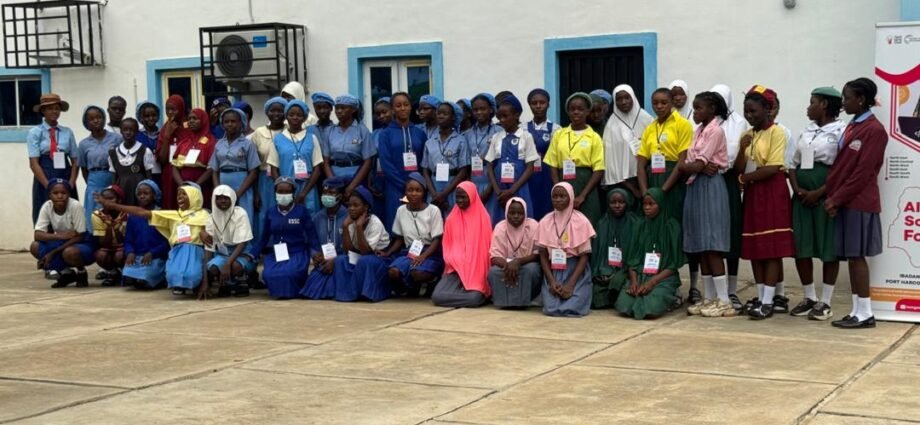
“The 51 participants in Ilorin were drawn from eight schools; four public and four private, and this was intentional in order to spread the reach of the programme for more girls.
“The male child seems to be given more advantage, especially when you go to the rural areas.
“The programme, therefore, seeks to introduce girls to Science, Technology, Engineering and Mathematics (STEM), AI and data science while they are still in secondary school, giving them time to build confidence and skills before they reach higher education and the workplace.
“The ultimate objective is for the girls to become capable of competing with anyone, regardless of gender,” he said.
The digital gender gap cannot, however, be closed through bootcamps alone, as all relevant stakeholders need to key in.
Prof. Patricia Etejere, a retired lecturer in the Department of Educational Management at the University of Ilorin, said the confidence demonstrated while presenting their projects showed the potential of early exposure to technology.
She also believed that the responsibility for closing the digital divide must extend beyond the government.
“Parents who can afford it can provide devices such as smartphones and laptops. Schools can also make computers available to students so they can practice regularly, while NGOs and other stakeholders can support such initiatives.
“The challenge is particularly important because skills cannot be sustained if girls return to environments where they have little or no access to computers,” she said.
For sustainability and continuity of the lessons learnt in the programme, Osalor said the long-term goal is for participants to return to their schools and establish AI and Data Science clubs.
She said the girls were expected to share what they have learnt with other students, creating a ripple effect beyond the original 51 participants.
However, the Ilorin programme representing the North Central Zone, is only one part of a wider plan as the Tech Girls Club intends to take the “AI & Data Science for Her” project to the other five geopolitical zones of Nigeria, with a target of reaching 300 girls, that is 50 girls from each zone.
The project, as sponsored by Neural Information Processing Systems, has its broader mission to encourage more girls to participate in STEM and to help them use technology not only to pursue technology careers but also to solve problems in whatever fields they eventually choose.
For Olawoyin, the girl who entered the bootcamp unable to operate a computer, returning to school will mean carrying something much bigger than a certificate.
Her team’s decision to tackle human trafficking may not have produced a finished solution.
But a girl who once had no computer skills was encouraged to look at a problem in society and ask: Can technology help solve this? That question is precisely where the digital gender gap begins to change.
For the organisers, the hope is that Olawoyin will not remain the only girl in her school asking that question, nor will Zainab, who wants to establish a technology club.
Aminat also wants to teach others about programming, joining the dozens of other girls who spent five days discovering that AI, Python, and data science are not exclusively the language of boys or technology experts.
They are returning to their schools not only as learners, but also as potential teachers, innovators and problem-solvers.
Observers say the 51 girls in Ilorin are only the beginning. If the plan works, they will start a chain reaction, with each student teaching the next until the digital gender gap begins to shrink.(NANFeatures)
Edited by Chijioke Okoronkwo
***If used, please credit the writer and the News Agency of Nigeria.