


By Jumoke Olaitan
The Minister of Education, Dr Tunji Alausa, has called for the implementation of 80 per cent practical training in agricultural curricula for polytechnics and Colleges of Education.
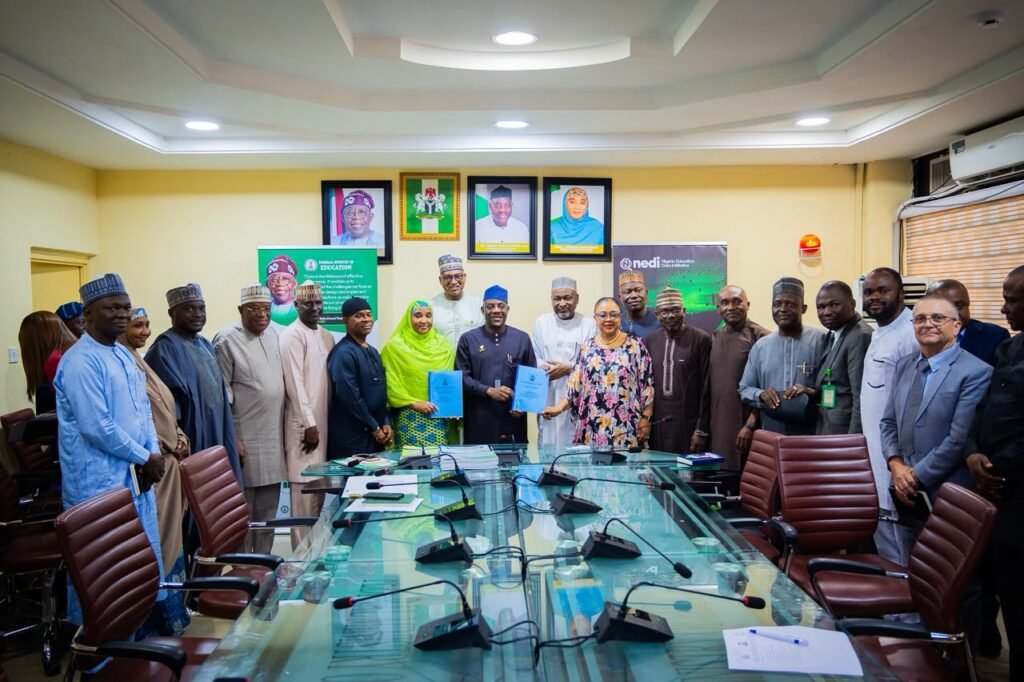
Alausa made the call on Thursday in Abuja while receiving the report of the committee on the implementation of the reviewed agriculture curricula for the institutions.
He said the shift from the previous 70 per cent theoretical and 30 per cent practical model to 80 per cent practical and 20 per cent theory would equip Nigerian youths with relevant skills for the agricultural sector.
“We’re not turning our input into output. And the major reason why we’re not turning our input into output was because these kids were poorly trained.
“You have a lot of schools that have agricultural programmes.
“They don’t even have demonstration farms in their schools. And even if they had demonstration farms, the content they were being taught did not meet the content of today.
“And what we were doing then was also, we’re not training these students, and then telling them these programmes are being delivered to them as a skill-based training. And that was what got to this,” he said.
He expressed optimism that the new approach would produce a better-trained workforce, strengthen capacity in agriculture and translate training into productive activities that would contribute to national development.
Alausa stressed that the objective was to ensure that young Nigerians acquired practical skills that could be applied beyond the classroom.
“The three major reasons why we had to review the curriculum of agriculture in colleges of education is because previous curriculum was mostly theory-based, not competency-based.
“The curriculums were antiquated, and those training was not done in a way at the level of skill-directed training.
“And what did we have? We got graduates coming out that were ill-trained, ill-equipped, and not prepared to help improve our food security in the country,” he said.
He also called for a comprehensive rollout of the new curricula, including sensitisation of industry players, academics, teachers and other stakeholders on the rationale behind the reforms.
The minister emphasised the need for adequate teacher training and other support to enable institutions to implement the curricula effectively.
He said the reform was in line with President Bola Tinubu’s commitment to advancing agriculture as a skills-based sector and promoting youth participation in the sector.
“You know, as one of the pillars of President Bola Tinubu, the new agenda is food security.
“And we’re seeing that the president invested enormously in agriculture, investing in farming inputs, tractors, seedlings, and also bringing security to our farmlands across various parts of the country.
“Today, farmers are back to farm, producing food, and also contributing to their local economy, giving them decency of life.
“But then, if we now look at our total agricultural output in this country, you’ll be shocked to know that 80 per cent of our agricultural output is still from subsistence farming.
“The mechanised farming contribution to our food output is just 20 per cent. We can’t continue this way.
“And that’s why we need to change the people we’re training at our polytechnics and colleges of education. And I’m extremely happy today.”
He assured that the ministry would work with NBTE, institutions, industry and other stakeholders to ensure effective implementation of the reviewed curricula.
Earlier, the Minister of State for Education, Prof. Suwaiba Ahmad, commended the committee for its commitment to the review.
Ahmad acknowledged the contributions of the National Board for Technical Education (NBTE), Skills Council, industry representatives and academics to the process.
She expressed optimism that the reviewed curricula would produce visible results in the agricultural sector, stressing the need for stakeholders and the public to be properly engaged on the reforms.
Presenting the report on behalf of the committee, NBTE Executive Secretary, Prof. Idris Bugaje, said the exercise produced 36 new and reviewed National Diploma (ND) and Higher National Diploma (HND) curricula, three National Certificate in Education (NCE) curricula and 31 National Occupational Standards.
Bugaje said 27 of the occupational standards were developed from scratch, while four existing standards were reviewed.
He said the assignment had been completed, with the resulting documents considered and approved by the relevant regulatory bodies, including the Board and Commission.
According to him, the complete set of curricula will be formally presented at a later public event.(NAN)(www.nannews.ng)
Edited by Funmilayo Adeyemi


Comments