



By Abbas Bamalli
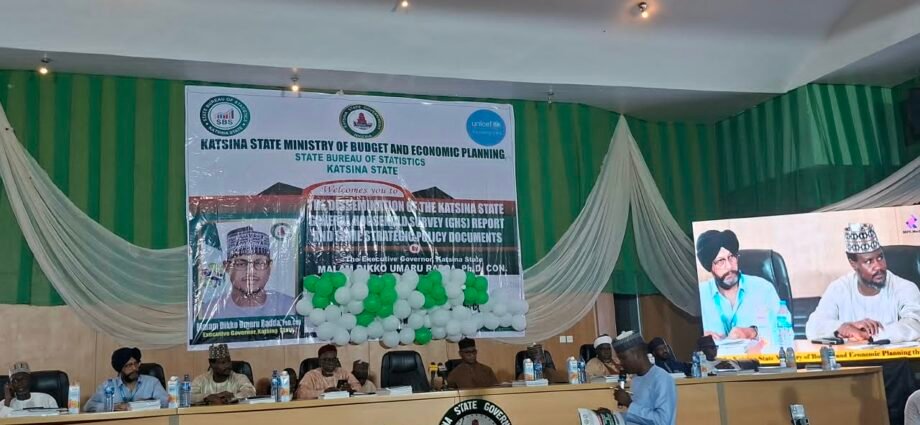
Gov. Dikko Radda of Katsina State has launched the state’s General Household Survey (GHS) Report to strengthen evidence-based planning and improve service delivery.
Radda, represented by his Deputy, Alhaji Faruq Jobe, said the survey provided comprehensive household-level data covering all 34 local government areas of the state.
According to him, the report contained critical information on household welfare, poverty, employment and livelihoods, agriculture, education, health, housing, water, sanitation and hygiene, access to basic services and social protection.
He said the survey would enable the government to move away from assumptions and design development interventions based on credible evidence and the actual needs of citizens.
“Development interventions will increasingly be targeted using credible data. Resources will be allocated where they are needed most, while performance will be measured objectively,” he said.
Radda said the report represented one of the administration’s significant achievements in institutionalising evidence-based governance and strengthening statistical systems across the state.
He said every Ministry, Department and Agency (MDA) would be expected to use statistical evidence in preparing policies, strategic plans, annual budgets and monitoring frameworks.
The governor pledged continued support for the Katsina State Bureau of Statistics to produce timely, quality and internationally comparable statistics for effective planning and decision-making.
He said reliable statistics were public goods that enhanced transparency, accountability and public confidence, while also providing investors with credible information on market opportunities and development prospects.
Radda said the survey was part of broader efforts by his administration to ensure that government policies were driven by facts, rigorous analysis and broad stakeholder consultation.
He expressed appreciation to UNICEF Kano Field Office for providing technical and financial support toward strengthening planning systems, statistical capacity and evidence generation in the state.
The governor urged MDAs, local government councils, development partners, researchers and other stakeholders to make extensive use of the survey findings in designing programmes and policies to improve the welfare of the people.
Earlier, the Commissioner for Budget and Economic Planning, Malam Malik Anas, said the survey provided a comprehensive understanding of the socio-economic conditions of households across the state.
Anas said the findings would help the government identify who was poor, where they lived, what made them vulnerable and the barriers preventing them from improving their livelihoods.
He said the GHS would provide a critical foundation for targeting government interventions and ensuring that scarce public resources were directed to areas and populations where they would have the greatest impact.
“The findings will also provide a valuable baseline against which we can measure progress in the implementation of the state’s development agenda,” he said.
Anas said the administration remained committed to strengthening the capacity of the Ministry of Budget and Economic Planning, the Katsina State Bureau of Statistics and other institutions involved in data generation and management.
He said the report would also serve as a useful resource for policymakers, development partners, researchers, civil society organisations and other stakeholders involved in development planning.
Also speaking, Dr Karanveer Singh, Officer-in-Charge, UNICEF Field Office Kano, said the organisation was delighted to join the Katsina Government in launching the GHS Report and other strategic policy documents.
Singh said the documents demonstrated the state’s commitment to evidence-based planning, inclusive development, accountability and improved outcomes for children, women, families and communities.
He said the GHS Report was particularly important because it provided timely evidence on the living conditions, needs and priorities of households in the state.
According to him, when effectively utilised, the evidence will guide resource allocation, improve targeting of interventions and strengthen monitoring of progress toward state, national and global development goals.
Singh said UNICEF remained committed to supporting Katsina in strengthening data systems, promoting evidence-based decision-making, implementing policies and programmes that would improve the wellbeing of children, families and communities.
He congratulated the state government, Bureau of Statistics and other stakeholders for completing the documents.
The UNICEF official urged them to move beyond dissemination to translating their findings into practical actions and measurable results.(NAN)(www.nannews.ng)
Edited by Yakubu Uba