


By Kemi Akintokun
The Redeemer’s Health Village (RHV), a faith-based health facility, has unveiled a robotic surgery service to advance healthcare delivery and reduce medical tourism in the country.
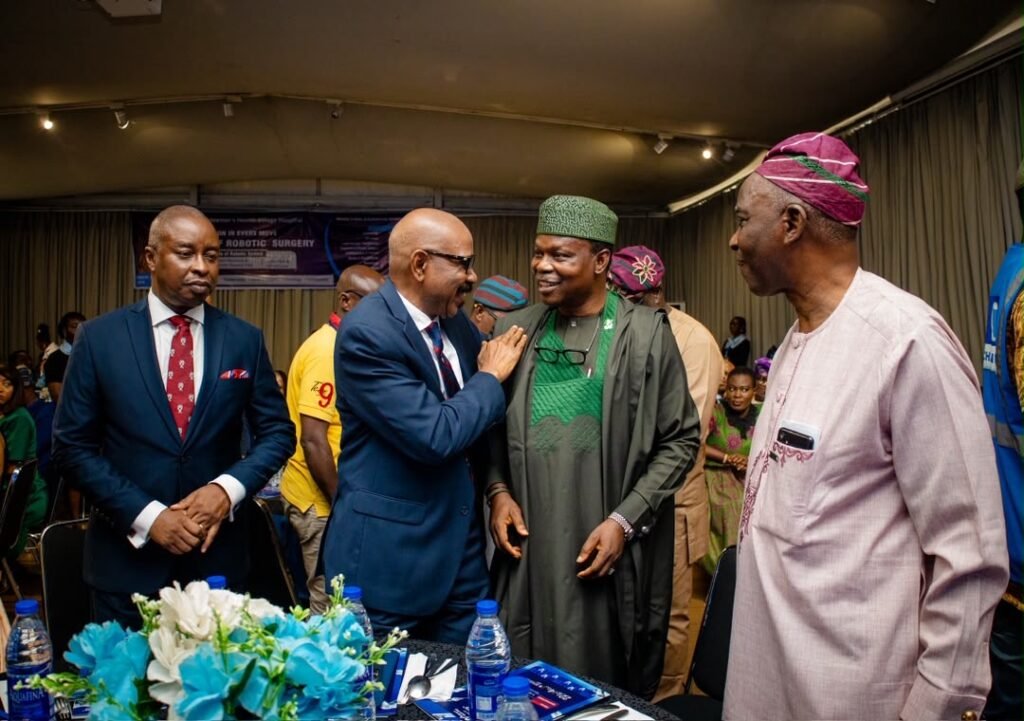
RHV unveiled the service in Lagos on Saturday at a dinner luncheon held in partnership with ROBOMED Global, a U.S.-based medical technology and capacity-building firm.
The News Agency of Nigeria (NAN) reports that the event has the theme, “Partnering to Advance Robotic Surgery in Nigeria”.
Speaking at the event, the Minister of State for Health, Dr Iziaq Salako, described the initiative as an advancement that offers precision, faster healing and better health outcomes.
Salako commended the leadership of the Redeemed Christian Church of God (RCCG) for investing in infrastructure, personnel and technology to deliver world-class healthcare services.
He said that the programme aligned with the government’s health transformation agenda, particularly in improving health outcomes and unlocking the healthcare value chain, while supporting efforts to reverse medical tourism from outbound to inbound.
“The vision of robotic surgery being translated into reality today will no doubt help to save lives and add value to the country.
“Government recognises private sector participation in delivering high-end medical services and will continue to promotie policies and incentives to strengthen domestic capacity, local manufacturing, research, innovation and healthcare value-chain transformation.
“This service which will include training for interested surgeons nationwide, will provide appropriate certification for safe and controlled practice to update clinical skills,” he said.
Salako also appreciated RHV’s partners, ROBOMED, describing the Nigerian diaspora-led enterprise as an example of professionals bringing expertise home through strategic partnerships to further support healthcare development.
He said the initiative would enhance the country’s capacity to provide precise and minimally invasive surgical care by Nigerian professionals trained to global standards, thereby reducing the need for overseas treatment.
He said the partners’ investment of about four million dollars demonstrated confidence in Nigeria’s economic reforms, and urged Nigerians in the diaspora to invest, create jobs and build greater prosperity.
Also speaking, former Minister of State for Health, Sen. Olorunnimbe Mamora, said robotic surgery would redefine surgical practice in Nigeria and West Africa through innovation and increased partnership.
Mamora said that robotic surgery was not meant to replace surgeons.
He explained that the robot was a sophisticated instrument that extends a surgeon’s eyes, hands and judgement to improve precision and dexterity.
Mamora, who chaired the event, said that because many Nigerians travel abroad for complex surgeries, the new service would increase the number of advanced surgical procedures performed locally.
He said: “Robotic surgery is not here to replace surgeons, the surgeon remains in complete control throughout every procedure.
“Technology does not and cannot replace the surgeon; it only empowers the surgeon, with patients remaining the greatest
“Many Nigerians travel abroad for complex surgical care, imposing enormous financial burdens on families and sometimes separating patients from their support systems during critical moments of illness.
“While some overseas referrals will remain inevitable, our collective goal should be to ensure that an increasing number of advanced surgical procedures can be performed safely and successfully here in Nigeria.”
Mamora said successful robotic surgery required trained surgeons, anaesthetists, theatre nurses, biomedical engineers, IT specialists and others, supported by sustainable financing and continuous professional development.
He lauded RHV and ROBOMED for their focus on training, knowledge transfer, mentorship, research and long-term capacity building.
He noted that technology could be bought, but human capacity must be continuously developed.
The former minister urged stakeholders to ensure the procedure was not limited to privileged Nigerians, but marked the beginning of a broader national journey toward excellence and internationally compliant surgical training..
Also, Pastor Enoch Adeboye, the General Overseer of RCCG, said the initiative represents commitment, vision and partnership to the future of healthcare in the country.
Adeboye, represented by Pastor Joseph Obayemi, former National General Overseer of RCCG, said robotic-assisted surgery at RHV would harness technology to improve procedures and enhance patient outcomes.
He added that the initiative would also present opportunity to develop local expertise, train Nigerian surgeons, promote research and reduce medical tourism.
“As a Christian mission, our interest in healthcare is rooted in our commitment to the well-being of humanity and the wish of God that we all live in perfect health.
“The establishment of RHV is borne out of divine mandate to bring world-class passionate care to the people of Nigeria.
“We believe that science and technology when compassionately deployed with the fear of God are powerful instrument for preserving lives and alleviating human suffering,” Adeboye said.
Speaking earlier, the Chief Executive Officer of RHV, Dr Adedamola Dada, said the introduction of robotic surgery would provide better surgical outcomes, reduce trauma and improve patient care.
Dada said four million dollars had been committed to the initiative for service delivery and training, and emphasised that sustaining the programme would depend on growing local expertise.
“We do not want a situation where we bring people from abroad. We want to create a pipeline of Human Resources.
“Training Nigerian professionals will enable the country to conduct surgeries locally, monitor patients and provide follow-up care.
“This is where the rest of the world is going. As a country, we cannot afford to be backwards,” he said.
He said the training aspect of the initiative would involve surgeons, biomedical engineers, nurses, anesthetists and other healthcare workers to ensure wider adoption of robotic surgery.
According to him, the investment demonstrates confidence in Nigeria and ensures that geography does not become a barrier to accessing world-class healthcare services.
Dada said the service would be provided at about five per cent of the cost of similar procedures in the U.S. and Europe.
He, however, noted that the initiative was not targeted at Nigeria alone, but also at the entire West African sub-region.
The Chief Executive Officer of ROBOMED Global, Prof. Obi Davies-Ekwenna, said the partnership with RHV was aimed at ensuring that Nigerians who require surgery could access safe, trusted and high-quality surgical care within the country.
Davies-Ekwenna said that the goal was to ensure patients requiring surgical intervention would no longer seek treatment outside the country, underscoring the need for safe and reliable surgical services.
He said the organisation’s vision was to increase access to world-class surgical care through sustainable robotic surgery programmes, training local surgeons and strengthening healthcare systems across West Africa.
He expressed excitement about the initiative, describing RHV as a remarkable place with a great team, where well trained professionals could carry out robotic surgery. (NAN)
Edited by Folasade Adeniran


Comments