


By Hauwa Umar
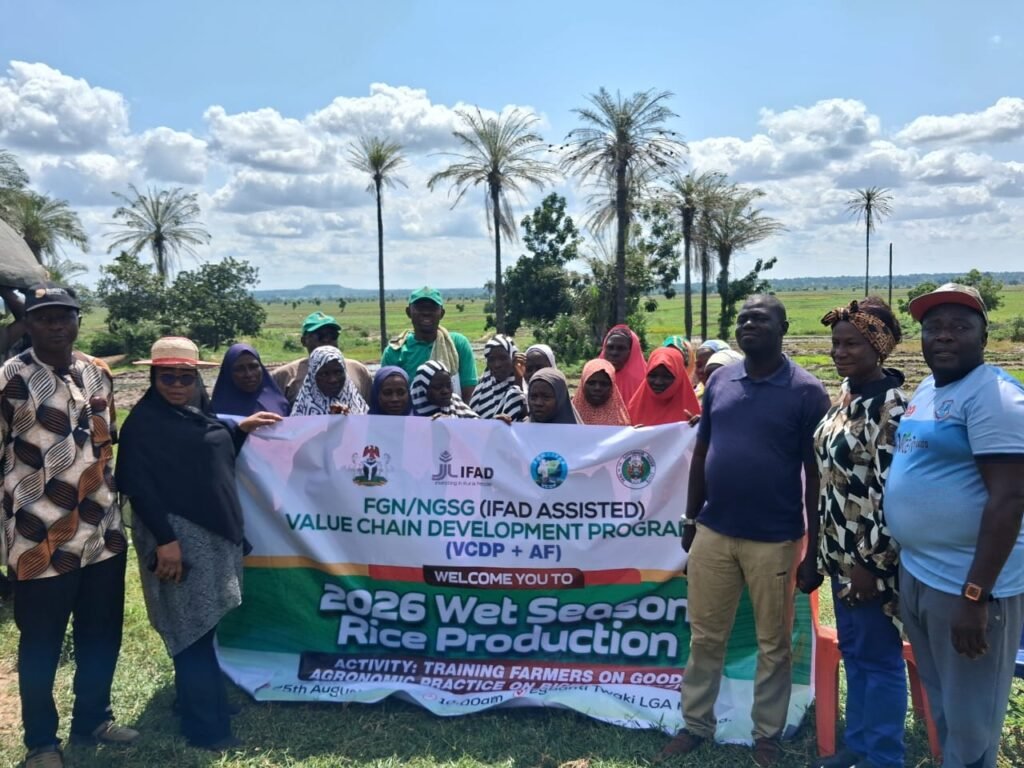
The Value Chain Development Programme (VCDP), has trained rice farmers on good agronomic practices to enhance production during the 2026 wet season in Egbanti, Katcha Local Government Area of Niger.
The News Agency of Nigeria (NAN) reports that VCDP is an IFAD-assisted programme.
The training, organised under the VCDP 2026 wet-season rice production programme, focused on improved seedlings, nursery establishment, transplanting, mechanised farming, proper application of farm inputs, record keeping and value addition.
Speaking at the training, Hajiya Hadiza Isah, the State Programme Coordinator of VCDP, said the training was designed to improve farmers’ productivity and ensure better returns on their efforts.
“The essence of this programme is to improve production. Farmers have been cultivating rice but are not getting the expected yields at the end of the season,” Isah said.
She said the programme had so far covered several local government areas, where farmers were being exposed to modern technologies and innovations aimed at improving their farming practices.
According to her, the intervention was necessary because some farmers still relied on traditional methods, adding that the adoption of improved practices would enable them to achieve better yields at the end of the planting season.
Isah said VCDP trained farmers during every planting season on improved crop production techniques, including the selection of quality seedlings, transplanting and proper crop management from planting to harvesting.
She added that the programme was also collaborating with researchers to provide farmers with practical knowledge and innovations capable of improving their farming activities.
Prof. Abigail Jirgi, Team Lead of Consultants for the VCDP 2026 wet-season farming programme from the Federal University of Technology, Minna, said the consultants had visited four local government areas to train farmers.
Jirgi said the farmers were taught on how to identify quality seedlings, prepare land properly and establish nursery beds for rice production.
She said the training also covered mechanised land clearing and appropriate planting and transplanting spacing, while stressing the importance of maintaining the recommended spacing for optimum crop performance.
According to her, farmers were encouraged to plant one seedling per stand to enhance the tillering ability of rice and ultimately improve productivity.
Also speaking, Prof. Emma Daniel, another consultant from the university, said the training was aimed at helping farmers move away from traditional farming methods and embrace mechanised agriculture.
He explained the benefits of using power tillers in rice production, adding that farmers, who were currently at the nursery stage, would also be taught proper transplanting techniques.
Daniel also trained the farmers on the use of improved rice seedlings and the appropriate application of chemicals and fertilisers before and after planting, including how to measure inputs correctly and determine when rice was ready for harvesting.
Similarly, Prof. Abdulaziz Abdullahi, another consultant, trained the farmers on value addition and record keeping, saying that accurate records would enable them to determine whether their farming activities were generating profit or loss.
He urged the farmers to minimise production losses and adopt appropriate value-addition practices to improve their returns from rice farming.
A beneficiary, Mr Yahya Umar, said the training had exposed farmers to various aspects of rice production, from land selection and preparation to harvesting.
He said farmers had also benefited from the VCDP intervention through the provision of farm equipment, including power tillers and harvesting equipment, as well as fertilisers at subsidised prices.
He said the programme had also linked farmers with financial institutions to enable them to access loans and expand their farming activities.
Umar expressed appreciation for the intervention, saying that the training, equipment and inputs had provided farmers with the knowledge and resources required to improve productivity and profitability. (NAN)(www.nannews.ng)
Edited by Muhammad Lawal



Comments