







By Martha Agas, News Agency of Nigeria (NAN)
Globally, customs administrations are shifting from manual processes to automated, data-driven, and intelligence-led risk management.
This transformation is fueled by advancements in Artificial Intelligence(AI), data analytics, and machine learning, which streamline border processes, enhance risk detection, and accelerate trade flows.
Analysts say the transformation is also being driven by the growing complexity of global trade, higher trade volumes, fragmented supply chains and the rapid growth of cross-border e-commerce, creating the need for faster clearance and stronger risk controls.
According to the World Customs Organisation (WCO), advanced technologies can help customs administrations strengthen risk management, improve data quality, facilitate trade, and enhance safety and security across the global supply chain.
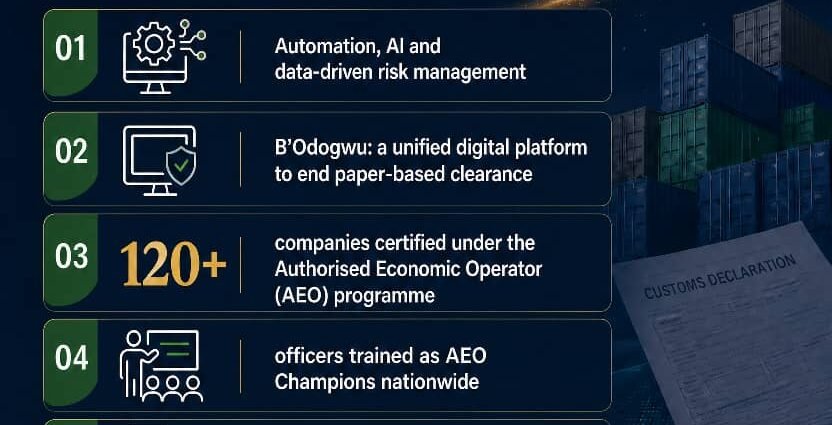
Against this backdrop, the Nigeria Customs Service (NCS) is accelerating its digital transformation through automation, AI, data-driven risk management and modern border-control systems.
As part of this modernisation drive, the NCS has introduced a series of reforms, including the Authorised Economic Operator (AEO) programme, which provides expedited Customs clearance for compliant traders.
So far, approximately 120 companies have achieved certification under the programme, while more than 3,270 officers have been trained nationwide as AEO Champions, contributing to increased Customs duty collections through enhanced compliance and higher volumes of legitimate trade.
The service has also deployed B’Odogwu, its Unified Customs Management System (UCMS), a digital platform for processing Customs and trade transactions designed to eliminate paper-based processing through end-to-end clearance on a single integrated platform.
The UCMS was developed as indigenous software for the NCS’s Trade Modernisation Project (TMP).
The project is a 20-year concession, with the execution agreement signed on May 30, 2022, between the Federal Government of Nigeria and Trade Modernisation Project (TMP) Ltd.
Another reform is the Advance Ruling System, which enables importers and exporters to obtain binding written decisions from Customs before importation on the tariff classification, Customs valuation and origin of specified goods.
The system is designed to improve predictability, promote compliance and reduce clearance challenges by providing greater certainty before goods are imported.
Together with advanced cargo-scanning equipment and other technology-driven systems, these reforms are intended to improve cargo clearance, revenue collection and border management.
Yet, as technology becomes increasingly central to Customs operations, analysts say the modernisation drive raises a critical question: can the service’s workforce keep pace with the systems it is expected to operate?
They say the adoption of increasingly sophisticated technologies is changing the skills required of Customs officers and stress that personnel must be adequately trained to deploy, manage and maximise the benefits of these systems.
This aligns with a study by the International Labour Organisation (ILO), which emphasised that education and training are essential to preparing current and future workers with the skills needed to thrive in the digital economy and benefit from technological transformation.
Similarly, the WCO says the successful adoption of disruptive technologies depends not only on technology but also on institutional readiness, human oversight and the skills of personnel.
For the NCS, the implication is clear: digital transformation must be accompanied by a workforce capable of understanding and effectively applying the technologies being introduced.
The service has consequently expanded its training programmes, both locally and internationally, to equip personnel with technical, operational and leadership skills needed to support its modernisation agenda and align with global best practices.
Training has moved beyond conventional Customs procedures to areas such as artificial intelligence (AI), image analysis, post-clearance audit, environmental trade regulations, fiscal reforms, leadership development and international knowledge exchange.
The approach is also reflected in the service’s efforts to involve personnel directly in the development and deployment of new systems.
For instance, customs personnel were integrated into the development of B’Odogwu in line with the Trade Modernisation Project’s capacity-building framework.
At the inception of the project, Mr Ahmed Ogunshola, the project’s General Manager, said the organisation targeted empowering 2,500 NCS personnel with technical skills by the first quarter of 2025.
“This will cover strategy, management and technical training, as well as direct skills and knowledge transfer.
“TMP has jointly designed, developed and deployed all technology systems and platforms for the project. This ensures that NCS has complete knowledge of all technology software, hardware and services from inception,” he said.
Beyond the technology-specific training associated with B’Odogwu, the NCS has broadened professional development under the leadership of the Comptroller-General (C-G) Bashir Adeniyi.
The focus now encompasses international knowledge exchange, digital transformation, institutional learning, inter-agency collaboration and specialised operational competencies.
An example is the partnership between the NCS and the Nigerian Institute of International Affairs (NIIA), Lagos, established about two years ago .
One of the core objectives of the partnership is to strengthen capacity and prepare officers for the changing demands of global trade and modern Customs administration.
Under the partnership, 40 senior officers graduated in June from the Advanced Senior Executive Course, in addition to the inaugural cohort of 25 officers who graduated in 2025.
The C-G said the training was designed to expose officers to global best practices and deepen their understanding of international trade dynamics.
According to him, the training is part of a broader modernisation plan aligned with the priorities of the World Customs Organisation (WCO) under its Strategic Plan for 2025 to 2028.
The plan focuses on building data-driven Customs administrations, while inclusiveness, including gender equality and diversity, is among its core guiding principles.
The service has also expanded its capacity-building efforts through technical missions with development partners and specialised operational training, ranging from engagements at the WCO Headquarters in Brussels to AI workshops in Abuja.
Stakeholders say leadership development programmes at the Nigeria Customs Command and Staff College have complemented these technical interventions, creating a broader framework for professional development within the service.
For Mr Eugene Nweke, Head of Research at the Sea Empowerment and Research Centre (SEREC), the investment in human capital has produced noticeable improvements in the professional capacity of many officers, particularly in ICT, valuation, classification, risk management and trade facilitation.
“Technology can only deliver its full value when matched by competent, ethical and adequately motivated personnel,” Nweke said.
Evidence of this broader approach was also presented at the 17th Session of the Capacity Building Committee of the World Customs Organisation, held in Brussels from Feb. 25 to 27, 2026.
At the session, NCS Spokesperson, Abdullahi Maiwada, delivered a presentation titled ‘Communicating the Results of Capacity-Building Initiatives More Effectively: Nigeria Customs Service Experience and Lessons Learned.’
His presentation highlighted how the service is increasingly linking training with measurable organisational outcomes rather than treating capacity building as an isolated activity.
Using the Time Release Study as an example, Maiwada explained how transparent data visualisation and performance reporting improved public understanding of cargo clearance processes.
He equally highlighted measurable outcomes under the Advance Ruling Programme, where stakeholder participation expanded significantly, alongside progress under the Authorised Economic Operator (AEO) Programme.
The same emphasis on institutional learning is increasingly evident in the service’s response to emerging technologies, particularly the use of AI in revenue management and financial accountability.
A consultant on international trade, Mr Okey Ibeke, noted that targeted capacity-building programmes, continuous professional training and ICT skills development for personnel were strengthening institutional competence and improving adherence to international best practices in Customs administration.
“There is observable improvement in the efficiency, professionalism, and integrity of personnel in the discharge of statutory duties,” he said.
The NCS has also responded directly to the growing role of AI in its operations.
In April, the service conducted a specialised capacity-building programme on AI-driven revenue generation, remittances and reconciliation in Abuja.
The programme brought together senior Customs officers, technology experts and members of legislative oversight committees, reflecting the service’s effort to prepare its workforce for an increasingly technology-driven operating environment.
At the training, the NCS boss reaffirmed the service’s commitment to leveraging innovation to strengthen transparency and public financial management.
“We want to reap the benefits of Artificial Intelligence collectively, “Adeniyi said.
At the operational level, the training programme has extended to specialised areas required to support modern border management.
Advanced image analysis training for Chief Examiners and Releasing Officers, for instance, has strengthened the Service’s non-intrusive inspection capabilities.
The focus has also extended beyond physical inspection to post-clearance processes, with technical workshops on Post Clearance Audit conducted in partnership with the World Bank Group under the Accelerated Revenue Mobilisation Reform (ARMOR) programme.
The two-week Technical Assistance Mission on Post Clearance Audit (PCA), held in June at the service’s headquarters in Abuja, was designed to strengthen compliance management, revenue assurance and trade facilitation through modern audit techniques.
Training in the NCS has similarly extended to environmental trade regulations and new fiscal reforms, delivered in collaboration with international partners and through joint programmes with the Nigeria Revenue service.
The service has complemented these domestic interventions with international cooperation, including strategic engagements with France, the United Nations Office on Drugs and Crime (UNODC) and other international institutions to combat transnational illicit drug trafficking.
Taken together, the initiatives point to a broader institutional approach in which technology, operational training, international cooperation and professional development are being pursued as interconnected elements of Customs modernisation.
However, the scale of the transformation also exposes a second challenge: having the right number of people to operate and sustain the expanding systems.
Stakeholders insist that, in spite of the progress, there is still room for improvement in the discharge of Customs duties and a pressing need for more manpower to enable the service to perform its constitutional responsibilities effectively.
Addressing this, the Comptroller-General recently announced an annual recruitment cycle in the service and released the final list of 3,852 successful candidates for its 2024/2025 recruitment exercise.
Adeniyi said the annual recruitment cycle would help the NCS aligned its manpower planning with anticipated retirements, rather than responding to staffing gaps as they arise.
The manpower issue is particularly significant as the service continues to expand its responsibilities while revenue and trade volumes increase.
In 2025, the NCS recorded N7.28 trillion in revenue, exceeding its N6.58 trillion target.
Against this background, the NIIA says effective Customs modernisation requires human-capacity development to keep pace with technological change and evolving trade operations.
In addition, Ibeke said that while challenges such as manpower deficits and incomplete automation persisted, sustained investment in technology and continuous capacity building would be critical to consolidating gains and positioning the Service to meet contemporary trade and security demands.
The question, therefore, is no longer simply whether the NCS is investing in technology or training its personnel. It is whether both investments are progressing at a pace that allows one to reinforce the other.
For SEREC, the answer remains mixed. While the Centre acknowledges improvements in personnel capacity, it says the gains are not yet uniform across the service.
Ultimately, stakeholders say the next phase of Customs modernisation must shift from merely deploying technology to actively measuring the productivity, integrity, and service quality of individual personnel and commands.
They say performance evaluation should comprehensively incorporate clearance time, compliance outcomes, dispute resolution, trade facilitation, decision accuracy, and overall stakeholder satisfaction.(NANFeatures)
Edited by Chijioke Okoronkwo
***If used, please credit the writer and the News Agency of Nigeria.