









By Henry Oladele
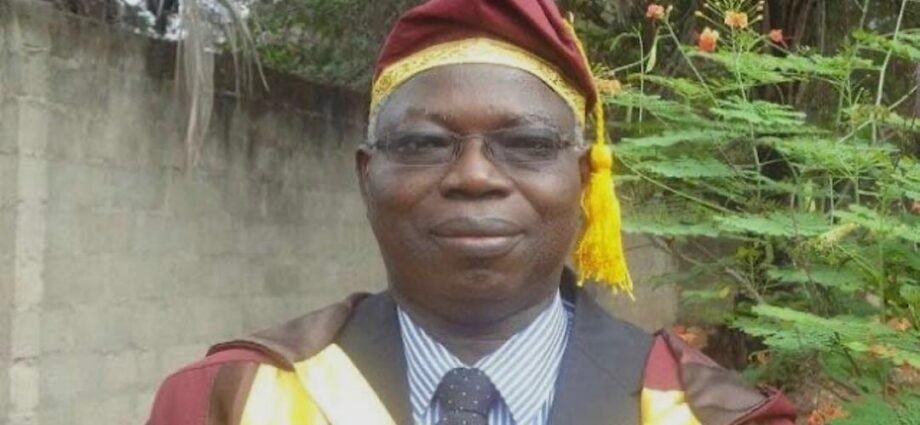
A Professor of Sociology at the University of Lagos (UNILAG), Omololu Soyombo, has called for an end to the excessive deployment of police officers to Very Important Personalities (VIPs) in the country.
Soyombo made the call in his exaugural lecture titled: “Why We Are Where We Are: A Sociological Analysis of the Trials and Travails of Security Control in Nigeria”.
The News Agency of Nigeria (NAN) reports that the professor will retire from service in a few days.
The don also called for improved conditions of service for police and other security personnel.
He said improved welfare for security personnel would boost their morale and enhance efficiency in protecting the nation and its citizens.
“There should be improved conditions of service for the police and other security agencies for the onerous duties they perform,” he said.
The don said there had been reports of security officers killed while performing their duties, stressing the need for adequate insurance coverage for their families and dependants.
Soyombo advocated the recruitment of more police personnel, noting that the country’s current police strength was inadequate for its growing population.
He also urged reduced deployment of police officers for non-core policing duties.
According to him, more personnel should be recruited and deployed to core policing responsibilities, particularly the protection of vulnerable communities and institutions.
He called for enhanced security in schools, given the incessant attacks on educational institutions and the abductions of pupils, students and teachers.
The professor stressed the need to equip security personnel with modern technology and sophisticated equipment to effectively confront criminals, terrorists and bandits.
“Our strength is not so much in how many security personnel we have but how well-equipped they are,” he said.
Soyombo said modern warfare was technology-driven, adding that one well-equipped security personnel could be more effective than 100 ill-equipped personnel.
He advocated greater intelligence sharing and coordination among security agencies to enable them to prevent crimes before they occurred.
“They will be stronger, more efficient, and more effective when they work together,” he said.
The don also called for effective border management and stricter control of small arms and light weapons to reduce trans-border crime and the proliferation of illegal weapons.
He urged government to enforce mining regulations and stop illegal mining activities, which he said contributed to insecurity and terrorism in some communities.
Soyombo further advocated appropriate punishment for offenders, stressing that impunity encouraged criminality and should not be allowed to thrive.
He called for more diligent prosecution of suspects to prevent cases from being abruptly terminated or offenders from being released through extra-judicial means.
The professor urged security agencies to maximise science and technology, including forensic science, CCTV, aerial surveillance, drones and communication technologies.
He said technology could help security agencies trace, track, identify and apprehend criminals, but warned that criminals could also exploit technological advancements.
“Thus, the police and security agencies must always improve and update their knowledge, training, and capacity,” he said.
Soyombo said Nigeria’s insecurity was multi-faceted and required several measures to address it, rather than a single solution.
“It is necessary to note that there is no single-item, one-fix solution to the problem of insecurity in Nigeria,” he said.
He also linked the country’s security challenges to value disorientation, saying society had abandoned virtues such as honesty, hard work and integrity.
The don expressed concern over the shortage of positive role models, noting that young people often learnt more from what leaders did than what they said.
Soyombo used the lecture to reflect on Nigeria’s security challenges and the responsibilities of citizens.
He urged Nigerians to examine their individual and collective roles in creating a safer society, stressing that citizens must contribute to solving problems they have the capacity to address.(NAN)
Edited by Buhari Bolaji