








By Emmanuel Ijikanmi
The Corporate Affairs Commission (CAC) has called for harmonisation of Nigeria’s beneficial ownership registers to strengthen transparency and accountability.
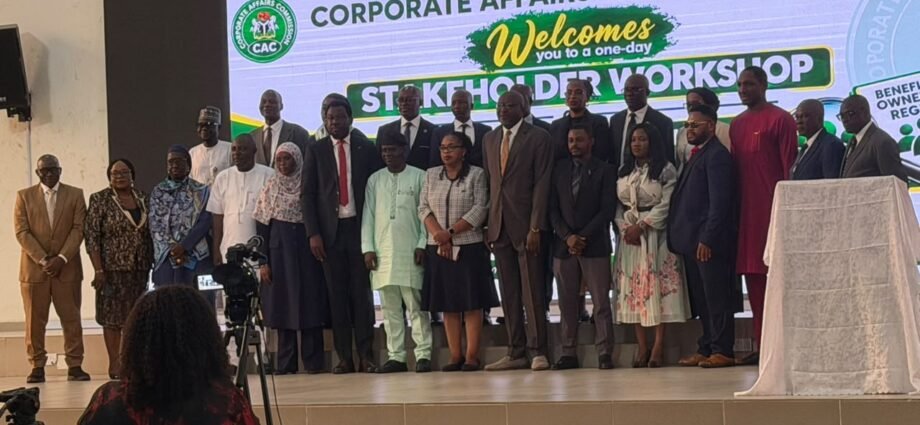
The CAC Registrar-General, Hussaini Magaji, made the call at a one-day stakeholder workshop in Abuja on Tuesday.
Magaji said harmonising the registers would ensure that information on persons who ultimately own or control companies was accessible through a coordinated national framework.
He said disclosure of beneficial ownership was crucial aimed at combating corruption, illicit financial flows, money laundering, terrorism financing and abuse of corporate structures.
“In Nigeria, our legal and regulatory framework captures this concept through the term, Persons with Significant Control, (PSC),” Magaji said.
He said that the PSC framework sought to identify the natural persons who ultimately owned, controlled or significantly influenced corporate structures.
According to him, beneficial ownership information should serve as a practical tool for transparency, corporate accountability, investigative journalism and law enforcement.
Magaji urged journalists and civil society organisations to interrogate ownership structures, investigate corporate relationships and responsibly use information obtained from the register.
He said that the appearance of a person’s name in corporate records did not constitute evidence of criminality, urging users to verify information before publication.
He said the media and civil society remained important partners in ensuring that beneficial ownership transparency translated into stronger corporate governance and accountability.
Also speaking, Maimunat Modi, Associate, Institute of Chartered Secretaries and Administrators (ACIS), said beneficial ownership was a global transparency concept that had evolved over time.
Modi said the Companies and Allied Matters Act (CAMA) 2020 provided Nigeria’s general legal framework for beneficial ownership disclosure through PSCs.
She said that beneficial owner must be a natural person with significant ownership, voting rights, influence or control over a company or other legal entity.
“Beneficial ownership is a proactive transparency mechanism rather than the traditional corporate law concept of lifting the veil,” Modi said.
She said that beneficial ownership information could help journalists and civil society organisations investigate companies, understand ownership structures and establish connections between corporate entities.
She distinguished legal ownership from beneficial ownership, saying a legal owner could be a beneficial owner, but a beneficial owner did not necessarily have to be the legal owner.
Similarly, Musikilu Mojeed, Editor-in-Chief, Premium Times Nigeria, urged journalists to use beneficial ownership data to produce public-interest stories and investigate corporate structures.
Mojeed said complex ownership arrangements could involve several companies and jurisdictions, making it difficult to identify the individuals ultimately benefiting from assets and transactions.
He urged journalists investigating public contracts to ask critical questions about the real owners of companies benefiting from government projects.
According to him, journalists should examine whether ownership structures correspond with public contracts and investigate suspicious changes in ownership.
Mojeed said beneficial ownership information could help journalists investigate corruption, money laundering, illicit financial flows, asset concealment and questionable public procurement.
Odeh Friday, Country Director, Accountability Lab Nigeria, called for stronger interoperability among government databases to enable journalists and Civil Society Organisations (CSOs) to connect beneficial ownership information with other relevant records.
Friday said access to beneficial ownership information should not be considered in isolation, but should be connected with public procurement, property, financial and other government databases.
He urged journalists and civil society organisations to connect the dots by combining information from different sources to establish ownership, financial and corporate relationships.
Friday also called for improved data sharing among government agencies, saying better access to information would strengthen public accountability and enable citizens to make informed decisions.
He said journalists should ask who the real owners of companies were, whether ownership matched public contracts and whether suspicious patterns existed within corporate structures.
The stakeholders’ workshop was organised to improve journalists’ and CSOs’ understanding of beneficial ownership disclosure and the use of the Beneficial Ownership Register.
Journalists and CSOs were urged to use beneficial ownership information to strengthen investigative reporting, public accountability and efforts to trace illicitly acquired assets. (NAN)
Edited by Kadiri Abdulrahman