




By Philomina Attah
The North Central Development Commission (NCDC) has unveiled a draft 20-year Economic, Infrastructural and Social Development Plan for the North Central region.
The plan covers 2027 to 2046 and seeks to transform Benue, Kogi, Kwara, Nasarawa, Niger, Plateau and the Federal Capital Territory (FCT) into a productive, connected, inclusive and resilient region.
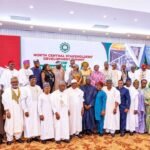
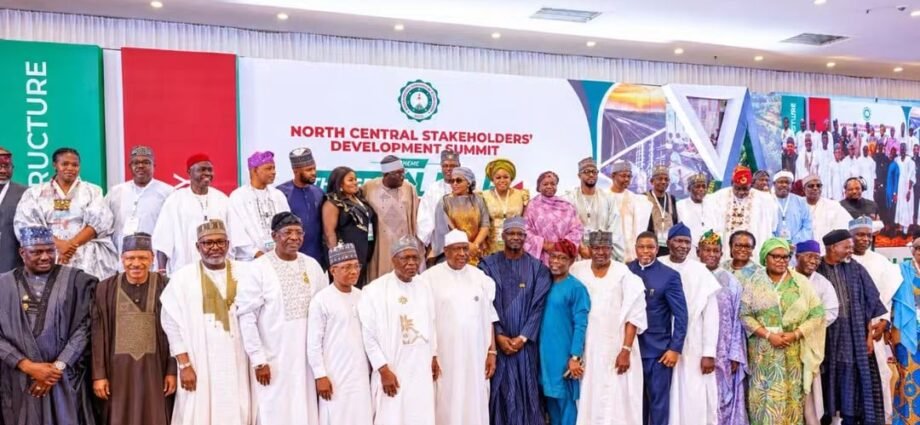
This is contained in a communique issued at the end of the NCDC Road Map and Stakeholders’ Development Summit held at the Abuja Continental Hotel, Abuja, from Sept. 14 to Sept. 15.
The communique was presented by the Chairman of the Technical Sub-Committee, Prof. Muhammad Nuhu, and adopted by participants at the close of the summit.
The theme of the summit was “The Great Leap Forward: A 20-Year Economic, Infrastructural and Social Development Plan for the North Central Region”.
The communique said the summit recorded 862 physical attendees and 49 online participants, including representatives of Federal Government, governors of mandate states and FCT, National Assembly members, traditional and religious leaders, development partners, private sector, academia, civil society and media.
It said the Managing Director of NCDC, Dr Cyril Tsenyil, welcomed participants and described the summit as beginning of inclusive, evidence-led development journey.
It added that the new NCDC logo was unveiled as symbol of unity and collective transformation.
According to the communique, the keynote speaker, Sen.
Iyorwuese Hagher, urged the region to convert its historic contributions, diversity, natural resources and human capital into shared prosperity.
It said the Governor of Nasarawa State and Chairman, North Central Governors’ Forum, Abdullahi Sule, underscored the region’s agricultural and mineral potential and formally presented the draft 20-year plan.
It said the Secretary to the Government of the Federation, Sen. George Akume, who represented the President, commended the consultative process and called for high-impact and fundable interventions.
The communique noted that North Central possesses extensive agricultural land, water, minerals, energy resources and strategic location, but assets had not translated to commensurate productivity and incomes.
It observed that fragmented planning; weak inter-state connectivity, insecurity, infrastructure gaps, limited value addition and inconsistent implementation had constrained regional growth.
It said security remains productive infrastructure, adding that plan must focus on catalytic, region-wide programmes with clear baselines and measurable outcomes.
The summit resolved to develop GIS-enabled regional economic database and map comparative advantages of each state during foundation horizon.
It resolved to build state-specific agricultural and livestock value chains around mechanisation, irrigation, storage, processing and export, and to formalise artisanal mining with mineral-processing clusters.
On infrastructure, it resolved to implement integrated programme connecting six states and FCT through strategic roads, rail, inland waterways and logistics, with priority to corridors unlocking agricultural land and markets.
It gave urgent consideration to Abuja-Lokoja road, regional rail, Baro inland-port logistics and dry-port connections.
It resolved to develop practical regional energy programme and integrate security, climate resilience and maintenance into project design.
On social development, it resolved to establish disaggregated human-capital and social-inclusion data system to guide interventions for children, youth, women, persons with disabilities and rural communities.
It also resolved to implement safe and inclusive education framework, expand STEM, technical and vocational pathways linked to regional value chains, and strengthen health access.
On security, it resolved to establish coordinated regional security and peace-building framework supporting statutory security institutions through intelligence sharing, early warning and inter-state coordination.
It also resolved to integrate security planning into farms, transport corridors, schools and markets and strengthen role of traditional institutions in peace-building.
On climate and environment, the summit resolved to develop North Central Climate and Disaster Resilience Programme with geo-referenced mapping of flood, erosion and drought hazards.
It resolved to undertake priority flood and erosion interventions, provide Safe Homes for climate-displaced persons, and adopt safeguard-before-scale principle for mining corridors.
On digital economy, it resolved to develop inclusive regional digital infrastructure programme, establish AI and digital-skills centres, and create innovation financing mechanism.
On financing, it resolved to match financing instruments to economics of each project, establish disciplined project-preparation pipeline, and mobilise public resources, development finance, PPPs, capital markets and diaspora capital.
On institutional delivery, it resolved to give plan durable legal backing, establish Programme Management Office within NCDC and define responsibilities across stakeholders, with public performance framework and regular reviews.
The summit further resolved that security, reliable data, inclusion, climate resilience, digital enablement and private-sector participation shall be treated as cross-cutting requirements.
It said young people, women, persons with disabilities, displaced persons and rural communities shall participate meaningfully in programme design.
Participants expressed appreciation to President Bola Tinubu for establishing NCDC and to governors of mandate states, FCT Minister, National Assembly and other stakeholders for their contributions.(NAN)(NAN)
Edited by Francis Onyeukwu