


By Okon Okon
Stakeholders in the pension and labour sectors have raised concerns over the impact of rising inflation, inadequate pension benefits and challenges in pension administration on retirement security in Nigeria.
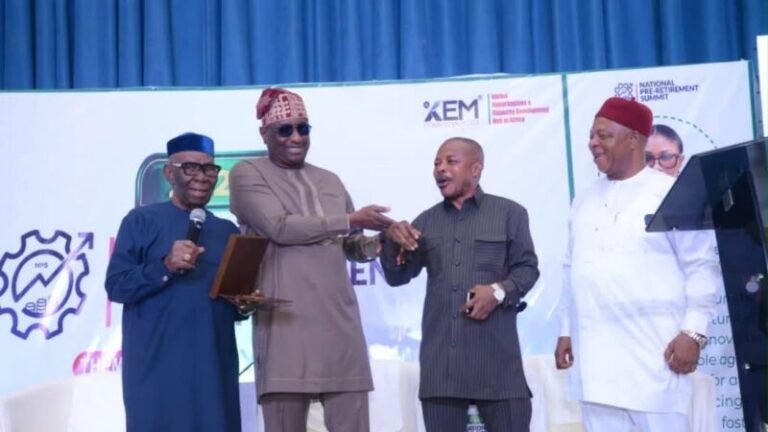
They made the call on Thursday at the 2026 National Pre-Retirement Summit organised by XEM Consultants Ltd. in collaboration with strategic partners in Abuja, including the Nigeria Labour Congress (NLC) and the Trade Union Congress (TUC).
The stakeholders urged workers to plan early for retirement and develop multiple sources of income to cushion the effects of rising living costs after active service.
Dr Dasuki Arabi, Director-General, Bureau of Public Service Reforms (BPSR), said retirement planning should not be left entirely to government, employers, pension administrators or family members.
“Retirement planning must be understood not merely as a personal financial matter, but as part of the broader national workforce policy conversation that should be happening consistently,” he said.
Arabi, who delivered the keynote address, said individuals must take informed decisions and deliberate actions to secure their lives after active service.
He said the circumstances in which people worked, earned income, accessed healthcare, raised families and prepared for old age were significantly influenced by public policies and institutional arrangements.
Arabi said the Federal Government had introduced reforms aimed at improving retirement welfare, including interventions on exit benefits and measures to strengthen the pension system.
He said the BPSR had also introduced pre-retirement training as one of its flagship programmes to prepare public officers for the financial, psychological and practical realities of life after active service.
According to him, the programme was designed to help workers transit from salary dependence to self-reliance and purposeful retirement.
The director-general noted that Nigeria’s labour market was changing rapidly, with workers increasingly moving between employers, sectors and occupations while combining formal employment with entrepreneurship, consultancy and other sources of income.
He said the National Bureau of Statistics had reported that informal employment accounted for about 93 per cent of total employment in the second quarter of 2024.
Arabi said the development had significant implications for retirement policy and made it necessary to extend pension planning beyond civil servants and corporate employees.
He said traders, artisans, farmers, small business owners, freelancers and other workers outside the conventional formal sector should also have realistic opportunities to prepare for old age.
Earlier, Dr Maurice Mbaeri, a retired Permanent Secretary in the Office of the Secretary to the Government of the Federation (SGF), said the summit was designed to provide participants with practical tools for life after active service.
Mbaeri, who served as Chairman, Organising Comm of the summit, welcomed participants noting that the programme would provide a framework for developing personal retirement plans, acquiring digital skills, exploring entrepreneurship and managing health and investments after retirement.
He said more than 100 institutions and stakeholders, including pension regulators, labour unions, financial institutions, healthcare providers and technology partners, were participating in the summit.
President of the Nigeria Labour Congress (NLC), Mr Joe Ajaero, described pension as deferred wages and expressed concern over the effect of inflation and currency depreciation on retirees’ purchasing power.
Ajaero said the value of retirement savings could decline significantly when inflation remained high, stressing the need for pension policies to take inflation into account.
He advocated indexing pensions to inflation to protect retirees from declining purchasing power.
According to him, retirement security should go beyond pension contributions, with workers encouraged to develop additional sources of income and productive assets before leaving active service.
Dr Eugenia Ndukwe, convener of the summit, said rising inflation, increasing living costs and rapid changes in digital technology informed the decision to organise the 2026 edition.
Ndukwe, who is also the Chief Executive Officer of XEM Consultants, said the theme, “Own Your Retirement: From Planning to Action”, was aimed at encouraging workers and retirees to take greater responsibility for their financial, professional and personal lives after active service.
She said retirement planning should cover pension accounts, relationships with pension fund administrators, account balances, financial literacy, skills acquisition and alternative sources of income.
“Retirement is much more than pension. Those approaching retirement need to consider what they will do with their time, knowledge and experience after leaving active service,” she said.
The News Agency of Nigeria (NAN) reports that the stakeholders used the summit to urge Nigerian workers to plan early and develop multiple sources of income ahead of retirement.
========
Edited by Emmanuel Afonne

Comments