


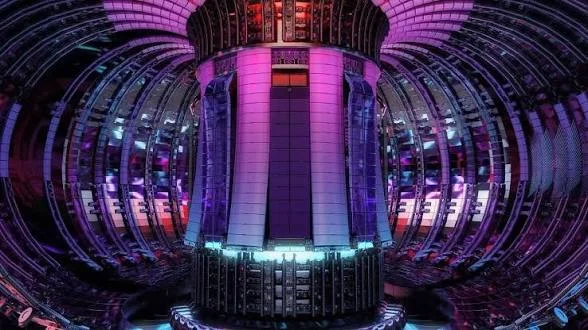
China said it has completed testing of what it describes as the world’s largest superconducting magnet for a nuclear fusion research project.
The D-shaped magnet was developed by the Institute of Plasma Physics in Hefei using domestically developed technologies, TV BRICS, a NAN partner, reported on Wednesday.
The component weighs 582 tonnes, measures 21 metres long and 12 metres wide, and took six years to develop.
Song Yuntao, Director of the institute, said the magnet was the heaviest superconducting magnet in the world and had the highest energy storage capacity among such coils.
He said it was 1.3 times larger than the magnets used in the International Thermonuclear Experimental Reactor (ITER) project and had three times their energy storage capacity.
The magnet will be installed in the Burning Plasma Experimental Superconducting Tokamak (BEST), which is under construction in Hefei.
BEST is intended to bridge the gap between the experimental EAST tokamak and the proposed China Fusion Engineering Demonstration Reactor (CFEDR).
In 2025, EAST sustained plasma at 100 million degrees Celsius for 1,066 seconds, setting a world record.
BEST is designed to conduct experiments on self sustaining deuterium-tritium burning plasma, with a target energy gain of five times the energy invested, or Q=5.
Construction of the facility is advancing, with a 400-tonne foundation for its main unit installed in late 2025.
The project is expected to be completed by the end of 2027, according to its roadmap.
Future experiments will focus on steady state burning plasma and are expected to target fusion power output of between 20 and 200 megawatts.
China plans to demonstrate electricity generation through nuclear fusion around 2030, followed by a demonstration reactor in 2035 and a commercial reactor after 2040.
Fusion energy development is included in China’s strategic research agenda for 2026–2030.
The country is also strengthening international cooperation in plasma research, with scientists from more than 10 countries involved in collaborative programmes.
Song said completion of the magnet marked an important step towards advancing burning-plasma research and fusion engineering.
Edited by Halima Sheji

Comments