


By Kelu Musa
Hannatu Musawa, Minister of Art, Culture, Tourism and the Creative Economy, has said the Nigerian fashion industry can significantly drive job creation and national economic growth if provided with strategic attention and investment.
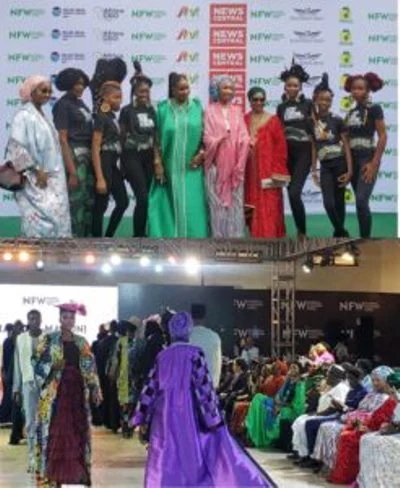
The News Agency of Nigeria (NAN) reports that Musawa stated this at the official opening of the 2026 Nigeria Fashion Week in Abuja on Friday.
The event, themed “Beyond the Runway: Fashion and Culture at the Heart of the Green–Blue Economy,” is scheduled to hold from Oct. 1 to 4.
According to Musawa data analysis by the ministry identified fashion as the leading subsector with potential to contribute to economic growth and job creation.
She emphasised that optimum exploration of the fashion value chain, from raw material production to retail, can significantly boost job creation and economic growth.
She said the ministry’s strategy was designed to support President Bola Tinubu’s target of building a 1 trillion-dollar economy.
“We found that fashion has the ability to really contribute to the job creation market and also to growing the economy,” she said.
The minister said fashion was one of 49 subsectors within the creative economy and had strong potential to expand Nigeria’s economic base.
“Fashion is not just about expression, it is about economic growth, job creation, soft power and also our identity,” she said.
Musawa said Nigeria’s cultural identity and traditional clothing had given the country significant soft-power potential globally.
“Everybody in the world wants to dress like a Nigerian, so that’s where it’s at,” she said.
She said the government would focus on policies, infrastructure, funding and partnerships with the private sector to strengthen the fashion industry.
“We as government need to create an enabling environment, the proper policies, the proper framework for funding and the proper infrastructure,” Musawa said.
She said the ministry was working with private-sector partners to establish creative hubs where fashion entrepreneurs could develop skills across the industry’s value chain.
Musawa said the ministry had also introduced the Creative Economy Development Fund to provide funding for creative-sector businesses.
She said applications had been received, adding that the ministry would briefly reopen the application portal to enable more people to apply.
“Funding is very important. In the next three to four weeks, I would want everyone to engage with what is happening in the ministry,” she said.
Musawa said the ministry was also working with state governments to ensure fashion development extended beyond Lagos and Abuja.
She said infrastructural projects were being developed with support from the French Treasury through Creative CTICo, with hubs planned for Lagos, Abuja and Katsina.
The minister said government’s strategy was to replicate approaches used by countries that had successfully monetised their creative industries.
Earlier, Lexy Mojo-Eyes, Chief Executive Officer of Legendary Gold Ltd, organisers of Nigeria Fashion Week, said the event was moved from Lagos to Abuja to strengthen engagement with government.
Mojo-Eyes said the organisers had been promoting Nigerian fashion for 35 years and wanted to take the industry to a level where creativity translated into enterprise.
“One thing is to be creative. Another thing is to actually make money from it, empower other people and things like that,” he said.
Mojo-Eyes said adequate government policies were necessary to create an enabling environment for fashion entrepreneurs and other players across the value chain.
“That is why, when we spoke with the minister, she insisted we bring it to Abuja,” he said.
He said Nigeria Fashion Week was open to Nigerian and international designers, providing opportunities for collaboration and access to new markets.
According to him, designers from different countries were participating in the 2026 edition, creating opportunities to promote Nigerian fashion internationally.
Also speaking, Obi Asika, Director-General, National Council for Arts and Culture (NCAC), said the relocation of the fashion week to Abuja would support efforts to position the city as a destination.
Asika said bringing major creative events such as the fashion week to Abuja would help showcase Nigeria’s indigenous fabrics, leather, crafts and cultural heritage.
“Everything here is coming from our culture. It’s coming from our indigenous fabrics, all leathers from Kano, Katsina and Sokoto, and our crafts as well,” he said.
He urged greater use of Nigerian cultural aesthetics in hotels and other hospitality facilities, saying the country’s heritage should be reflected in its built environment.
Asika said Nigerian fashion included luxury products, noting that designers could develop premium brands while also producing affordable ready-to-wear collections.
NAN also reports that the Nigeria Fashion Week 2026 is being held in Abuja for the first time, with more than 40 Nigerian and international designers scheduled to showcase their works.
Highpoints of the event included a fashion runway showcase and an exhibition of made-in-Nigeria products.(NAN)
Edited by Joshua Olomu
Comments