


By Joshua Olomu
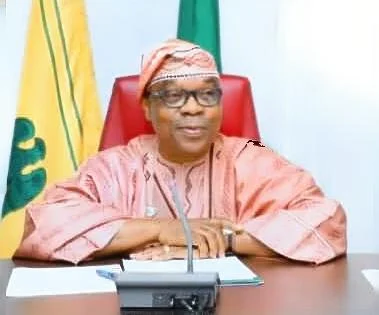
The Minister of State for Foreign Affairs, Amb. Sola Enikanolaiye, has urged African governments to place trade and economic cooperation at the centre of Pan-African diplomacy.
He made the call in his speech at a ministerial roundtable on “Trade and Economic Cooperation at the Centre of Pan-african Diplomacy” on Friday in Egypt.
The roundtable was hosted by Dr Badr Abdelatty, Minister of Foreign Affairs, International Cooperation and Egyptian Expatriates of the Arab Republic of Egypt.
It was attended by ministers of states, representatives of the African Union Commission, AUDA-NEPAD, the AfCFTA Secretariat, Afreximbank and the Regional Economic Communities, amongst other stakeholders.
According to the minister, the theme of the roundtable speaks directly to how African countries should conduct their diplomacy in this decade.
“For too long, we treated trade and diplomacy as separate tracks, with foreign ministries managing relationships and trade ministries managing transactions.
“Experience has taught us otherwise,” he said.
The minister said partnerships endure only when they rest on shared economic interests, anchored on the wellbeing of citizens.
He added that economic ambitions are realised only in an environment of trust, predictability and common purpose.
“That is why Nigeria welcomes a conversation that places trade and economic cooperation at the centre of Pan-African diplomacy.
“For Nigeria, Africa is the centrepiece of our foreign policy. We are the continent’s most populous nation, with a young and enterprising population of well over two hundred million people.
“Our stake in an integrated continent is therefore concrete. A larger, better-connected African market is an opportunity for our manufacturers, farmers, innovators and service providers, and equally for theirs,” he said.
Enikanolaiye said Nigeria was championing initiatives that promote trade and economic cooperation across the continent.
According to him, the digital economy offers, perhaps, the fastest route to a truly continental market.
“Young Nigerian innovators are building payment, logistics and financial services platforms that serve customers well beyond our borders.
“In the second quarter of this year, the information and communication sector grew by 9.62 per cent, more than twice the pace of the economy as a whole,” he said.
He added that the sector also contributed 11.74 per cent of real GDP, with about 156.9 million internet users recorded.
According to the minister, Nigeria ratified the AfCFTA Digital Trade Protocol in Nov. 2025 and is a co-champion of the Protocol, together with Kenya and South Africa.
“We are ready to share that experience and to learn from the experience of others,”he said.
The minister said Nigeria was also supporting African capital with initiatives such as the Economic Development Tax Incentive
He said the incentive, administered by the Nigerian Investment Promotion Commission, has offered qualifying investors in priority sectors a tax credit of 5 per cent a year for five years on eligible capital expenditure.
“The Commission’s One-Stop Investment Centre brings together twenty-seven government agencies to help investors navigate approvals.
“We believe that the most durable investments on this continent will be those that African businesses make in one another.
In this regard, Aliko Dangote of Nigeria is setting the pace across Africa, to the applause and admiration of all,” he said.
At the sub-regional level, Enikanolaiye said ECOWAS has already laid the foundation through its Trade Liberalisation Scheme.
“The African Continental Free Trade Area is the most important trade instrument we have built together. As of September, fifty Pan -African of the fifty-four signatory countries have deposited their instruments of ratification.
“The Guided Trade Initiative has grown from seven participating countries to thirty-nine,” he said.
According to him, Nigeria validated its National AfCFTA Implementation Strategy, gazetted its Provisional Schedule of Tariff Concessions for trade in goods in April 2025.
He said the country also submitted its schedule of specific commitments on services through ECOWAS in Oct. 2025, and ratified the AfCFTA Digital Trade Protocol in Nov. 2025.
“We have also begun trading under the Guided Trade Initiative.
“A dedicated air cargo corridor linking Nigeria to East and Southern Africa, developed with Uganda Airlines and the United Nations Development Programme, has reportedly cut freight costs for participating businesses by between 50 and 75 per cent.
“Yet an agreement on paper does not move goods. The task before us now is to make it work at the border, at the port and at the bank,” he said.
According to the minister, trade cannot flow without finance, noting that African exporters still pay too much for credit, and too much of trades are still settled in third currencies.
“Institutions such as Afreximbank, whose headquarters is in Cairo, and platforms such as the Pan-African Payment and Settlement System show what becomes possible when Africans build financial infrastructure for African needs.
“In April 2025, the Central Bank of Nigeria directed all banks to adopt PAPSS and begin originating transactions on the platform,” he said.
He said the CBN initiative has simplified documentation for PAPSS payments, allowing individuals to transact up to 2,000 United States dollars and companies up to 5,000 dollars on the strength of their existing customer documentation.
“It also allowed authorised dealer banks to source foreign exchange for PAPSS settlements through the official market. These payments can be made in local currencies, which reduces reliance on third currencies,” he said.
The minister identified slow and costly border procedures, underdeveloped logistics corridors as some non-tariff barriers facing trade across the continent.
“Movement of business people is still too restricted. And too much of our raw material leaves the continent without being processed.
“These are problems that no trade ministry can solve alone. They call for the kind of sustained political engagement that only diplomacy can provide,” he said.
Moving forward, Enikanolaiye urged that trade facilitation become a standing item in Pan-African diplomatic engagement, with regular coordination among our foreign, trade and finance ministries.
According to him, there is need for states to act decisively on non-tariff barriers, simplify border procedures and move towards the mutual recognition of standards.
He also called for widening of access to trade finance and local-currency settlement, particularly for small businesses, women traders and young entrepreneurs.
“Fourth, we should invest jointly in transport and energy corridors and in regional value chains, so that more of what Africa produces is processed in Africa.
“Fifth, we should speak with one voice in all multilateral external trade and investment negotiations, because our bargaining position is stronger when we stand together,” he said.
While commending the strong bilateral ties between Nigeria and Egypt, Enikanolaiye noted that both countries were two of Africa’s largest economies and long-standing partners in the cause of continental renewal.
“Our two countries held a Nigeria-Egypt Business Forum in Abuja in July 2025, where Nigeria proposed a Nigeria-Egypt Joint Investment Council.
“On the sidelines of the Eighth Ministerial Meeting of the AfCFTA in Abuja this year, Egypt and Nigeria agreed to hold technical meetings on joint projects in digital identity and digital transformation.
“We look forward to working with Egypt to ensure that these fresh initiatives are implemented,” he said.
Edited by Ekemini Ladejobi
Comments