


By Felicia Imohimi
A Non-Governmental Organisation (NGO), Community Action for Food Security in Africa (CAFS), has called for the integration of blockchain technology into parabolic solar dryers to improve traceability and transparency in agricultural commodity processing.
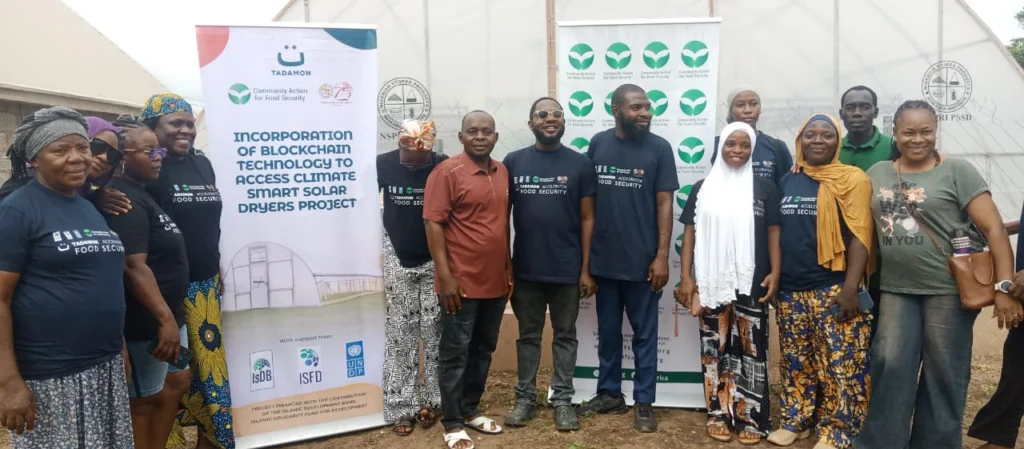
Mr Azeez Salawu, Founder of CAFS, made the call on the sidelines of a dissemination workshop on the incorporation of blockchain technology into climate-smart solar dryers at Kuchibiyi community in Bwari Area Council, FCT.
The project, supported by the UN Development Programme (UNDP) under the Tadamon Accelerator for Food Security, is aimed at addressing post-harvest losses in Nigeria’s food supply chain.
Salawu said the project, being piloted in Ilorin and the FCT, combined climate-smart infrastructure with digital technology to improve food preservation and strengthen access to shared processing facilities.
He said integrating solar-powered dryers with blockchain technology would help reduce food losses while improving transparency, equitable access and sustainability.
“Blockchain technology introduces solar-powered dryers as a clean, efficient and climate-resilient method of preserving agricultural produce.
“It also provides a blockchain-enabled platform to track usage, promote transparency and democratise access to shared infrastructure.
“We are collaborating with the Nigerian Stored Products Research Institute (NSPRI), with support from UNDP, Islamic Development Bank (IsDB) and Islamic Solidarity Fund for Development (IsFD) under the Tadamon Food Security Accelerator Project.
“We are trying to bring more transparency, trust, ownership and data to the solar dryer,” he said.
Salawu said the workshop was organised to sensitise community members to the technology, demonstrate its economic benefits and introduce them to a training manual on its use.
He said the integration would also discourage the drying of agricultural produce on bare ground or tiled roads, where it could be exposed to stones, impurities and contamination.
“The blockchain technology will help them keep proper records and know who is doing what.
“With the technology, farmers and agripreneurs can save, dry their produce properly, generate accurate data, reduce food safety challenges and improve productivity and income.
“Each produce will have a batch number and QR code that can be verified anywhere, showing the product’s location, weight, moisture content and dry content, which will boost sales,” he said.
Prof. Lateef Sanni, Executive Director, NSPRI, commended CAFS and its partners for introducing blockchain technology into the institute’s climate-smart solar dryer system.
Sanni said the initiative was a step toward digitalising post-harvest management in the country.
“We will ensure that we map out 100 locations where we have digital dryers across the country and integrate the blockchain technology.
“We will train the actors to use it to trade in terms of drying their commodities and address some of the inherent weight issues.
“We will build the capacity of farmers, processors and other actors, as well as strengthen traceability,” he said.
Residents of Kuchibiyi community also welcomed the facility, saying it had improved the way agricultural produce was dried and preserved.
Speaking on behalf of the Chief of Kuchibiyi, Mr Shaibu Kuchibiyi, said the dryer had reduced challenges associated with drying produce on bare ground.
“Before, we dried our products on the ground, exposing them to sand and animals.
“When it rains, if nobody is there to pack them, the produce will be drenched. But with this technology, whether rain or shine, there is no cause for worry.
“Within three days, your product is dried,” he said.
Kuchibiyi appealed for additional food processing equipment, including corn peelers and groundnut shellers.
He said the community had put measures in place to protect the facility from vandalism and ensure its regular maintenance.
Earlier, Mrs Ijeoma Enome, President, Agribusiness Women Cooperative, said the facility was being used by cooperative members and farmers in the community.
Enome said members now bought, dried and processed agricultural produce for different value chains using the facility.
She added that CAFS was working with the cooperative to maintain the facility and use blockchain technology to promote transparency in its operations. (NAN) www.nannews.ng
FUA/TAK
Edited by Tosin Kolade


Comments