


By Angela Atabo
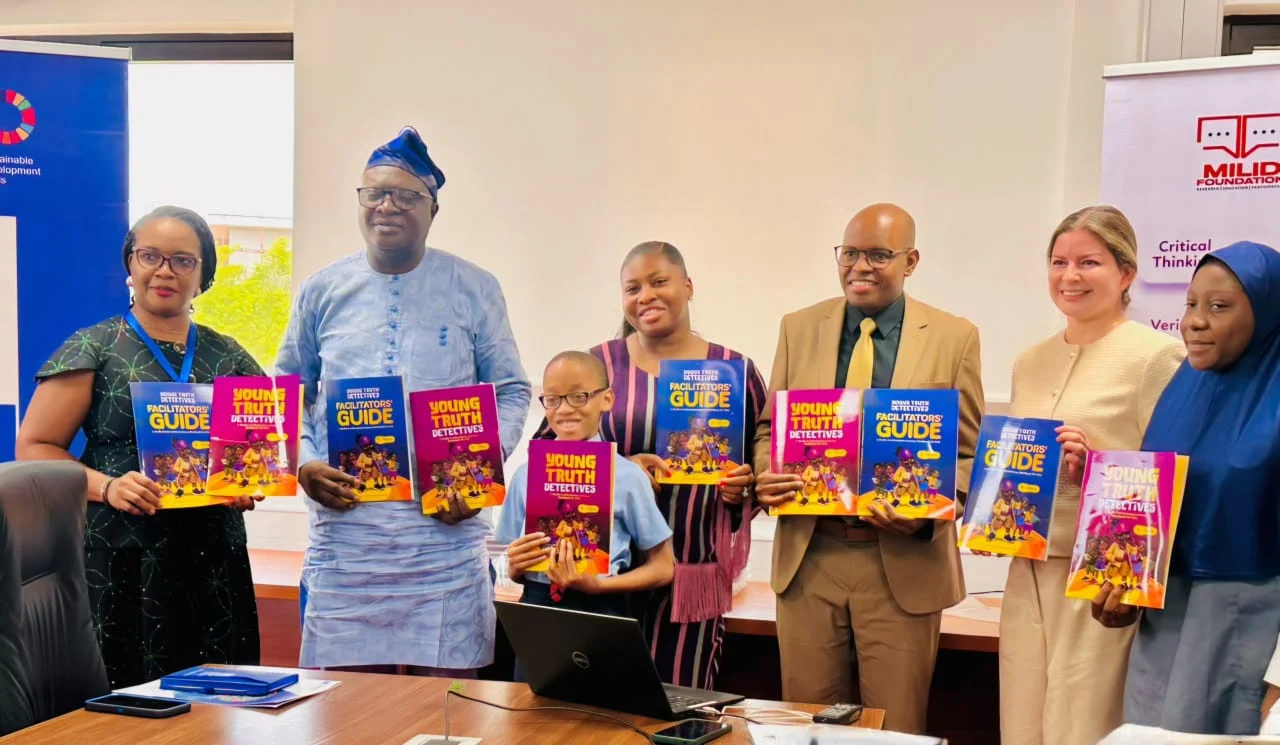
The United Nations Educational, Scientific and Cultural Organisation (UNESCO) and its partners have unveiled a media and information literacy book to help children aged six to 10 identify misinformation, fake news and online dangers.
The workbook, entitled “Young Truth Detectives (YTD),” is written by Mrs Chiamaka Okafor-Onumah, Executive Director of the Media and Information Literacy and Intercultural Dialogue Foundation (MILID Foundation).
The public presentation of the YTD and the facilitators guide was hosted by UNESCO,MILID Foundation, Zedx Original and Two Books One Pen Enhancement Initiative, on Thursday, in Abuja.
Speaking at the event, UNESCO Representative to Nigeria and Head of its Abuja Office, Dr Isaías Barreto da Rosa, said education remained the most effective tool for combating fake news, hate speech, misinformation and disinformation.
Barreto da Rosa, said “The two books address issues related to information literacy for children.This is an important topic.
“We see today all over the world an exponential increase when it comes to fake news, hate speech, disinformation, misinformation and this exponential increase of fake news, misinformation, disinformation and hate speech has to be fought.
“When we teach our young children how to be detectives of truth, how to check facts, how not to share information that are not verified, we are contributing to a better society and that is why this initiative is particularly important.”
He said UNESCO was supporting the initiative because media and information literacy was central to its efforts to promoting responsible use of social media and information.
Similarly, the Secretary-General of the Nigerian National Commission for UNESCO, Dr Lateef Idowu Olagunju, said the workbook would help children access reliable information and develop critical thinking skills before sharing news.
Olagunju said children needed to learn how to question information, establish its source and understood the motives behind its publication to keep them from harms way.
He commended the development of digital learning resources, including cartoons, to make media literacy lessons more accessible and engaging for children growing up in the digital age.
Dr Sharon Omotoso, Director of the International Media and Information Literacy Institute said parents and other stakeholders should work together to guide children’s engagement with media and technology.
Omotoso explained that parents should not only monitor their children’s online activities but also educate themselves about emerging digital risks.
According to her, children face threats ranging from online scams and identity theft to exploitation, security breaches and the misuse of artificial intelligence.
The director called for wider media literacy education to equip children with the knowledge to protect themselves from harmful online interactions and information disorder.
In her remarks, Okafor-Onumah said the initiative was developed to address the growing challenge of misinformation and disinformation by instilling responsible information habits in children from an early age.
She said many existing interventions targeted adults, journalists and young people, whereas the foundation believed that influencing information habits early could promote lasting behavioural change.
Okafor-Onumah explained that the workbook contained six missions designed to make learning interactive and enjoyable while helping children develop lifelong media and information literacy skills.
She added that a facilitator’s guide had also been developed to support teachers, parents and community members in delivering the lessons in both formal and informal settings.
According to her, the materials can be used in schools, churches, mosques and other community gatherings, making media literacy education a shared responsibility.
She said the initiative would seek partnerships with individuals and organisations willing to adopt schools, particularly in rural and underserved communities, to ensure that children outside urban centres also benefitted.
Okafor-Onumah said the books were currently not for sale, as the organisers intended to assess their usefulness and impact before determining the next steps.
She added that although the materials were initially produced in English, the foundation planned to translate them into local languages to expand access among children in communities where English was not widely spoken.
She said the initiative was designed to promote a whole-of-society approach to tackling information manipulation and strengthening information integrity in Nigeria.
She expressed hope that the workbook would help nurture a generation of children capable of critically evaluating information, verifying facts and making responsible decisions about what they consume and share. (NAN)
ATAB/KOO
===========
Edited by Kevin Okunzuwa

Comments