


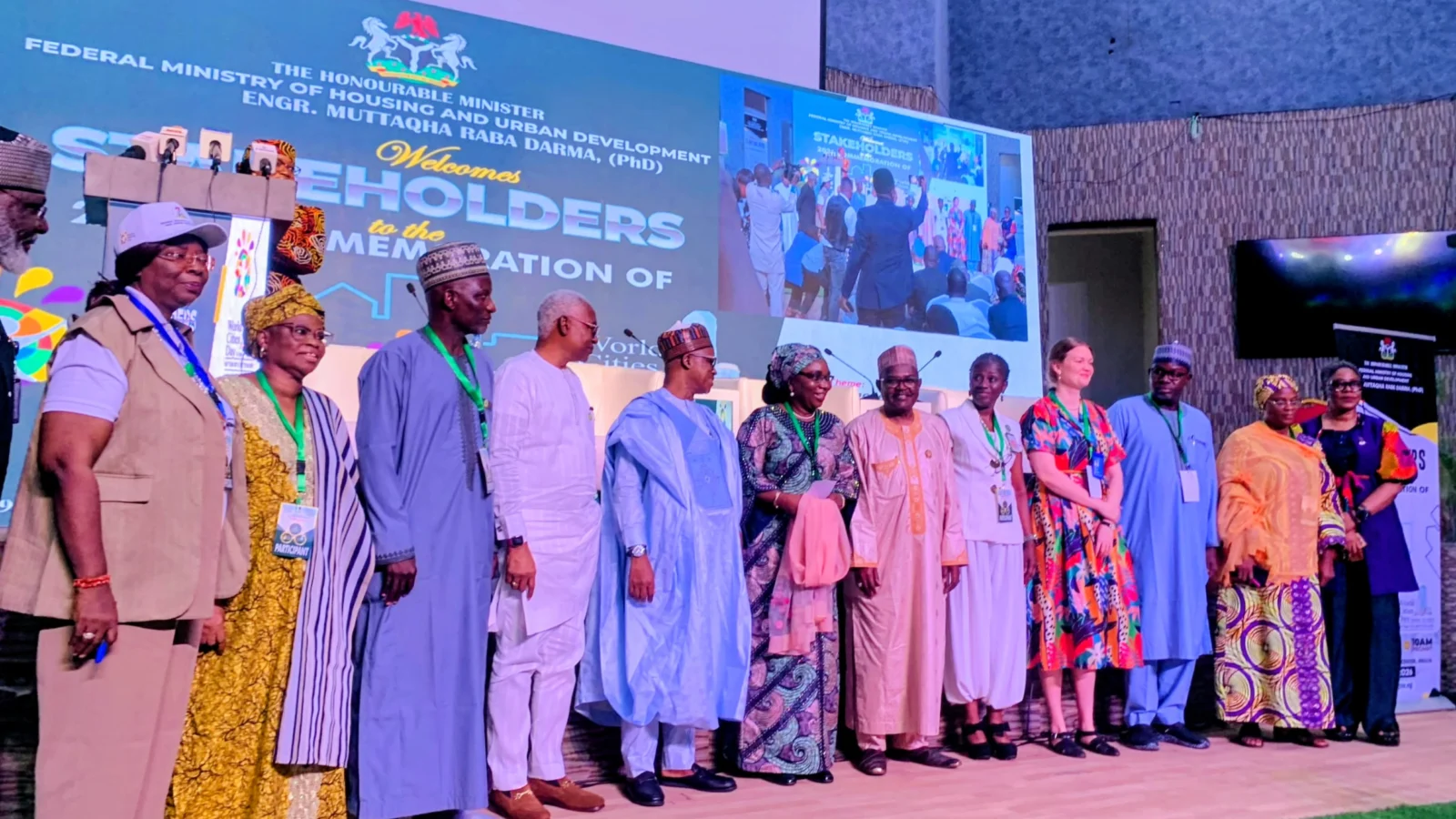
By Oyintutu Oyinkolade
The Federal Government says it is implementing reforms to strengthen housing institutions, improve service delivery, reduce construction costs and create an enabling environment for investment in the housing sector.
The Minister of Housing and Urban Development, Dr Muttaqha Darma, disclosed this at the 2026 Urban October commemoration of World Habitat Day and World Cities Day in Abuja on Monday.
The event was themed “Adequate Housing for All” and “Regenerating the City: Adequate Housing for All”, highlighting the need for inclusive housing and sustainable urban development.
Darma, represented by his Chief of Staff, Dr Abba Yakubu, stressed the importance of expanding access to affordable housing and promoting sustainable urban development across the country.
He said the government was implementing reforms to strengthen housing institutions, improve coordination among relevant agencies and enhance service delivery in the sector.
“The Federal Ministry of Housing and Urban Development is implementing reforms to strengthen housing institutions, improve service delivery and create an enabling environment for investment,” he said.
The minister explained that the reforms included improved coordination among federal housing agencies, strengthened land administration and effective physical planning.
He said the ministry was also aligning housing delivery with national urban development priorities to ensure that housing projects addressed the country’s growing needs.
Darma added that the government was promoting local building-materials manufacturing hubs to reduce construction costs and make housing more affordable for Nigerians.
He said the government was implementing the Renewed Hope Cities and Estates Programme, which targets the delivery of 100,000 housing units across the 36 states and the Federal Capital Territory.
According to him, the programme provides different housing options through Renewed Hope Cities, Renewed Hope Estates and the proposed Renewed Hope Social Housing initiative.
The minister stressed that increasing the supply of housing units must be accompanied by measures to ensure that Nigerians could afford to own homes.
He identified high interest rates, limited long-term funding, stringent eligibility requirements and low mortgage penetration as major obstacles to homeownership in the country.
Darma said the ministry was strengthening the Federal Mortgage Bank of Nigeria, the Nigeria Mortgage Refinance Company and other financial institutions to improve access to affordable housing finance.
He called for stronger partnerships among federal, state and local governments, private developers, financial institutions and development partners to address the country’s housing challenges.
Earlier, the Permanent Secretary of the ministry, Dr Shuaib Belgore, represented by Mrs Margaret Adejobi, Director of Urban and Regional Development, said adequate housing and sustainable urbanisation required effective policies and collaboration among stakeholders.
Adejobi said rapid urbanisation, increasing housing demand, rising construction costs, infrastructure deficits and environmental challenges continued to place pressure on Nigerian cities and communities.
She emphasised the importance of coordinated efforts to address the challenges, noting that sustainable urban development required contributions from both public and private sector stakeholders.
“Achieving these objectives requires effective policies, integrated urban planning, innovative housing finance, strong institutional coordination and collaboration among the public and private sectors, professional bodies, development partners and citizens,” she said.
Adejobi said the commemoration provided an opportunity for stakeholders to examine housing and urban development challenges and identify practical solutions to improve living conditions.
In his remarks, UN Secretary-General António Guterres, said more than three billion people worldwide were denied adequate housing, while over one billion lived in informal settlements and slums.
Guterres, represented by Niina Rinne, Chief Technical Adviser and Head of the UN-Habitat Nigeria Country Office, stressed that addressing the global housing crisis required more than constructing additional houses, calling for better planning of neighbourhoods and cities.
“We cannot address the housing challenge simply by constructing more houses. We must also plan better neighbourhoods and better cities,” Guterres said.
He explained that adequate housing should be safe, affordable and well located, with access to basic services, infrastructure, employment opportunities, public transportation and public spaces.
Guterres warned that poorly located housing could increase transportation costs, place additional pressure on infrastructure and expose communities to environmental risks.
He called for coordinated action by national and local governments, stronger partnerships and affordable financing to enable developing countries to invest in housing on a larger scale.
World Habitat Day is observed on the first Monday of October, while World Cities Day is marked on Oct. 31, with both observances forming part of Urban October, a UN-Habitat initiative promoting sustainable urban development.(NAN))
Edited by Deji Abdulwahab
Comments