



By Angela Atabo
The Federal Mortgage Bank of Nigeria (FMBN) says it approved more than N208 billion in housing and mortgage loans and financed 6,911 affordable housing units in 2025.
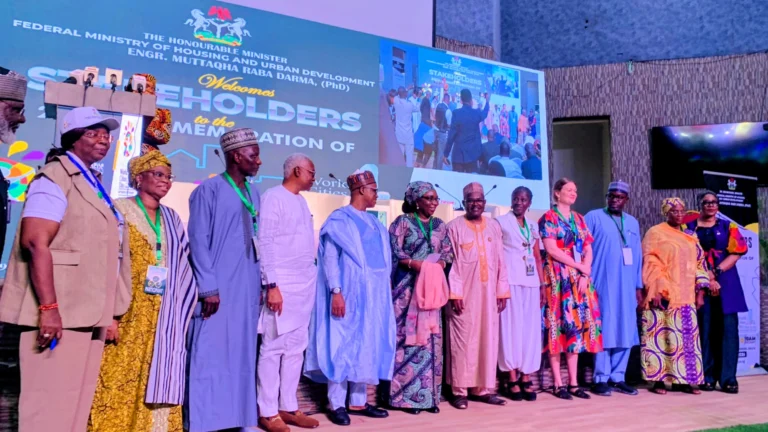
The Managing Director and Chief Executive Officer of FMBN, Mr Shehu Osidi, disclosed this at the 2026 World Habitat Day and World Cities Day commemoration in Abuja on Monday, organised by the Federal Ministry of Housing and Urban Development.
Osidi said the 6,911 housing units represented 96 per cent of the bank’s annual target of 7,200 units under the 2025 Presidential and Ministerial Deliverables.
“Under the 2025 Presidential and Ministerial Deliverables, the Bank financed 6,911 affordable housing units, representing 96 per cent of its annual target of 7,200 units.
“During the period, over N208 billion in housing and mortgage loans was approved.
“Over N120 billion disbursed to support housing construction, mortgage financing, home renovation, cooperative housing, and Rent-to-Own initiatives.”
According to Osidi, the achievements underscore the bank’s role in expanding access to affordable housing for Nigerians.
“As Nigeria’s foremost mortgage institution and the custodian of the National Housing Fund (NHF), the central theme of this event, ‘Adequate Housing for All’, resonates with our slogan and belief that ‘Everyone Deserves a Home’,” he said.
Osidi said the bank had facilitated thousands of mortgages since its establishment, providing Nigerians with opportunities to own homes with dignity.
He explained that FMBN was expanding its interventions to address the changing housing needs of Nigerians through products such as the Rent-to-Own Scheme, Home Renovation Loans, NHF Diaspora Mortgage Loan and Non-Interest Mortgage Financing.
The managing director said the bank had formally inaugurated the Diaspora NHF Mortgage Loan to enable Nigerians living abroad to invest in affordable housing in the country.
He also announced plans to begin implementing the Non-Interest Mortgage Product and Rent Assistance Product before the end of October.
According to him, the Non-Interest Mortgage Product is designed for NHF contributors who prefer ethical financing options.
He explained that the Rent Assistance Product is expected to ease rental payment burdens for federal civil servants and provide a pathway towards eventual homeownership.
Osidi said FMBN would continue collaborating with the Federal Ministry of Housing and Urban Development and other stakeholders to expand access to housing finance and support affordable housing delivery.
He urged stakeholders to work towards building resilient, inclusive and sustainable cities where adequate housing would be accessible to all.
Earlier, the National President of the Nigerian Institute of Town Planners (NITP), Dr Ogbonna Chime, called for coordinated action to address Nigeria’s housing deficit, informal settlements and inadequate urban infrastructure.
Chime, represented by Dr Garba Jibrin, the institute’s Second National Vice-President, said the theme highlighted the need to ensure access to affordable and inclusive housing while transforming cities into functional, resilient and liveable settlements.
He said addressing the country’s housing challenges required more than the construction of housing units, emphasising the importance of effective physical planning, sound land management, infrastructure provision, urban regeneration and appropriate development control.
“Urban and regional planning professionals have a strategic role in guiding urban growth, coordinating land use and integrating housing with transportation, environmental management and essential public services,” he said.
Chime emphasised the need for stronger collaboration among the three tiers of government, professional bodies, the private sector, academia and local communities to achieve sustainable urban development.
He also called for greater attention to youth-driven initiatives, climate action and urban resilience, noting that young people should be empowered to contribute innovative solutions to urban challenges.
According to him, climate considerations must inform housing delivery, urban regeneration and infrastructure development.
Chime urged stakeholders to translate the outcomes of the commemoration into practical policies, coordinated programmes and measurable interventions to improve housing accessibility and the quality of urban life.(NAN)
Edited by Abiemwense Moru


Comments