



By Aderogba George
International development partners have called for stronger institutions, digital solutions and cross-border cooperation to combat human trafficking and improve support for survivors in Nigeria.
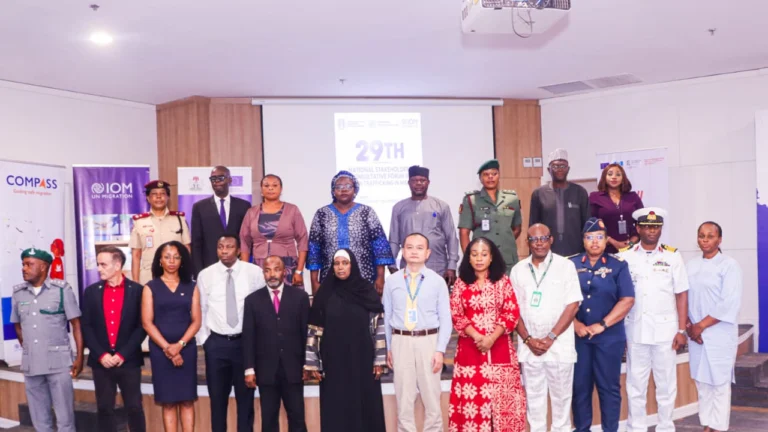
They made the call on the sidelines of the 29th National Stakeholders’ Consultative Forum (NSCF) on Human Trafficking in Nigeria on Tuesday in Abuja.
Mr Javier Leon, Team Lead, Foundation for the Internationalisation of Public Administration (FIAP), said sustained collaboration among government agencies, law enforcement, civil society and international partners was vital to tackling trafficking.
Leon acknowledged Nigeria’s efforts, noting that the National Agency for the Prohibition of Trafficking in Persons (NAPTIP) played a key role in the response.
He said FIAP was implementing a European Union-funded project to support migration governance in Nigeria, in collaboration with NAPTIP, the United Nations Office on Drugs and Crime (UNODC) and Nigerian partners.
The project, he said, aimed to strengthen institutions, improve investigative capacity and enhance responses to human trafficking and migrant smuggling.
Leon said the ongoing review of the National Action Plan provided an opportunity to assess progress, identify gaps and set priorities for the next phase.
He urged stakeholders to measure success by the lives protected, victims supported and potential victims prevented, rather than meetings held and officers trained.
Similarly, Mr Mathias Esene, representative of the International Centre for Migration Policy Development (ICMPD), said stronger institutions and survivor-centred interventions were critical to combating trafficking.
Esene said ICMPD was working with NAPTIP through anti-trafficking education and advocacy initiatives and the T-PAC Project, funded by the Government of the Netherlands.
He said the initiatives combined prevention with institutional strengthening, improved investigations and better support for survivors.
Esene said that 160 investigators and prosecutors had received specialised training across eight target states under the organisation’s capacity-building intervention.
He added that support for NAPTIP’s Cybercrime Response Team and Joint Case Team on Cybercrime had improved their capacity to investigate digital evidence and technology-enabled crimes.
He urged stakeholders to translate the gains into better institutional coordination and improved access to protection, dignity and justice for survivors.
Also speaking, Mrs Ojoma Ali, representative of the Swiss Government, said digital technology could strengthen trafficking prevention and facilitate assistance to victims across borders.
Ali cited the recent rescue of four girls from Kogi State who were trafficked to Mali, saying a distress message sent through digital channels helped trigger a coordinated response.
She said the response involved NAPTIP, civil society organisations and Nigerians in Mali.
Ali commended those involved in the rescue and urged sustained support to help the survivors recover and rebuild their lives.
She said digital platforms could enable prospective migrants to verify job offers before travelling, while secure case-management systems could improve information sharing among agencies handling trafficking cases.
She, however, emphasised that technology-driven interventions must respect privacy, data protection and survivors’ dignity.
Ali reaffirmed Switzerland’s commitment to supporting Nigeria’s anti-trafficking efforts as the country prepared its 2027–2031 National Action Plan.
She said Nigeria and Switzerland had marked 15 years of migration partnership and recently held a meeting of their Joint Technical Committee on Migration in Benin.
Ali added that Switzerland had signed a new project with the Kofi Annan International Peacekeeping Training Centre in Ghana, which would consider Nigerian participants for a migration management course scheduled for late January.
She said Switzerland would sustain its support for Nigeria’s migration management and anti-trafficking efforts.
The News Agency of Nigeria (NAN) reports that the National Stakeholders’ Consultative Forum brings together government institutions, development partners and civil society organisations to discuss strategies for preventing human trafficking and strengthening protection for victims.(NAN)
Edited by Abiemwense Moru


Comments