


By Talatu Maiwada
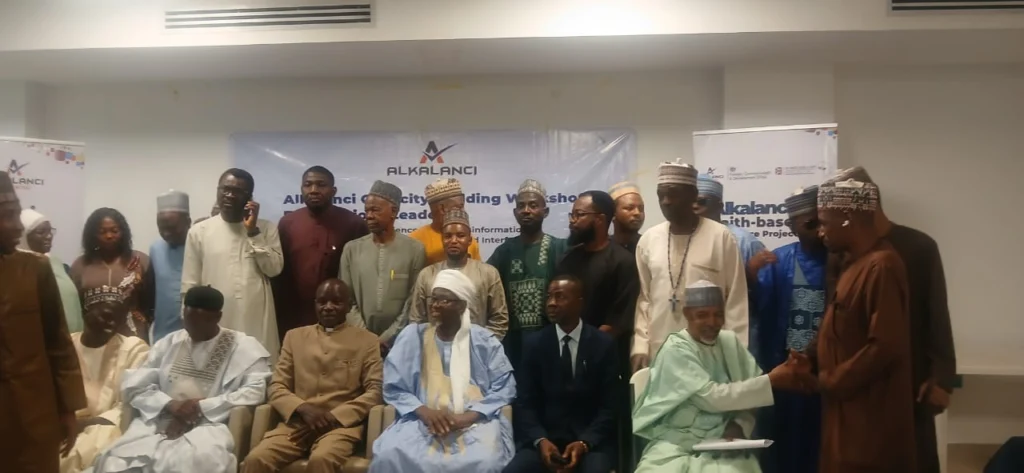
Alkalanci, a Non-Governmental Organisation (NGO), has urged religious leaders in Adamawa to promote responsible information sharing and discourage fake news and disinformation to sustain peace and unity.
Ms Victoria Bamas, Programme Manager, Alkalanci, made the call at a two-day workshop organised by the NGO for religious leaders in Yola.
The workshop, themed “Scaling Faith-Based Resilience Against Disinformation and Foreign Information Manipulation and Interference (FIMI)”, was funded by the Foreign, Commonwealth and Development Office and ISF West Africa.
Bamas said the organisation initiated the training after observing that false information was spreading faster than fact-checkers could verify it.
She said the organisation adopted a train-the-trainer approach, targeting religious leaders because of their influence, credibility and close relationships with grassroots communities.
“We decided to engage people who are influential and trusted and religious leaders fall under this category.
“The idea is to equip them with the necessary skills so they can return to their communities and disseminate the knowledge,” she said.
She identified the monetisation of false information as an emerging challenge, noting that some individuals deliberately circulated sensational and misleading content to generate online engagement and financial benefits.
According to her, incentives associated with online visibility, advertising and exposure had worsened the spread of misinformation and propaganda.
Bamas said the organisation was training 20 religious leaders in Adamawa, using smaller interactive sessions to ensure effective participation and practical learning.
She expressed optimism that the initiative would strengthen information literacy and encourage religious leaders to incorporate responsible communication into their regular teachings.
Rev. Joel Manzo, Chairman, Christian Association of Nigeria (CAN), Adamawa Chapter, described the workshop as timely, saying unverified information often triggered confusion, misunderstandings and conflicts in communities.
Manzo urged religious leaders to exercise restraint in their public statements and promote mutual respect, peaceful coexistence and unity among their followers.
“Most of the things people communicate and disseminate are not verified, and such information causes confusion and misunderstanding among us,” he said.
He urged participants to pay attention to the training and ensure that the knowledge acquired was transferred to their respective communities.
Manzo also called on religious leaders to use their pulpits, worship centres and social media platforms to promote truth, reconciliation and responsible communication.
He said responsible information sharing was not only a civic obligation but also a faith-based responsibility, citing biblical teachings on truthfulness and the rejection of falsehood.
Similarly, Malam Bappare Umar, State Secretary, Jama’atul Nasril Islam (JNI), Adamawa Chapter, described the initiative as important, given the state’s diverse ethnic, religious and cultural composition.
Umar said the training would equip religious and traditional leaders with the knowledge to address misinformation and prevent messages capable of triggering conflicts between communities.
He called for the extension of the training to local government areas and wards to ensure that grassroots communities benefited from the initiative.
Ahead of the 2027 general elections, Umar urged media practitioners and information activists to guide non-professional social media users on responsible information dissemination.
He observed that the increasing use of digital platforms had made it easier for individuals to manipulate information and circulate misleading content.
“Not everybody using social media is highly enlightened; some people can react to information wrongly and use it in ways that may cause problems,” he said.(NAN).
Edited by Abiemwense Moru
Comments