


By Angela Atabo
The Secretary to the Government of the Federation (SGF), Sen. George Akume, and the Surveyor-General of the Federation (SGOF), Abdulganiyu Adebomehin, have urged African countries to invest in geospatial technology to accelerate development.
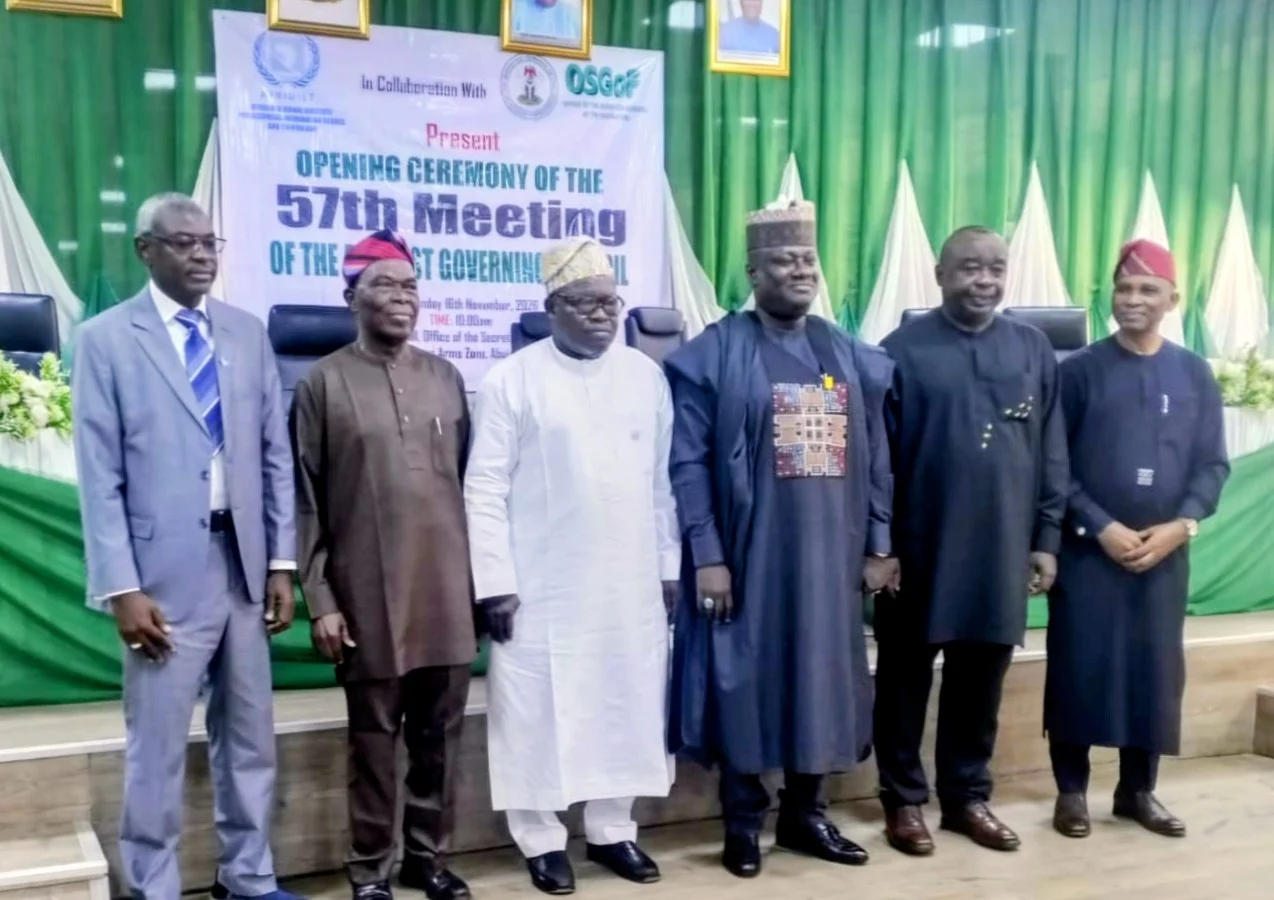
They made the call at the opening of the 57th Meeting of the Governing Council of the African Regional Institute of Geospatial Information Science and Technology (AFRIGIST), on Monday in Abuja.
Akume, represented by the Permanent Secretary, General Services Office, OSGF, Dr Abubakar Kana, said geospatial information had become indispensable in addressing the continent’s growing developmental challenges through informed, ta-driven and innovative solutions.
“The African continent is increasingly confronted with complex developmental challenges that require informed, data-driven, and innovative solutions.
“Whether in the areas of land administration, or urban planning, agriculture, environmental management, infrastructure development, disaster risk reduction, security, or climate resilience, the role of geospatial information has become indispensable.
“Accurate and timely geospatial data now serves as a critical foundation for effective governance and sustainable development.”
Akume urged AFRIGIST, as Africa’s foremost regional institution dedicated to capacity building on geospatial science and technology, to continue to provide leadership in developing the human and institutional capacities.
He said this would aid in providing the required capacity to harness the immense potential of geospatial information for the benefit of African nations and its people.
He said reliable geospatial data and skilled professionals were essential to achieving the African Union’s Agenda 2063, the Sustainable Development Goals and other regional development frameworks.
He urged the Governing Council to use the meeting to review the institute’s programmes, strengthen partnerships, explore innovative funding mechanisms and establish a strategic direction to enhance its relevance.
The SGF said the challenges confronting Africa transcended national boundaries and required collective action and regional cooperation.
Akume noted that as digital transformation continued to reshape economies and societies, geospatial information would remain vital to evidence-based decision-making.
On his part, Adebomehin said the meeting provided an opportunity to review the institute’s performance and strengthen its governance and sustainability.
Adebomehin, who is also the Chairman of AFRIGIST governing council, said growing demand for geospatial information across Africa had made the institute’s mandate increasingly important to economic planning, food security, environmental management, public health and national security.
He noted that emerging technologies, including artificial intelligence, earth observation systems, unmanned aerial systems and geospatial data analytics, required the institute to continually adapt to changing needs.
He said the council would examine policy and financial matters, assess the institute’s activities and consider strategic initiatives to ensure its continued relevance.
Adebomehin urged member states to sustain their support through collaboration, investment and active participation in AFRIGIST programmes.
The Executive Director of AFRIGIST, Prof. Lazarus Ojigi, said the institute has trained no fewer than 4,000 professionals from over 29 African countries since its establishment in 1972.
Ojigi said the institute had continued to build critical human capacity in the application of aerospace and geospatial information science and technology across the continent.
He said the trainees included civil servants, military and paramilitary personnel, including technicians to postgraduate qualifications, professional master’s degrees and PhDs.
He described the institute as a bilingual pan-African institution operating in English and French under the auspices of the United Nations Economic Commission for Africa (UNECA).
Ojigi commended the Federal Government for sustaining the institute’s vision and mandate, noting that Nigeria had satisfactorily fulfilled its obligations as host country, particularly in infrastructure development.
He said eight member states, namely Benin, Burkina Faso, Cameroon, Ghana, Mali, Niger, Nigeria and Senegal, currently supported the institute through biennial recurrent budget contributions.
The executive director said the institute was expanding its membership base, with discussions ongoing with Côte d’Ivoire, Guinea-Bissau, Liberia, South Africa, Rwanda, Togo and Sierra Leone.
Ojigi identified UNECA as a strategic partner, adding that the institute also maintained academic and technical partnerships with Obafemi Awolowo University, Ile-Ife, the Federal University of Technology, Akure, and the University of Abomey-Calavi, among others.
He however, identified the need for additional funding to establish an Advanced Geospatial Data Processing Laboratory for e-learning and Geospatial Artificial Intelligence (GeoAI).
According to him, the laboratory, already approved for establishment, will strengthen advanced geospatial analytics, remote capacity building, cloud computing, machine learning and research collaboration. (NAN)
Edited by Folasade Akpan

Comments