


By Millicent Ifeanyichukwu
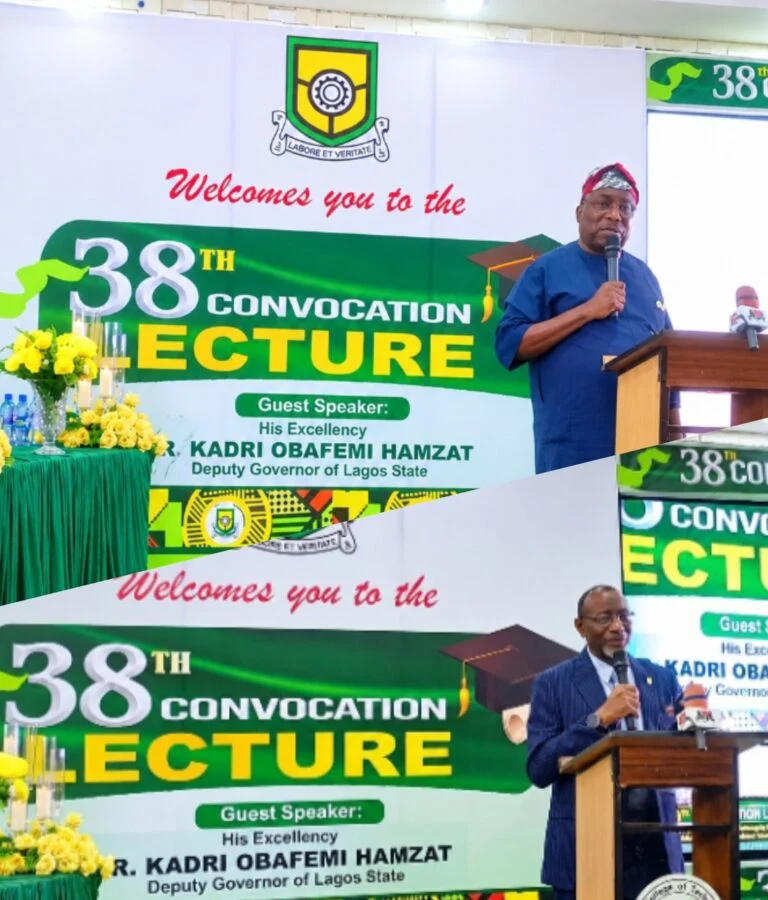
Lagos State Deputy Governor, Dr Obafemi Hamzat, has called for stronger partnerships between tertiary institutions and industries to bridge skills gaps and accelerate national development.
Hamzat made the call in a lecture delivered on his behalf by the Commissioner for Tertiary Education, Mr Tolani Sule, at YABATECH’s 38th Convocation Lecture on Tuesday.
The News Agency of Nigeria (NAN) reports that the lecture was titled, ‘From Silos to Energy: Reimagining Nigeria’s Tertiary Education System for National Transformation’.
He said Nigeria must move beyond certificate-driven education to prioritise practical competence, innovation and creativity, enabling graduates to address real-world challenges.
According to him, the question was no longer simply what graduates knew, but what they could do with their knowledge.
Hamzat identified weak academia-industry relations, poor research commercialisation, institutional rivalry and inadequate policy coordination as major obstacles to effective tertiary education.
He urged industries to participate actively in curriculum development, workplace training, applied research and skills assessment to ensure graduates acquired relevant labour-market competencies.
“Industry should not be a distant observer of tertiary education. It must become an active stakeholder in shaping the competencies, research priorities and practical experiences that our institutions provide,” he said.
He also advocated stronger collaboration among universities, polytechnics and colleges of education through joint research, shared facilities, credit transfers and flexible academic pathways.
On innovation, Hamzat said research findings should translate into marketable products, technologies and practical solutions rather than remain confined to academic publications.
“Research should not end with publication. It should also find expression in products, processes, policies and solutions that improve lives,” he said.
He called for increased investment in technical and vocational education, digital literacy, artificial intelligence and entrepreneurship.
He urged the private sector, alumni and development partners to support tertiary education financing.
However, he stressed that private-sector participation should complement, not replace, government’s responsibility for education funding.
He added that such partnerships must guarantee transparency and measurable outcomes.
Speaking on Lagos State’s initiatives, Hamzat said establishing the Ministry of Tertiary Education in 2023 had strengthened coordination and monitoring of state-owned institutions.
He added that the state was pursuing digital learning, research collaboration, staff development, accreditation and infrastructure improvement.
He also cited efforts to harmonise salary disparities across its tertiary institutions.
Describing YABATECH as a major contributor to technical and vocational education, Hamzat urged it to deepen industry partnerships, applied research and entrepreneurship.
He cited the institution’s research in food preservation and waste-to-energy innovation as examples of academic knowledge addressing societal challenges.
“YABATECH’s next chapter should be defined not only by the number of graduates it produces, but also by the quality of solutions, enterprises, innovations and professionals,” he said.
Earlier, YABATECH Rector, Dr Ibraheem Abdul, said stronger collaboration among tertiary institutions, industries, researchers and government was essential to national transformation.
Abdul said education, industry, research and public policy had operated largely within separate institutional boundaries, limiting shared learning, innovation and collective impact.
He said the challenge was building institutional connections to translate existing knowledge and talent into meaningful national progress.
“We must move beyond producing graduates for the labour market to developing innovators, entrepreneurs and problem-solvers who can shape the economy of tomorrow,” he said.
Abdul said YABATECH was strengthening industry-responsive education through initiatives including the National Skills Qualification Framework and proposed Solar-Powered Smart Campus Ecosystem.
Other initiatives included the Digital Technology Academy and YabaTech Skills Centre.
He described President Bola Tinubu’s approval of the institution’s conversion into the Federal University of Technology and Vocational Studies, Yaba, as a major milestone.
According to him, the transition brought greater responsibilities, including strengthening applied research, advanced skills development and industry partnerships while maintaining academic standards.
The rector commended the Federal Ministry of Education for supporting technical and vocational education.
He also appreciated the Lagos State Government for rehabilitating the students’ hostel damaged by fire.
He urged graduating students to embrace lifelong learning, entrepreneurship and creativity, stressing that their contributions to society would determine the value of their education.
“Success is not merely the number of graduates we produce, but the difference they make,” he said.
Abdul urged stakeholders to move beyond discussions and build partnerships that delivered sustainable development outcomes. (NAN)
MIL/KTO
=========
Edited by Kamal Tayo Oropo


Comments