


By Fortune Abang
Amb. Sola Enikanolaiye, Minister of State for Foreign Affairs, has called on political stakeholders to work collectively to strengthen anti-corruption reforms and advance Nigeria’s democracy.
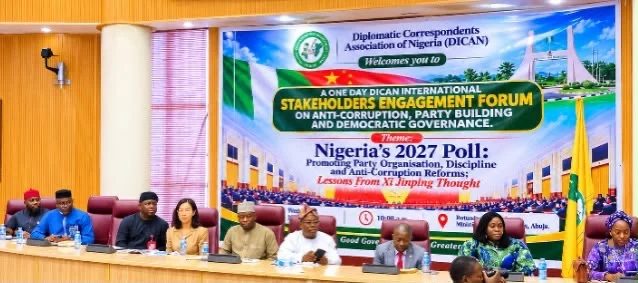
Enikanolaiye gave the advice at a one-day international stakeholders’ engagement forum organised by the Diplomatic Correspondents Association of Nigeria (DICAN), in Abuja.
The forum is themed: “Nigeria’s 2027 Poll: Promoting party organisation, discipline and anti-corruption reform: Lessons from President Xi Jinping’s thoughts” focused on strengthening democratic growth.
Enikanolaiye, represented by Mr Mohammed Aliyu, Assistant Director of Administration in the ministry, stressed that Nigeria’s 4Ds foreign policy prioritised Demography, Development, Diaspora and Democracy, to achieve set targets.
He said that anti-corruption and party building are not only fundamental pillars of democratic governance, but essential for strengthening democratic institutions.
According to him, it also ensures inclusivity in political participation, upholding the rule of law, promotion of transparency and accountability, as well as fostering public trust in governance.
In his remarks, Mr Ola Olukoyede, Chairman, Economic and Financial Crimes Commission (EFCC), reaffirmed the commission’s resolve to boost the fight against financial crimes.
According to Olukoyede, represented by Mr Dele Oyewale, EFCC’s Head of Media and Publicity, Nigeria remains committed to fighting corruption in line with international best practices.
“The best export we can make to the rest of the world is what we do with the issue of corruption; The best diplomatic statement we make to the rest of the world is our commitment to fight corruption,” he said.
Dong Hairon, the representative of the Chinese Embassy in Nigeria, restated the country’s readiness to work more closely with Nigeria through Xi Jinping’s models in tackling corruption.
According to her, Xi’s model centered on curbing corruption and has not only helped to build public trust in the country but also gain Chinese people’s support in advancing modernisation goals.
“China has been able to sustain the campaign against corruption since 2012, by operating a zero-tolerance policy with full coverage and no exception,” she said.
Dr Yusuf Dantalle, Chairman, Inter-Party Advisory Council (IPAC) and National Chairman, Allied Peoples Movement (APM), commended DICAN for convening the forum, describing it as a strategic dialogue.
According to him, while Nigeria and Chinese systems differ in terms of party discipline, institutional strengthening and anti-corruption governance, a lot could be learnt from Xi’s thoughts.
“Valuable lessons such as ways to strengthen political party organisation, promote discipline and commitment to national interest, drive development and stability, can be learnt,” he said.
Dr Otive Igbuzor, founding Executive-Director of African Centre for Leadership, Strategy & Development (Centre LSD), said that China’s experience under Xi offered important comparative insights for Nigeria.
“Xi’s thought on socialism with Chinese characteristics for the new era emphasises ideological commitment.
“Others include strong party organisation, leadership development, organisational discipline, anti-corruption, institutional effectiveness and people-centred development,” Igbuzor said.
Dr Charles Onanuju, Director, Centre for China Studies (CCS), recounted the 18th National Congress of the Communist Party of China in 2012, to extol Chinese governance growth.
“Modern China’s governance and the clarity of its process are considerably illuminated by Xi Jinping’s thoughts,” he said.
On his part, Mr Henry Mbadiwe, Registrar/Chief Executive Officer, Chartered Institute of Project Managers of Nigeria (CIPMN), underscored the need for democratic institutions to reflect on good leadership, institutional discipline, accountability and collective national aspirations.
Earlier, Mr Idehai Frederick, DICAN’s Chairman, expressed the organisation’s appreciation to the speakers for their contributions to the constructive dialogue, saying such would advance Nigeria’s preparation ahead of the 2027 elections.
“The forum was designed to bring stakeholders together, to exchange ideas on strengthening governance, improving political party structures and advancing anti-corruption reforms in Nigeria,” he said.
The forum attracted policymakers, diplomats, political actors, scholars and civil society representatives to discuss the way forward for governance and democratic reforms ahead of Nigeria’s general elections. (NAN)
Edited by Joseph Edeh
Comments