


By Raji Rasak
The Renewable Energy Association of Nigeria (REAN) has called for stronger collaboration among industry stakeholders to promote safety compliance, uphold technical standards and accelerate sustainable growth of Nigeria’s renewable energy sector.
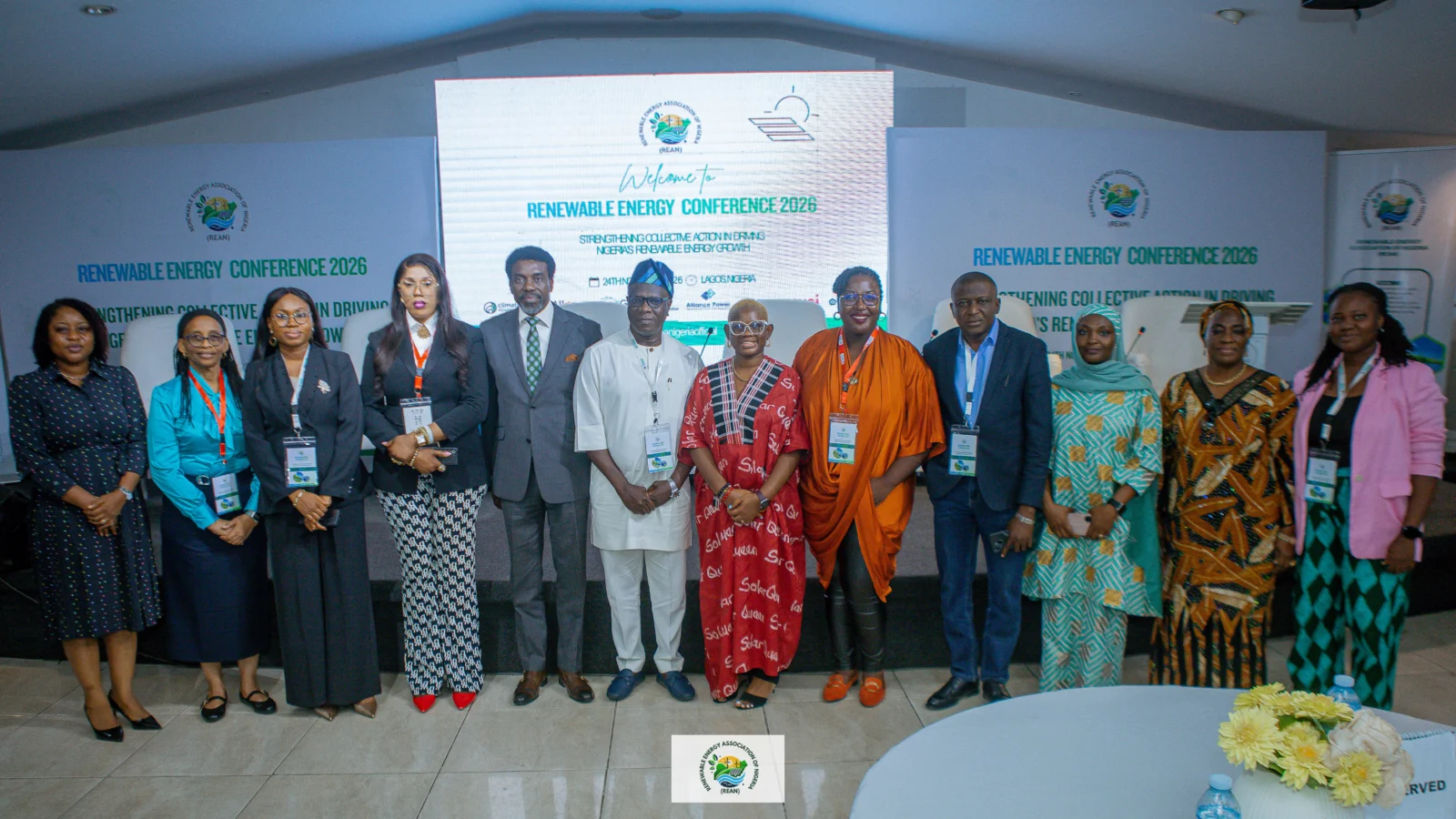
The President of REAN, Mr Ayo Ademilua, made the call at the association’s conference in Lagos on Tuesday, with the theme: “Strengthening Collective Action in Driving Nigeria’s Renewable Energy Growth”.
Ademilua said the conference provided an opportunity for policymakers, regulators, investors, financiers, development partners and renewable energy developers to strengthen collaboration and develop practical solutions to challenges facing the sector.
He said Nigeria needed to move beyond small-scale achievements to delivering renewable energy projects with significant megawatt capacity, adding that collective efforts would accelerate development across the country’s geopolitical zones.
“Individually, we are making tiny steps, but collectively, we can do amazing things across different geopolitical zones,” he said.
In his keynote address, Mr Olusegun Adesayo, Managing Director of the Nigerian Electricity Management Services Agency (NEMSA) and Chief Electrical Inspector of the Federation, emphasised the importance of strict adherence to safety and technical standards in expanding renewable energy infrastructure.
Adesayo warned that increasing electricity access without adequate attention to safety, quality and technical standards could undermine Nigeria’s energy transition.
He said Nigeria had enormous renewable energy resources, particularly solar energy, which offered opportunities to expand electricity access, create jobs, attract investments and stimulate economic growth.
He identified the Presidential Power Initiative, the Distributed Access through Renewable Energy Scale-up (DARES) Project and other power sector reforms as initiatives promoting private sector participation and sustainable energy development.
According to him, the initiatives demonstrate the Federal Government’s commitment to building an electricity sector capable of supporting industrialisation, economic growth and improved living standards.
He, however, warned that poor-quality equipment, substandard installations and non-compliance with technical requirements posed serious risks to lives, property, investments and public confidence in renewable energy technologies.
Adesayo said NEMSA remained committed to ensuring that renewable energy infrastructure deployed across the country met prescribed safety and technical standards.
“Our responsibility is to ensure that solar installations, mini-grids, electrical equipment and other associated infrastructure are not only functional and efficient but also safe, reliable and compliant with applicable standards.
“At NEMSA, we firmly believe that electrical safety is not an option; it is a fundamental requirement for sustainable development,” he said.
He urged renewable energy developers, contractors, manufacturers and investors to prioritise compliance at every stage of project development, from conception and installation to commissioning and operation.
Also speaking, the Lagos State Commissioner for Energy and Mineral Resources, Mr Biodun Ogunleye, reaffirmed the state’s commitment to developing a diversified, resilient and sustainable energy ecosystem.
Ogunleye, represented by Mrs Ifeoluwa Akolade, Assistant Director, Lagos State Ministry of Energy and Mineral Resources, said the state had moved beyond policy formulation to implementation across the energy value chain.
He said meaningful progress in renewable energy required a shared vision, coordinated action and sustained collaboration among government, the private sector, development partners, financial institutions and technology providers.
According to him, renewable energy is no longer merely an alternative to conventional energy sources but an essential component of the future energy sector.
Similarly, the Chairman of the Nigerian Electricity Regulatory Commission (NERC), Dr Musiliu Oseni, reaffirmed the commission’s commitment to providing regulatory certainty and maintaining an open-door policy for industry stakeholders.
Oseni, represented by Mr Malik Kabir, Deputy Manager, Renewables, NERC, said the commission introduced clearer regulatory frameworks in 2026 to support the growth of the renewable energy industry.
He said NERC issued the Mini-Grid Regulations 2026 in April, extending the framework to isolated mini-grids of up to five megawatts and interconnected mini-grids of up to 10 megawatts per site.
He added that the regulations required distribution companies to publish the hosting capacity of their feeders and provided investors with clearer protection when the national grid was extended to their locations.
Oseni also said NERC issued the Net Billing Regulations 2026 in June, allowing eligible customers with solar systems between 50 kilowatt-peak and 1.5 megawatt-peak to export surplus electricity to the network and receive credits on their bills.
“Put simply, the roof over your head can now help pay your electricity bill. We are working with the distribution companies on implementation,” he said.
He congratulated REAN on its 10th anniversary, noting that the association was established in November 2016 to provide a unified voice for the renewable energy industry.
“Ten years is no small achievement in this industry. Today, REAN is a trusted partner of the commission,” he said(NAN)
Edited by Yunus Yusuf




Comments