


By Deji Abdulwahab
President Bola Tinubu has urged Nigerians, particularly the Muslim Ummah, to invest in public trust and institutions that will outlive them.
Tinubu said such investments would promote sustainable development, strengthen communities and ensure that the benefits of generosity continued to serve humanity beyond the lifetime of individuals.
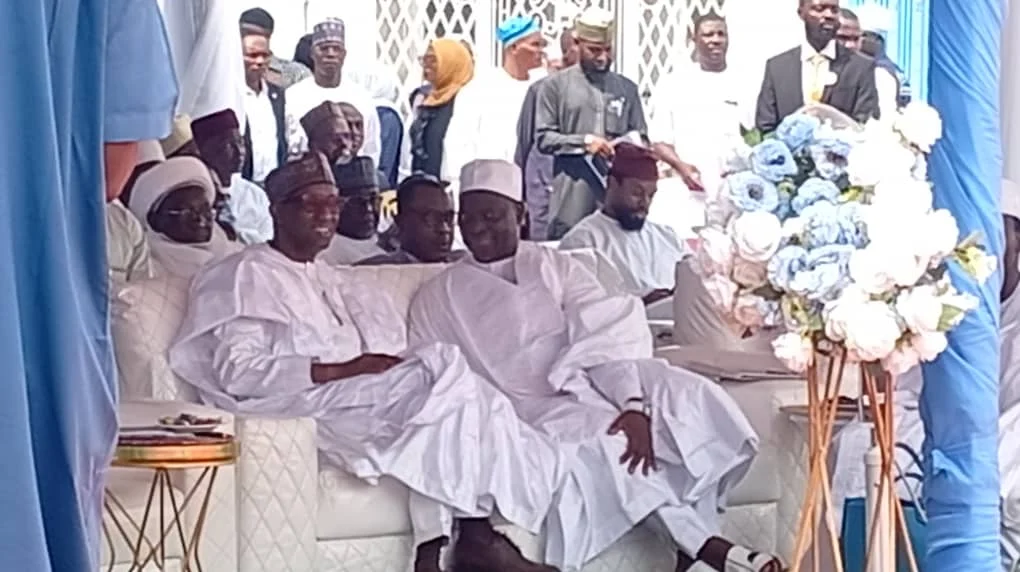
The President, represented by the National Security Adviser (NSA), Malam Nuhu Ribadu, made the call on Friday, at the inauguration of Al-Habibiyyah Islamic Centre Jumu’ah Masjid and the launch of its N3 billion Waqf Endowment Fund in Abuja.
The News Agency of Nigeria (NAN) reports that the event was organised under the theme, “A Journey of Vision, Faith and Service.”
Tinubu urged Nigerians to embrace investments that would create lasting social value rather than focusing exclusively on personal possessions and achievements.
“It invites each of us to invest in public trust and institutions that will outlive us,” he said.
He questioned the value of a life whose blessings ended with its owner, stressing that meaningful contributions to society gave human existence greater purpose.
According to him, educating a child, assisting a patient and helping a distressed neighbour were among the contributions that gave life enduring significance.
He commended the leadership and members of Al-Habibiyyah Islamic Society for establishing a centre that combines religious worship, knowledge acquisition and humanitarian services.
He said Almighty Allah had blessed individuals with different resources, including wealth, knowledge and influence, which should be deployed to benefit others.
“We must also acknowledge that Almighty Allah has granted us different advantages. Some possess wealth, others possess knowledge or influence,” he added.
He said gratitude for such blessings required individuals to extend the benefits of their resources and opportunities to other members of society.
Tinubu observed that the founders of the centre had demonstrated their commitment to this responsibility by providing a facility where religious worship and the pursuit of knowledge could enrich the community.
He described the mosque as a Sadaqah Jariyah, an enduring charity that would continue to benefit donors and generations yet unborn.
The President expressed excitement over the proposed N3 billion Waqf Endowment Fund, describing its objectives as worthy of support and collective generosity.
He said the fund’s proposed interventions in humanitarian services, healthcare, education and social welfare would provide sustainable assistance to vulnerable members of society.
He explained that a properly managed endowment would ensure that essential services continued long after the excitement surrounding the inauguration had subsided.
Tinubu said such an arrangement would also reduce the dependence of beneficiaries on occasional fundraising appeals to meet their needs.
He, however, stressed the importance of transparency, integrity and accountability in managing the proposed endowment.
“Every contribution must be managed with honesty, and every beneficiary must be treated with dignity,” he said.
Tinubu added that the accountability of those managing the fund must match the generosity of its donors.
He further urged religious institutions to remain accessible to people in distress and demonstrate through their activities the compassionate teachings of their faith.
He said Islam encouraged peaceful relationships, mutual understanding and harmonious coexistence with neighbours, irrespective of their religious affiliations.
He maintained that religious institutions would best honour their teachings when people of different backgrounds experienced the compassion and humanity they professed.
Tinubu congratulated Al-Habibiyyah Islamic Society, its leadership, members and donors for their sacrifices towards the successful completion of the project.
He particularly commended the National Chief Imam of Al-Habibiyyah Islamic Society, Malam Fuad Adeyemi, and his colleagues for translating the obligations of faith into practical service to humanity.
He expressed hope that worshippers and students who would benefit from the centre would become better equipped to contribute positively to their communities.
The President also prayed that those who acquired knowledge at the centre would use it to improve the lives of people whose dignity was undermined by ignorance.
He subsequently inaugurated the mosque and centre, praying that the facility would remain a place of learning, mercy, worship and fellowship for generations.
In his remarks, the Sultan of Sokoto, Alhaji Muhammad Sa’ad Abubakar III, called for stronger partnerships between Christians and Muslims to promote national unity and development.
Abubakar, who is also the President-General of the Nigerian Supreme Council for Islamic Affairs (NSCIA), said sustained interfaith cooperation was necessary to make Nigeria a better country.
“We’ve been working closely with Christian leaders to make this country a better place, to bring understanding between us Christians and Muslims in this country.”
The Sultan urged religious leaders to strengthen the existing relationships and sustain efforts towards promoting understanding and peaceful coexistence among Nigerians.
He disclosed that he had been associated with the Al-Habibiyyah project for about 20 years and had maintained a close relationship with Imam Adeyemi.
“I have also consistently supported the project, monitored its progress and offered advice on issues relating to its development,” he said.
The Sultan commended the management and Board of Trustees (BOT) of the centre for their commitment, urging them not to relent in maintaining high standards.
He also pledged to follow up on financial donations promised by individuals to ensure that they redeemed their pledges towards the development of the centre.
In his keynote address, Prof. Salisu Shehu, Deputy Secretary-General of NSCIA and Executive Secretary of the Nigerian Educational Research and Development Council (NERDC), emphasised the importance of charity in Islam.
Shehu described the Waqf initiative as an illustration of the emphasis placed on charitable giving in the Qur’an and the teachings of Prophet Muhammad (SAW).
He explained that the Prophet had taught that a person’s deeds would cease after death, except for three enduring contributions, including Sadaqah Jariyah, or continuous charity.
Quoting Imam Shafi’i, Shehu said some people remained alive through the enduring contributions they made to humanity, even after their death.
He therefore urged Nigerians to support initiatives that would establish lasting charitable institutions capable of benefiting generations.
Similarly, Dr Princewill Ireoba, Director of Ecumenism and Interfaith Relations of the Christian Association of Nigeria (CAN), reaffirmed the association’s commitment to constructive engagement with Muslim organisations.
Ireoba said the centre should serve not only as a place of worship but also as a beacon of hope, peace and humanitarian service, irrespective of religious or ethnic differences.
Most Rev. Peter Ogunmuyiwa, Archbishop of the Abuja Metropolitan Province of The African Church, described the mosque as a centre for building bridges, promoting interfaith engagement and bringing humanity together.
Earlier, Adeyemi said the society’s journey began in 2003 with Al-Habibiyyah Academy, which was established to help busy executives plan Qur’anic studies, adding that its activities had expanded to include a food bank, Zakat and Waqf Foundation, teenagers’ workshops and interfaith initiatives.
He said the N3 billion Waqf Endowment Fund would support mosque maintenance across Nigeria, educational assistance, empowerment programmes and other humanitarian and developmental activities.
According to him, the ultimate aim is to sustain the society’s contributions to national development and humanity for generations to come.(NAN) www.nannews.ng
Edited by Philip Yatai



Comments