










ANALYSIS: Aviation fuel scarcity: Matters arising
By Itohan Abara-Laserian, News Agency of Nigeria (NAN)
Nigeria’s aviation industry, which recently celebrated a global safety milestone, is facing a huge challenge – high cost of Jet A1 (aviation fuel).
Some industry experts have termed this challenge an emergency that has moved from the tarmac to the balance sheet.
Instead of the usual hourly shuttles between cities, domestic airlines and passengers now face ‘consolidated’ flights and cancellations.
Nigeria recorded an impressive 91.45 per cent Effective Implementation score in the just-concluded International Civil Aviation Organization Coordinated Validation Mission.
However, this milestone is being overshadowed by challenges associated with Jet A1 price hike, , including reduction of flight frequencies.
On April 26, Air Peace announced flight frequency cut on its Abuja-London route.
The airline reduced its daily flight from Nigeria to London to three flights per week.
On April 28, Ibom Air expressed worry at the increased cost of fueling its aircraft, as Jet A1 price skyrocketed within weeks.
The airline’s management said the cost of fueling its aircraft rose from an average of ₦2.1 million per flight in January to about ₦7.6 million as at April 26, indicating an increase of about 350 per cent.
The price of Jet A1 had jumped from ₦900 per litre in late February to ₦3,300 in some states.
Analysts are worried that aviation fuel now accounts for 45 per cent to 50 per cent of total operating costs of airlines, making air ticket prices unstable.
The Airline Operators of Nigeria (AON) noted that the increase in the price of aviation fuel was triggered by global crude oil prices following geopolitical tensions in the Middle East.
The President of Aircraft Owners and Pilots Association Nigeria, Dr Alex Nwuba, regretted that airlines paid about ₦150 billion in excess for Jet A1 from February to April, urging end to the fuel crisis.
“Nigeria consumes roughly 14,100 barrels of jet fuel per day, which converts to about 2.24 million litres daily.
“This is the fuel that keeps every domestic airline in the sky, every route open and every job alive.
“When fuel prices behave normally, this is manageable but when prices break away from global reality, the consequences become catastrophic.
“When you extend this across the February to April period, even using conservative averages, Nigerian airlines have overpaid above ₦150 billion in just three months.
“This is money that left their accounts, money that could have gone into salaries, maintenance, safety, fleet renewal, and expansion,” Nwuba said.
According to him, the aviation sector has absorb, in three months, a financial shock equivalent to what a government allocates to ministries for a full year.
“No industry can survive that. No private investor can withstand that. No airline can continue to operate under that kind of pressure without breaking.
” This is why the industry is crying out and why the country must respond, not out of sympathy, but out of economic necessity.”
He expressed worry that Nigeria depot price of Jet A1 rose from about ₦900 per litre in February to ₦2,000 in March, before climbing to ₦3,000 to ₦3,300 by April.
Retired Air Commodore Ademola Onitiju, President of Aviation Safety Roundtable Initiative, had in a letter of appeal to President Bola Tinubu, Aviation Minister, Mr Festus Keyamo (SAN), and the National, Assembly, argued that Jet A1 crisis was not caused by the tension in the Middle East alone.
Onitiju said it was a widening local problem that must be confronted with urgency and precision.
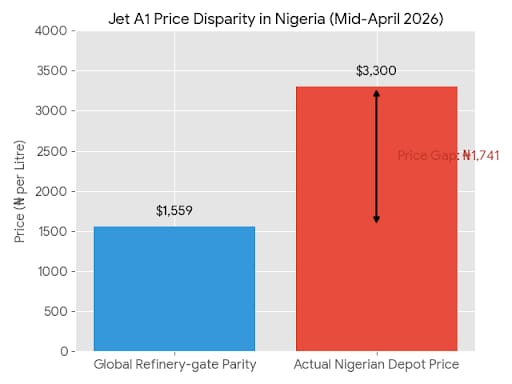
“A representative Platts/IATA‑style benchmark of $184.63 per barrel in mid‑April converts to approximately $1.161 per litre. At an illustrative exchange rate of ₦1,342 per dollar, this implies a refinery‑gate parity of roughly ₦1,559 per litre.
“Yet depot price in Nigeria surged from ₦900 per litre in late February to ₦2,000 by late March and ₦3,000–₦3,300 by mid‑April.
“Even after accounting for logistics and exchange‑rate volatility, the domestic price was nearly double the global parity,” he argued.
Onitiju also said that the aviation sector faced a dangerous chain reaction triggered by debt concessions.
“Once the Federal Government opened the door to concessions for agencies, every stakeholder followed.
“Airports warned of income losses, concessionaires sought relief, and ground handlers now threaten service suspension over ₦9 billion owed. These pressures are real, but they must be sequenced correctly.
“If airlines collapse, the entire system collapses with them. Without airlines, there will be no agency receivables, no ground‑handling revenue, no concession income, and no jobs for thousands of Nigerians,” he said.
He called for stabilisation of the system, including time‑bound Jet A1 refund mechanism.
“This is not a subsidy but a temporary parity‑restoration measure.
“Government should contract six months of Jet A1 supply at negotiated parity prices covering the hardship period of February to April 2026, and extend corrective supply for additional four months while global markets stabilise.
“The next is that a narrowly-targeted emergency stabilisation package for airlines is essential.
“Airlines require short‑term, low‑interest bridge loans and working‑capital guarantees to cover immediate cash‑flow shortfalls and essential operational costs.
“Parallel measures must protect ground handlers, concessionaires, and other service providers while airlines are stabilised.”
According to him, options include emergency liquidity advances, short‑term rent freezes or deferrals, and promissory commitments for verified renovation and investment losses.
“A 30 per cent mandated cut on specified debts consistent with the approach already applied to agencies may be necessary, but it must be used sparingly, only after independent valuation, and only for verified operational receivables.
“To ensure transparency and accountability, a neutral reconciliation vehicle should be established to process payments, advances and concessions,” he said.
Onitiju added that beyond emergency measures, structural reforms would be indispensable, saying that a comprehensive overhaul of the aviation charging ecosystem was overdue.
He called for establishment of a national energy price protection programme to prevent future aviation fuel crisis.
The President of Airline Operators of Nigeria, Dr Abdulmunaf Yunusa Sarina, in a letter to aviation fuel marketers, also raised an alarm.
According to him, the increase in the price of aviation fuel was driven by marketers and has significantly raised airlines’ operational costs.
He argued that the rise was not in line with global crude oil price trends, which reflected about 30 per cent increase.
Meanwhile, the Nigerian Midstream and Downstream Petroleum Regulatory Authority (NMDPRA) in an executive summary dated April 26, pegged aviation fuel at ₦1,760 to ₦1,988 per litre and ₦1,809 to ₦2,037 per litre for Lagos and Abuja, respectively.
The regulator said a meeting was convened by the Minister of Aviation and Airspace Management on April 22 and April 23 to deliberate on the challenges of supply and pricing of aviation fuel.
NMDPRA disclosed that the meeting, which had in attendance representatives of ministries of aviation and petroleum resources, NMDPRA, Federal Airports Authority of Nigeria (FAAN) , Nigerian Airspace Management Agency, Nigeria Civil Aviation Authority, airline operators and aviation fuel marketers, resolved that a technical committee should be constituted.
NMDPRA consequently convened a meeting of the technical committee on April 24 to discuss the issues and recommend the way forward.
The agency listed the recommendations to include end-user price ranging between N1,760 to N1,988 per litre and N1,809 to N2,037 per litre in Lagos and Abuja, respectively.
“The indicative prices are based on Platts average prices for the period of April 17 to April 23.
“Products purchased outside this window may be higher due to high volatility in current prices precipitated by U.S. and Iran war and varying operational costs by operators,” it said.
The recommendations include that NMDPRA should direct marketers to sell directly to airline operators within this period.
It was also recommended that the Ministry of Aviation should facilitate a consultative meeting between oil marketers and airline operators to resolve outstanding debts.
“Marketers should consider a 30-day credit window for airline to pay up for supplies.”
This intervention came as part of the Federal Government’s broader efforts to cushion the impact of Jet A1 crisis, which has significantly increased operating costs for domestic carriers.
According to Keyamo, the initiative underscores the current administration’s commitment to stabilising the aviation industry, safeguarding airline operations, and ensuring continued viability of domestic air transport services.
Air passengers have also expressed worry at the effects of hike in aviation fuel, as a one-way domestic air ticket currently costs between ₦200,000 and ₦250,000.
A frequent traveller, who asked to be identified simply as Mr Babatunde, said the increases in aviation fuel had become discouraging, urging fast resolution of the fuel crisis.
Analysts appeal to all stakeholders to do more to bring down the cost of aviation fuel to reduce the suffering of air travellers, airline operators, the entire aviation industry and Nigerians generally. (NANFeature)