


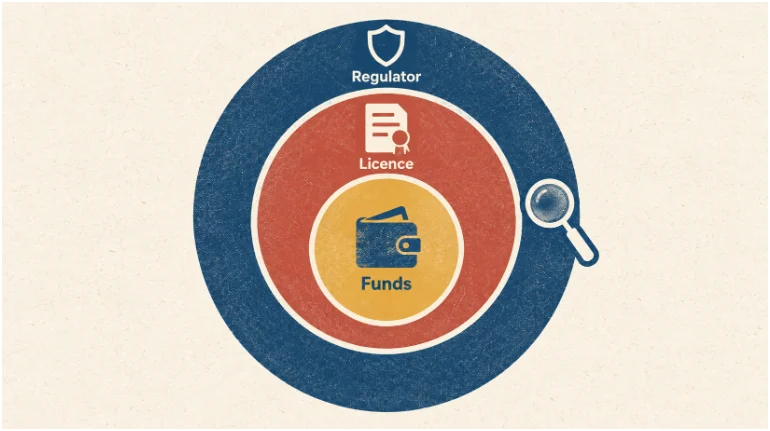
The message usually arrives on WhatsApp or Telegram. A friend of a friend has found a trading platform, the returns look excellent, and the account manager says it is “fully regulated”. Before sending a single naira, it is worth knowing what that word should mean. A regulated broker is one licensed by a named financial authority, with a licence number you can check yourself on that authority’s own website. Many platforms marketed to Nigerians mention South Africa, Europe or small offshore centres. Each of those carries different protections, and some carry very few.
What a regulated broker should look like in practice
A licence tells you that a supervisor has looked at the company and can act against it. It doesn’t guarantee profits, and it doesn’t make trading safe. It does give you somewhere to complain and someone who can sanction the firm.
Before opening an account, check:
- the exact legal name of the company you would be contracting with, which is often different from the brand name on the adverts
- the regulator’s name and the licence number, then look both up on the regulator’s own website rather than a link the platform sends you
- whether the website address, email domain and phone numbers match what the regulator lists
- what the product actually is, since many trading accounts offer leveraged contracts for difference (CFDs), where gains and losses are multiplied
South Africa’s Financial Sector Conduct Authority (FSCA) appears often in this discussion because many brokers serving African clients hold FSCA licences. A licensed South African financial services provider is given an FSP number, which should appear on its documents and can be checked against the FSCA’s records. If a firm quotes an FSP number that doesn’t match its name, treat that as a warning sign.
Which company will actually hold your account?
International brokers often run several companies under one brand, each licensed somewhere different. The country version of a website you land on doesn’t always tell you which of those companies you will sign with.
easyMarkets is a useful example of why the small print matters. In 2024, industry press reported that a South African subsidiary of the group had received an FSCA licence. Yet the company’s South African-facing site, which many people reach when searching for a regulated broker SA, states in its footer that accounts opened there are with EF Worldwide Ltd, which is licensed in the British Virgin Islands by the Financial Services Commission. That is a real licence, but it is not an FSCA one, and the rules and complaint routes differ. Whichever broker you look at, read the footer and the client agreement, and confirm which entity and which regulator apply to you before depositing.
Where Nigerian investors stand
Nigeria’s own regulator has been direct about the risks. In a public notice published in May 2026, the Securities and Exchange Commission said it was concerned about unregistered investment schemes promoted on WhatsApp, Instagram, Telegram, Facebook and TikTok, many of which resemble Ponzi schemes. It advised Nigerians to avoid platforms promising unrealistic or guaranteed returns, and to verify a firm’s registration on the SEC’s website before investing.
The penalties have also risen. Under the Investments and Securities Act 2025, operators of prohibited schemes face a fine of at least N20 million, up to 10 years in prison, or both, as NAN reported when the SEC explained the new law. Tougher penalties punish operators, but they don’t guarantee that investors get their money back.
Comparing the three situations
| Licensed by a major regulator (for example FSCA) | Licensed offshore only | Not licensed anywhere | |
| Can you check the licence? | Yes, on the regulator’s website | Usually, on the offshore regulator’s website | No |
| Rules on client money and conduct | Detailed and actively supervised | Vary by jurisdiction, often lighter | None |
| Where to complain | The regulator and local complaint bodies | The offshore regulator, at a distance | Nowhere official |
| Typical warning signs | Few, but still read the risk disclosures | Very high leverage, limited disclosure | Guaranteed returns, pressure to recruit, payment to personal accounts |
None of these columns makes trading low risk. Leveraged products can lose money quickly even at the most tightly supervised firm.
Frequently asked questions
Is a broker licensed in South Africa automatically safe for Nigerians?
No. An FSCA licence means the firm is supervised in South Africa, but you still need to confirm that your account would be with that licensed company, and you can still lose money trading.
What if a platform says it is regulated but gives no licence number?
Treat it as unregulated until proven otherwise. A genuine licence holder has no reason to hide its number.
Does a big brand name mean the firm is regulated where I live?
Not necessarily. Large brands often use different companies for different countries, and the one serving your region may be licensed somewhere with lighter rules.
Where do I report a suspicious platform in Nigeria?
The SEC has asked the public to report suspected illegal investment schemes through its official channels, which are listed on its website.
Conclusion
Choosing a regulated broker starts with three facts you can check yourself: the company’s legal name, its regulator and its licence number. For platforms that mention South Africa, the FSCA’s records are the place to confirm an FSP number. For anything promoted on social media with promises of guaranteed returns, the SEC’s advice is to check registration first and walk away if it doesn’t hold up.
Trading leveraged products such as CFDs carries a high risk of losing money. This article is general information, not financial or investment advice.