









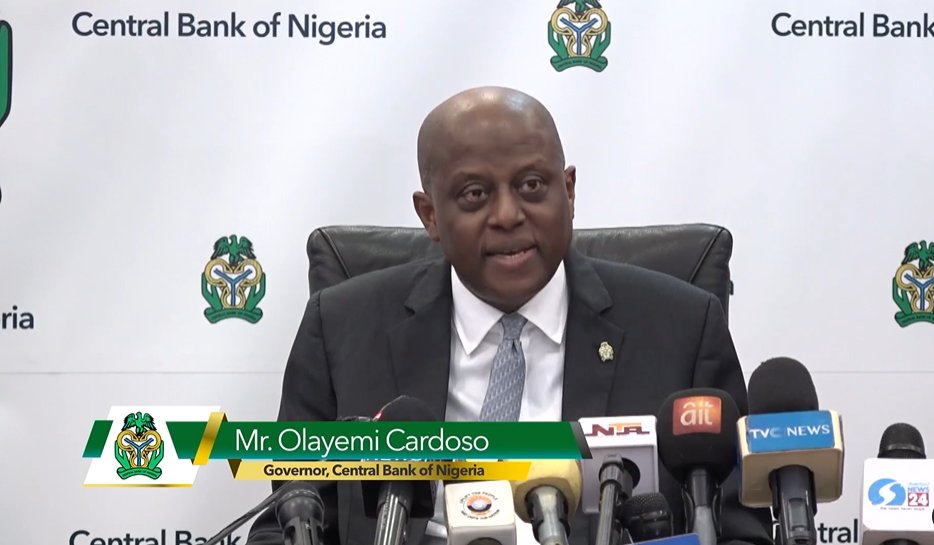










Cardoso said this in Abuja on Thursday at the apex bank’s Monetary Policy Forum themed, “Strengthening Nigeria’s Macroeconomic Stability Through Effective Monetary Policy: The Role of Critical Stakeholders”.
He said that the forum underscored CBN’s commitment to engage its critical stakeholders in open communication, inclusive consultation, and collaborative monetary policymaking.
He described the theme as both timely and consequential, as the country strove to deepen and consolidate macroeconomic stability in an environment shaped by significant global and domestic challenges.
“This forum reinforces a fundamental principle; macroeconomic stability is a shared responsibility.
‘’This is with monetary and fiscal authorities, financial institutions, private sector, and the wider public serving as indispensable partners in shaping policy outcomes.
“It is against this backdrop that I present the State of Monetary Policy in Nigeria, beginning with an honest assessment of the conditions we met,” he said.
Cardoso said that when he assumed office in 2023, the macroeconomic environment was marked by pronounced distortions and significant imbalances, with the economy facing heightened vulnerability and elevated stability risks.
According to him, headline inflation rose to 29.9 per cent in January 2024, reflecting sustained food price pressures, exchange‑rate pass‑through, and structural supply constraints.
“Excessive monetary financing had compromised policy integrity; Ways and Means advances had climbed to N26.95 trillion by May 2023, far beyond statutory thresholds, weakening the monetary‑fiscal interface and eroding credibility.
“The foreign exchange market was severely impaired, with over 7.0 billion dollars in verified FX backlogs, constraining private‑sector operations and damaging external confidence.
“Parallel market premium widened sharply to over 60 per cent, and the exchange‑rate architecture became increasingly fragmented,” the governor said.
He said that external reserves were under severe pressure, with net foreign reserves dropping to as low as 3.99 billion dollars at the end of 2023, while Nigeria’s balance of payments position oscillated between deficits and instability.
“These conditions collectively undermined the transmission of monetary policy, weakened investor sentiment, and strained the credibility of the Central Bank at home and abroad,” he said.
The CBN governor said that the condition necessitated the introduction of certain reforms to correct the anomalies.
“With a clear understanding of the gravity of these challenges, we moved swiftly to implement far‑reaching, bold, but necessary reforms.
‘’The reforms were aimed at restoring credibility, normalising policy conduct, rebuilding confidence, and stabilising the macroeconomic environment.
“The first critical step was the restoration of monetary–fiscal discipline. Ways and Means financing were reined-in decisively.
“It declined from N26.95 trillion to N3.51 trillion in December 2024 and further to N2.84 trillion by January 2026, marking one of the sharpest fiscal consolidations in recent history,” he said.
According to him, the action restored compliance with the law, strengthened central bank independence, signalled to markets about the apex bank’s commitment to orthodoxy and transparency.
He said that it also sent a clear message that the era of fiscal dominance had come to an end.
“We complemented these actions with a firm, but data-driven tightening cycle.
“Throughout 2024, the Monetary Policy Committee (MPC) maintained a restrictive stance to rein in inflation expectations by raising the policy rate cumulatively by 875 basis points from 18.75 per cent in January 2024 to 27.50 per cent in November 2024.
“While the Monetary Policy Rate (MPR) was kept at elevated levels for most of the year, improved inflation dynamics enabled the first policy rate cut in five years.
“A modest easing was carefully calibrated, with the policy rate reduced from 27.5 per cent to 27.0 per cent in September 2025, followed by a further cut to 26.5 per cent in February 2026,”he said.
Cardoso, who said that the reforms were not easy, added that they were necessary and designed to secure the long‑term stability and prosperity of our nation.
He said that the most challenging phase of macroeconomic adjustment was now over, with solid foundations laid for sustained stability.
“As we gather here today, I reaffirm the Central Bank’s unwavering commitment to openness, transparency, discipline, and engagement.
“This Forum represents exactly that spirit: We will continue to listen, learn, and refine our approaches in the collective interest of macroeconomic stability and national prosperity,” he said.
The Minister of Finance and Coordinating Minister of the Economy, Mr Wale Edun, said that the ongoing reforms provided soft cover as a basis for presenting resilience for trade, oil and emerging markets.
Edun said that Economic Management Team was monitoring global risks taking necessary steps to shield the Nigerian economy from its negative impact.
“We must recognise the resilience of the Nigerian economy as it continues to grow.
“The Federal Ministry of Finance is committed to continue to work with the CBN and other critical stakeholders to consolidate on the reforms and to sustain disinflation, and preserve macroeconomic stability,” he said.
The Minister of Budget and Economic Planning, Alhaji Atiku Bagudu, commended the CBN for its extensive engagement with stakeholders, which had both challenged and empowered them to deliver commendable outcomes.
According to Bagudu, these efforts are being acknowledged globally.
He said that the monetary policy forum was both timely and well judged.
“One of the key objectives is to obtain clear, constructive feedback from stakeholders.
‘’The feedback is essential in sharpening CBN’s responsibilities, particularly on the monetary policy side, ‘’ he said.
The Deputy Governor, Economic Policy Directorate, CBN, Dr Muhammad Abdullahi, said that the monetary policy forum had evolved into an indispensable platform for open dialogue between the apex bank and critical stakeholders.
“In an era where monetary policy outcomes depended increasingly on credibility, communication, and expectations, it is essential that we meet periodically.
“This is to ensure that policy directions are well understood and that stakeholders’ perspectives are incorporated into the broader policy framework.
“This engagement enhances transparency, strengthens trust, and helps improve the alignment between policy intentions and real-sector outcomes.
‘’It is thereby, enriching our collective understanding of the dynamics shaping Nigeria’s monetary and financial stability,” Abdullahi said.
He said that the CBN remained committed to openness, engagement, and responsiveness as it pursues its mandate of price stability and a sound financial system. (NAN)(www.nannews.ng)
Edited by Esenvosa Izah/Deji Abdulwahab