

















By Mark Longyen
The ECOWAS Court of Justice has pledged its commitment to ensuring the protection of the rights of women and girls across the West African sub-region through effective justice delivery.
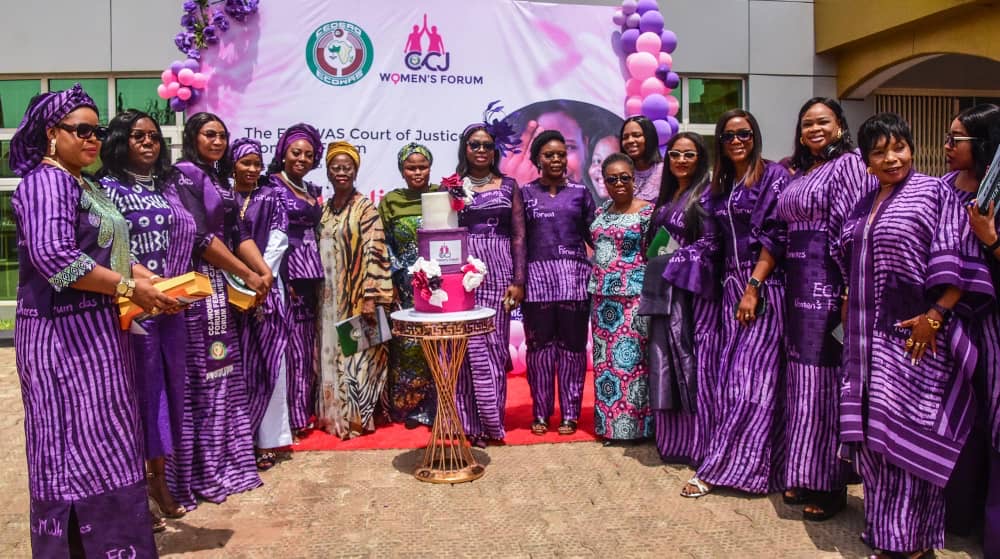
President of the Court, Justice Ricardo Gonçalves, made the pledge at the 2026 International Women’s Day celebration organised by the ECOWAS Court’s Women’s Forum on Monday in Abuja.
The News Agency of Nigeria (NAN) reports that the event, which is celebrated on March 8 yearly, was sub-themed: “Break the Silence, End Gender-Based Violence Now.”
“As we celebrate our women and their invaluable contributions to the achievements of the court, we also reaffirm our collective commitment to delivering justice, advancing rule of law, ending violence and discrimination, and creating a future where every woman and girl in the ECOWAS region can thrive in safety and dignity.
“We pledge to continue taking actions through our judgments, our outreach programmes, and our collaborative partnerships with member states and other stakeholders, to be able to build a region where justice and protection of the rights of women and girls is not an aspiration but a lived reality.
“At the ECOWAS Court of Justice, we recognise that the protection of women and girls’ rights within the ECOWAS space is central to the advancement of justice, upholding human dignity, fostering inclusive development, and strengthening our community,” he said.
According to him, the event’s sub-theme resonates deeply with the mission of the court and the past strides it has made in advancing the rule of law and protecting fundamental rights across West Africa.
He said this year’s global theme: “Rights, Justice, Action For All Women and Girls,” was a reminder that women are both participants in justice pursuit and pillars of strength within the court.
The court’s president said that the giant strides made by the court over the years reflected the court’s unwavering belief that the rights of women and girls must be protected, and justice must serve all without distinction.
Gonçalves, represented by Mrs Marie Saine, the Court’s Acting Deputy Chief Registrar, stressed that protecting the rights of women and girls within the ECOWAS sub-region was central to justice advancement.
“Through our jurisprudence, we have upheld fundamental rights of women and girls, challenged discrimination, and provided remedies for victims of sexual and gender-based violence and inequality.
“These groundbreaking decisions have not only delivered justice to individuals, but also set important legal precedents that reinforce the dignity and protection of women and girls throughout the region.
“They have also contributed to the development of regional human rights jurisprudence, influenced national policies, and triggered cultural and legal reforms,” he said.
He maintained that justice must be accessible and action must be taken to ensure that every woman and girl in West Africa can live free from discrimination and all forms of gender-based violence and be empowered to contribute fully to society.
According to him, gender-based violence is not only a violation of human rights, but also a barrier to equality, justice, and sustainable development.
“Too often, survivors suffer in silence, constrained by stigma, fear, or lack of support to seek justice. Today, we affirm that silence must end and justice must be translated into action,” he added.
Also speaking, Justice Dupe Atoki, said the emphasis on rights was a reminder that the rights of women and girls were not privileges to be granted at conveniences, but fundamental human rights that must be respected, protected, and fulfilled.
She noted that across the world, significant progress had been made, yet many women and girls were still facing barriers that limited their opportunities, silence their voices, or deny them full participation in society.
“The call for justice, on the other hand, highlights the vital role of the law, institutions, and courts in safeguarding equality and dignity.
“Justice must be accessible, impartial, and responsive to the realities faced by women and girls. We must ensure that discrimination, violence, and violence against women and girls is not tolerated,” she said.
Dr Tony Ojukwu, Executive Secretary, National Human Rights Commission, in a keynote address, described the ECOWAS Court of Justice as not just a judicial institution, but the conscience of the entire subregional community.
He called for collective action by all stakeholders toward ensuring that in the ECOWAS sub-region, “violence against women is met not with a shrug, but with the full weight of the law.”
Ojukwu, represented by the commission’s Director, Women and Children’s Department, Mrs Ngozi Okorie, tasked stakeholders on ensuring that every woman and girl knows that: “your voice is your power, and we are ready to listen.”
“Let us recommit ourselves to a future where every woman and girl can live free from violence, free to dream, free to lead, and free to thrive.
“Let us break the silence, demand justice, and take bold action because the rights of women are the rights of humanity, and the dignity of women is the dignity of us all,” Ojukwu said.
Earlier in her address of welcome, the President of ECOWAS Court Women’s Forum, Mrs Oluwatosin Nguher, said the event was a call to action toward accelerating gender parity across all spheres of society.
She said the occasion was also a celebration of women’s social, economic, cultural and political achievements, stressing that gender-based violence remained one of the most pervasive contemporary human rights challenges.
According to Nguher, gender-based violence undermines dignity, weakens institutions, disrupts communities and directly affects access to justice.
She emphasised that the ECOWAS Court being a judicial institution serving the entire ECOWAS sub-region cannot be indifferent to its impact, “as silence perpetrates harm, while action restores hope.”
“Let us, therefore, move beyond recognition to responsibility, beyond discussion to decisive action. Let us break the silence where it exists, amplify voices that have been unheard and champion the culture of respect, accountability and justice.
“Together, through unity, awareness and deliberate action, we can ensure that rights are protected, justice is accessible, opportunities are equitable for all women and girls across the region,” she added.(NAN)(nannews.ng)
Edited by Sadiya Hamza