


















By Angela Atabo, News Agency of Nigeria (NAN)
As Nigeria grapples with complex security challenges; including insurgency, communal conflicts, displacement, and gender-based violence, the role of the judiciary in protecting rights and ensuring accountability has become critical.
Indeed, according to the National Bureau of Statistics (NBS), over seven million Nigerians have been displaced by conflict in the past decade, while UN Women reports indicate that women and girls bear the heaviest burden of violence and insecurity.
Against this backdrop, Nigeria’s Third National Action Plan (NAP3) on Women, Peace and Security (2024–2028), launched in December 2025, strengthens the framework for involving women in conflict prevention, peacebuilding, and security governance.
Spearheaded by the Ministry of Women Affairs and Social Development, the plan aims to protect women and girls from violence, ensure gender-responsive recovery, and localise initiatives across all states.
Consequently, this reflects a renewed national commitment to addressing the disproportionate impact of conflict on women and girls.
However, experts emphasise that translating policy commitments into tangible outcomes requires more than declarations; it demands an effective, responsive, and accessible justice system.
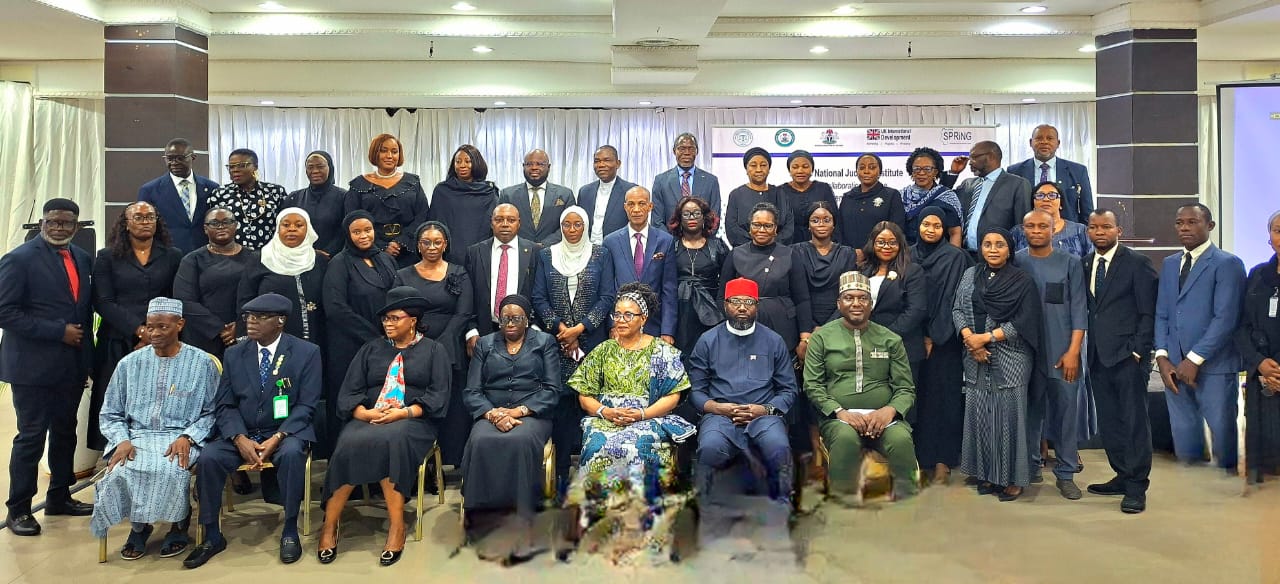
In this regard, a collaboration was recently established between the Strengthening Peace and Resilience in Nigeria (SPRiNG) Programme, funded by the United Kingdom Foreign, Commonwealth and Development Office (FCDO), and the National Judicial Institute (NJI).
It was intended to deepen judges’ understanding of Women, Peace and Security (WPS).
The partnership also marks a strategic milestone in institutionalising WPS principles within judicial processes, training, and policy frameworks, recognising that courts are central to turning the WPS agenda from paper commitments into practical realities for Nigerians affected by conflict and insecurity.
Dr Ukoha Ukiwo, SPRiNG Team Lead, highlighted the timeliness of the initiative, noting that the adoption of NAP3 provides a key opportunity to embed WPS norms within judicial processes.
“This is to ensure that the principles of women, peace and security is embedded in all processes and principles of the justice system itself.
“For us, this is a starting point, engaging with the National Judicial Institute, who, as we know, play a major role in research, in training and development of justice officers.
“This way, they will be able to see how they can embed WPS principles within the training curriculum of the justice sector and also use it.
“This is in terms of the policies they are framing, the processes to ensure that WPS principles are also embedded in them, because, at the end of the day, access to justice is what matters,” Ukiwo said.
Highlighting the significance of judicial engagement, the Chief Justice of Nigeria, Kudirat Kekere-Ekun, said that sustainable peace and justice depend on a justice system that is responsive, accessible, and accountable.
“Indeed, these responsibilities align closely with the judiciary’s constitutional role. The courts, beyond the resolution of disputes, are institutions entrusted with the protection of rights, the preservation of human dignity, and the maintenance of social order.
“Where court processes are slow, inaccessible, or insensitive to the realities of conflict and gender-based harm, justice is weakened.
“Where courts are informed, responsive, and properly supported, they strengthen accountability, deter wrongdoing and promote public confidence in the rule of law.
“Therefore judicial commitment aimed at giving effects to the national action plan must be reflected in judicial reasoning and courtroom practice,” she said.
Furthermore, Justice Kekere-Ekun stressed that the judiciary must ensure that vulnerable groups; especially women and children affected by conflict, have meaningful access to justice.
These responsibilities, she added include protecting rights, promoting participation, ensuring accountability, and safeguarding the dignity of survivors of violence.
Nevertheless, experts note that in spite of Nigeria’s progressive legal framework, significant gaps persist between legal standards and the lived experiences of victims.
Survivors of conflict-related sexual violence, women displaced by insurgency, persons with disabilities, and other vulnerable groups frequently encounter barriers, including procedural complexities, evidentiary challenges, stigma, and institutional limitations.
The Chief Justice acknowledged that these obstacles are not due to a lack of commitment by judicial officers but often reflect the complexity of cases involving conflict-related and gender-based harm.
“The development of a National Judicial Guide on WPS is considered a critical institutional milestone, providing judges with practical direction for handling cases involving sexual and gender-based violence, conflict-related crimes, and other issues affecting women and vulnerable populations”.
Kekere-Ekun said that integrating the guide into judicial education through the NJI is expected to promote consistency and sustainability, while also preserving judges’ discretion.
Similarly, the Attorney-General of the Federation, Lateef Fagbemi, emphasised the central role of courts in translating constitutional protections and international obligations into real outcomes for women and girls.
According to Fagbemi, “The Women, Peace and Security agenda is not merely a global framework but a practical responsibility that requires strong judicial leadership”.
He further noted that the Federal Ministry of Justice continues to collaborate with the judiciary through initiatives such as the Sexual and Gender-Based Violence Response Unit to strengthen survivor-centred justice responses and improve accountability for perpetrators.
In addition, the Minister of Women Affairs and Social Development, Imaan Suliaman-Ibrahim, highlighted the judiciary’s pivotal role in advancing gender-responsive governance.
“The proposed judicial guide therefore seeks to strengthen gender sensitivity within courtroom procedures and promote survivor-centred approaches to cases involving sexual and gender-based violence.
“By equipping judges with practical tools and guidance, the initiative aims to ensure that judicial processes better reflect the realities faced by women and girls affected by conflict,” she said.
Tony Ojukwu, Executive Secretary of the National Human Rights Commission (NHRC), underscored that women and girls often bear the greatest burden during conflict but remain central to peacebuilding and recovery.
“Courts therefore play a critical role in protecting victims’ rights and ensuring accountability. When women cannot access justice, cycles of violence and insecurity persist.
“But when judicial processes are fair, responsive, and inclusive, they contribute to national stability and sustainable peace”.
Meanwhile, Mrs Amina Akano-Bello, Gender Equality and Social Inclusion Lead for the SPRiNG Programme, observed that experience from implementing Nigeria’s earlier National Action Plans demonstrates that judicial engagement is essential for achieving meaningful progress on the WPS agenda.
“This engagement is therefore expected to review and validate the WPS Guide for the Nigerian Judiciary, as an instrument for operationalising the NAP on Women, Peace and Security.
“This is to ensure that the judiciary effectively translates commitments of the Women, Peace and Security into actionable judicial standards that improve protection and accountability.
“The role of the judiciary and more broadly justice sector institutions is critical to our shared commitments to fulfilling the transformative agenda of the UNHCR 1325 on Women, Peace and Security, “Akano-Bello said.
Looking ahead, experts emphasised that validating the National Judicial Guide on WPS represents a major step towards strengthening the judiciary’s role in implementing NAP3.
Beyond producing a document, the broader goal is institutional transformation, ensuring that judicial practice evolves to address the realities of modern conflicts and the unique vulnerabilities faced by women and girls.
Ultimately, operationalising the Women, Peace and Security agenda within Nigeria’s justice system is about ensuring that the courts remain a reliable source of protection, accountability, and hope.
Experts note that justice can be made more accessible by simplifying legal procedures, reducing delays in sexual and gender-based violence cases, expanding specialised courts or fast-track procedures, and promoting survivor-centred courtroom practices.
“They can also promote survivor-centred courtroom practices that protect the dignity and safety of victims. Improved access to justice strengthens public confidence in the legal system and deters future violations”.
In addition, they argue that courts can interpret laws to uphold women’s constitutional rights, protect human dignity, and hold perpetrators accountable through fair yet firm judicial decisions.(NANFeatures)
***If used, please credit the writer and the News Agency of Nigeria.