



















By Rukayat Moisemhe
Some experts in the built environment have called for the adoption of Environmental, Social and Governance (ESG) principles to attract long-term investment, drive sustainability and enhance global competitiveness.
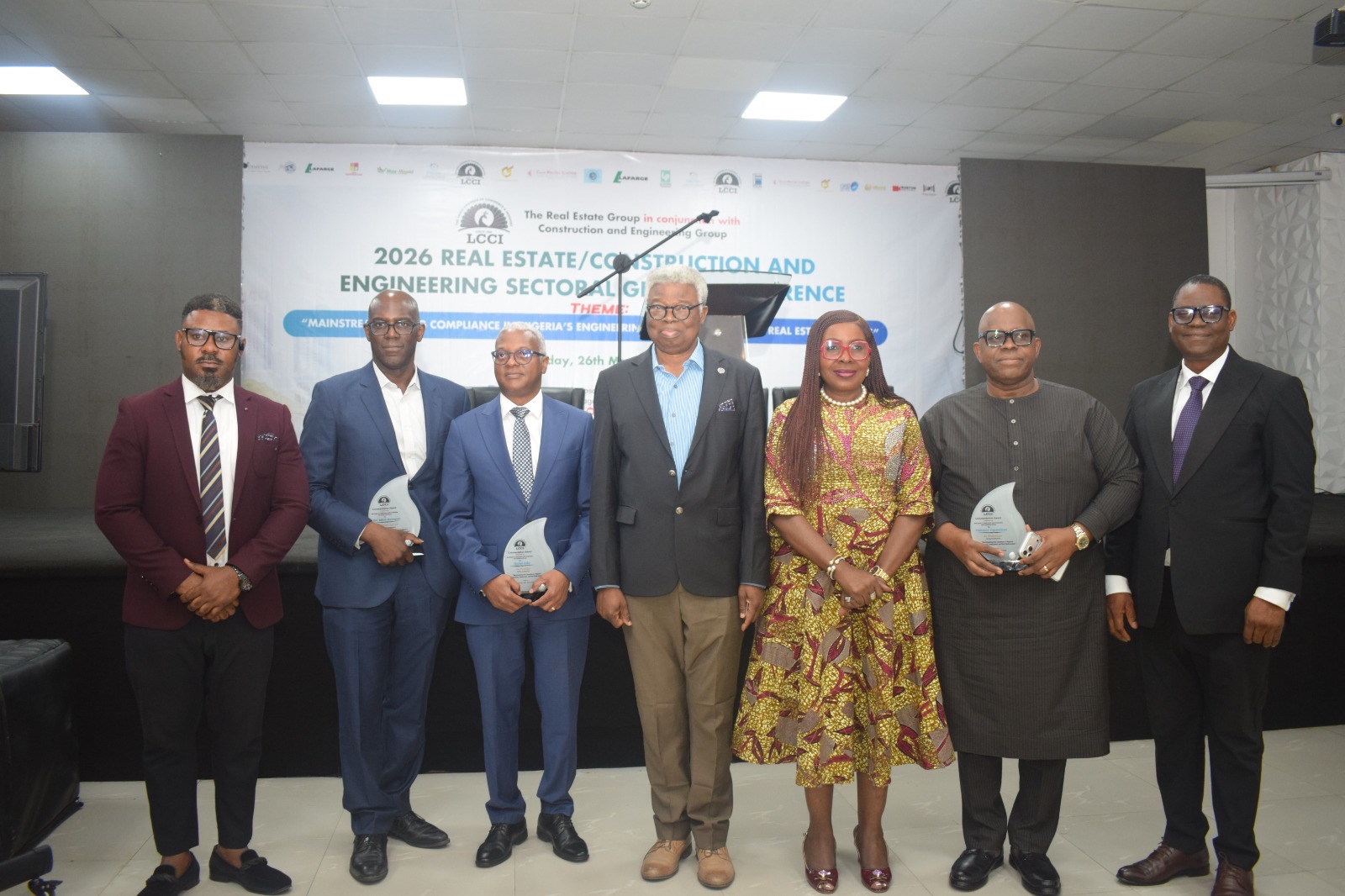
The experts made the call at the Lagos Chamber of Commerce and Industry (LCCI) 2026 Real Estate, Construction and Engineering Sectoral Group Conference held on Thursday in Lagos.
The conference has the theme: “Mainstreaming Environmental, Social and Governance (ESG) Compliance in Nigeria’s Engineering, Construction and Real Estate Sectors”.
President of LCCI, Mr Leye Kupoluyi, said the future of economic competitiveness would increasingly depend on the strength, efficiency and sustainability of the country’s built environment.
He cited data from the National Bureau of Statistics (NBS), which showed that the real estate, construction and engineering sectors contributed nearly 10 per cent to Nigeria’s Gross Domestic Product (GDP) in the fourth quarter of 2025, making them key non-oil drivers of growth.
Kupoluyi noted that Nigeria’s population, estimated at over 220 million, and rapid urbanisation had intensified the importance of the sectors, but warned that infrastructure development had not kept pace.
He described the gap as a structural challenge, stressing that ESG should be seen as a strategic tool for transformation.
“Globally, ESG has become a defining benchmark for investment decisions. Aligning our engineering, construction and real estate sectors with ESG principles is essential for unlocking long-term capital and enhancing global competitiveness,” he said.
Also speaking, Dr MKO Balogun, Group Managing Director, Global Properties and Facilities International, said sustainability had evolved from being perceived as a luxury to a core business imperative in Nigeria’s construction and real estate sector.
Balogun noted that sustainability was previously treated as an optional add-on, particularly in high-end or international projects, but had now become central to industry practice.
He cited the 2024–2025 Global Status Report for Buildings and Construction, which shows that the sector accounts for between 37 and 42 per cent of global greenhouse gas emissions, with operational activities contributing 27 to 35 per cent.
According to him, ESG principles should be seen as the foundation for building resilient cities, inclusive communities and a competitive economy.
He added that ESG had become a key determinant in access to finance, noting that over 83 per cent of global real estate executives rank ESG credentials among the top factors influencing investment decisions.
Balogun warned that failure to mainstream ESG practices could limit Nigeria’s access to global investment opportunities.
“While environmental and social factors attract attention, governance remains central to maintaining investor confidence and ensuring long-term infrastructure integrity.
“The business case for ESG is increasingly economic rather than theoretical, as investors demand higher sustainability standards,” he said.
He proposed the establishment of an ESG task force by LCCI to collaborate with professional bodies and government institutions in developing a practical compliance framework for Nigerian firms.
In his remarks, the Director-General of the Standards Organisation of Nigeria (SON), Dr Ifeanyi Okeke, emphasised the role of standardisation and quality assurance in achieving ESG compliance.
Okeke, represented by Mrs Musa Bauchi, Chief Standards Engineer, said adherence to standards, metrology and codes of practice was critical for sustainable sector development.
He expressed SON’s readiness to collaborate with stakeholders in developing ESG compliance regulations.
“For sustainability in the sector, all relevant standards must be properly developed, maintained and complied with. Communication and mutual understanding among regulators, industries and end-users are also essential,” he said.
Also, Dr Michael Oladiji, Chairman, Real Estate Group, LCCI, said ESG principles had become central to how investments are evaluated and projects delivered globally.
Oladiji noted that stakeholders in the built environment operate at the intersection of infrastructure, communities and economic growth, adding that decisions made today would shape future living standards and economic resilience.
“This conference is a call to institutionalise ESG as a standard practice, not an afterthought, and to embed it into organisational policies and decision-making processes,” he said. (NAN)
Edited by Olawunmi Ashafa